At the Sam's Club in Grapevine, Texas, the place where cash registers used to stand has a jaunty name: the dance floor. There are no belts, no candy racks engineered for your weakest moment, no line in which to reconsider the 48-pack of toilet paper occupying half the cart. A shopper scans items with a phone, pays in the app and heads for an exit arch. Cameras and software compare the basket with the receipt. The member keeps walking.
This is a small liberation carried out at warehouse scale. Sam's Club has spent four decades making the unit bigger - the box of cereal, the stack of steaks, the bottle of ibuprofen. Now it is shrinking the dead minutes around the purchase. Scan & Go attacks the checkout queue; computer vision attacks the receipt-check queue; curbside pickup removes the aisle; delivery removes the building. The warehouse is still there, of course. It has simply learned to travel.
The company underneath these conveniences is substantial but easy to misread. Sam's Club is not a public startup raising rounds, and it has no stand-alone valuation. It is a division of Walmart, with 601 U.S. and Puerto Rico clubs at the end of fiscal 2026. That year it recorded $93.015 billion in net sales, $95.54 billion in total revenue and $2.442 billion in operating income. If it were independent, the sales line would put it among America's very large retailers. Inside Walmart, it accounts for 13 percent of net sales.
A tornado cleared the floor
Grapevine became the prototype by accident. An EF-1 tornado struck the club in December 2022 and forced it shut. During the rebuild, Sam's Club changed its mind about what a warehouse front end needed to be. Instead of restoring the old bank of registers, it designed the reopened 150,000-square-foot location around mobile payment. The empty front became an omnichannel showroom where members can inspect merchandise sold online, scan a code and ship it home.
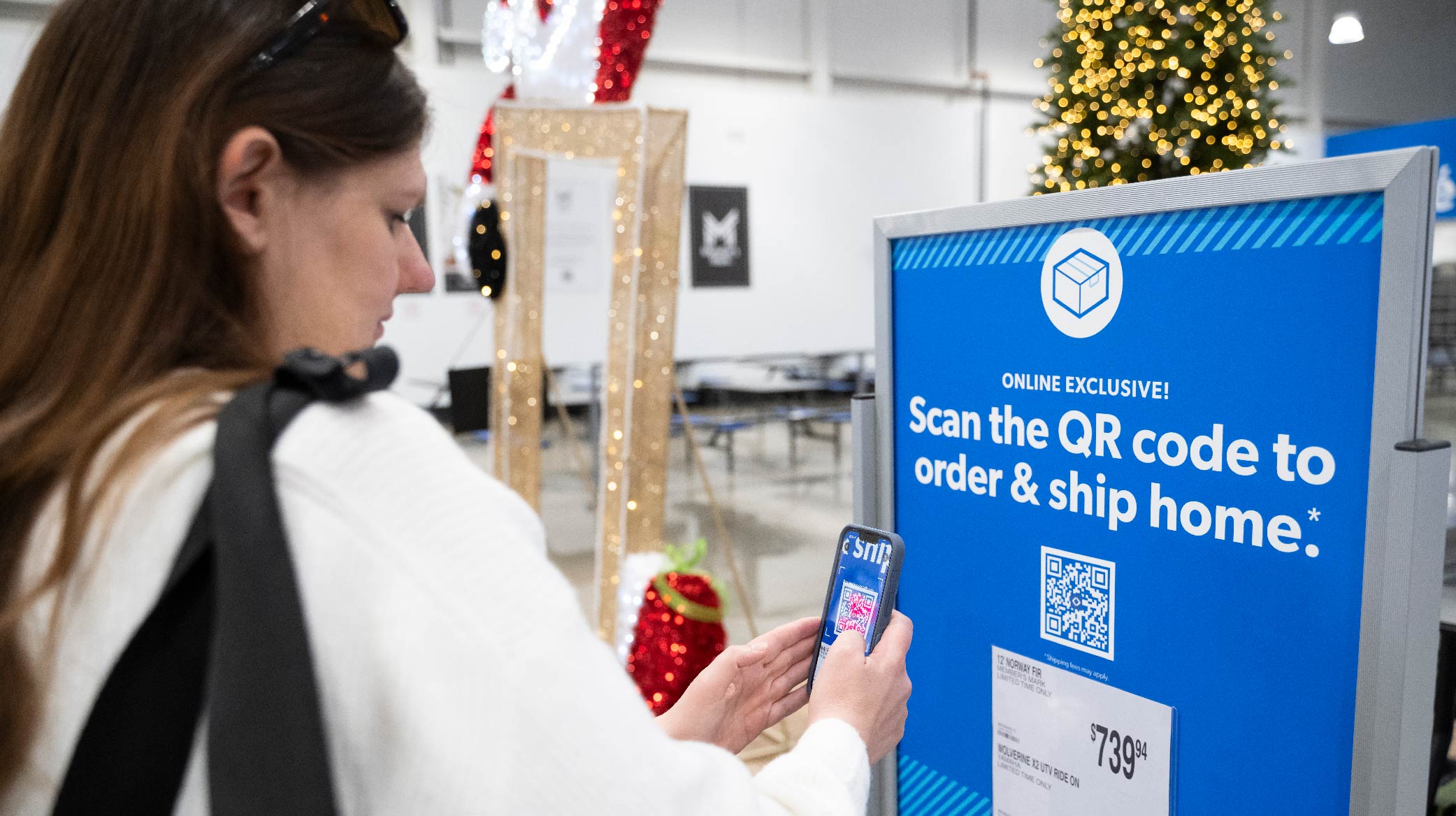
What failed first was not the store; it was the old sequence. Scan & Go, introduced in 2016, solved payment but still deposited app users into a familiar human bottleneck at the door. Associates inspected receipts and searched carts. In early 2024, Sam's Club began installing arches that photograph baskets and match what they see against a digital record. More than 120 clubs received the system in four months. In those clubs, the company said more than half of members got the automated exit experience and all members left 23 percent faster. By the Grapevine reopening that December, the arches had reached all 600 clubs then operating.
The disclosed cost is the membership, not the transformation. Since May 2026, Club costs $60 a year and Plus $120, before promotions and taxes. Sam's Club has not published a price tag for the arches, the Grapevine rebuild or its planned chain-wide remodel. That absence matters. Computer vision can make a fine demo; it becomes a business only when installation, false alarms, shrink and maintenance cost less than the labor and loyalty it saves.
“Our philosophy has always been simple: We are the agents for our customers.”Sam Walton
The fee is the front door, not the whole house
Sam Walton opened the first club in Midwest City, Oklahoma, on April 7, 1983. He called it an experiment. The original customer was the small-business owner who needed cases of supplies at a price the corner shop could use. Families followed. The pitch is still selective abundance: fewer items and fewer brands than a conventional supermarket, bought in very large quantities, often displayed on the pallet that carried them in. Less handling and deeper orders are supposed to become lower prices.
Membership changes the transaction. The fee creates recurring income and gives the retailer an identified buyer, not an anonymous basket. In fiscal 2026, Sam's Club U.S. booked $2.525 billion in membership and other income, up 8.7 percent. It also knows what a member saw, scanned, bought, collected curbside and had delivered. That is useful for inventory planning, but it is also the foundation of Sam's Club Connect, the retail-media operation selling advertisers access to measurable member journeys.
The quiet climb · Sam's Club U.S. net sales
Merchandise remains the engine: groceries and household consumables, electronics, furniture, apparel and seasonal oddities. Around it sit fuel, tires, pharmacy, optical and hearing services - errands that make a card worth keeping in a wallet. Plus members receive a richer set of shipping, delivery, early-shopping and Sam's Cash benefits. Ecommerce contributed about $15 billion of fiscal 2026 net sales, a reminder that “warehouse club” now describes the supply node as much as the shopping trip.
Carry fewer choices than a supermarket. Merchant judgment replaces the endless aisle.
Order large volumes, display from pallets and spread fixed work over more units.
Membership ties transactions across the club, app, fuel pump and delivery route.
Fees, useful services and private-label value give people reasons to renew.
Costco owns the mythology. Sam's wants the minutes.
The obvious comparison is Costco, the larger warehouse-club rival with its own beloved hot dog, formidable renewal economics and a talent for turning a Saturday stock-up into recreational anthropology. BJ's Wholesale Club is the smaller direct competitor. Then come Amazon, supermarkets, pharmacies, fuel stations and Walmart itself, each competing for a portion of the basket.
Sam's Club's clearest difference is digital convenience. Costco has guarded a relatively traditional club experience. Sam's offers in-app checkout, curbside pickup and store-based delivery, all plugged into Walmart's much larger fulfillment and technology system. In 2025, management announced an eight-to-ten-year plan to double membership and more than double sales and profit. It intends to remodel every existing club, complete an announced batch of 30 openings and build toward roughly 15 new clubs a year.
The trick is to expand without being limited to the map. A family far from a club can order nationally; a member near one can treat it as a fulfillment center. Express delivery made the logic comically concrete in 2026. In its first three weeks, nearly 65,000 orders averaged 55 minutes from placement to arrival. The ten fastest took less than 12 minutes. A daycare in Fargo received infant formula in under nine.
This advantage depends on conditions that do not travel easily. The customer must own a smartphone, tolerate scanning and trust cameras at the exit. The retailer needs accurate inventory, dense local demand and enough transaction volume to justify the hardware. A distant rural route will not behave like Fargo. Neither will a low-frequency category repay a membership on its own. Most important, convenience cannot rescue a bad assortment or a weak price. A frictionless trip to the wrong product is merely an efficient disappointment.
The private label has 150,000 unpaid editors
Member's Mark began in 1998 and eventually swallowed a confusing portfolio of 26 house brands. It now does more than put a cheaper name on a large package. Sam's Club has assembled a volunteer product room called the Member's Mark Community, where members test, taste, vote and comment. The group reached more than 150,000 participants in May 2026, triple its size two years earlier; 15,000 of them take part in at least five activities a month.
This is where feedback visibly changed the company's mind. Members asked for simpler food. Beginning in 2022, Sam's Club pushed suppliers to remove more than 40 specified ingredients, including certified synthetic colors, artificial flavors, aspartame and high-fructose corn syrup, from qualifying Member's Mark food and drinks. By January 2026, every covered product shipping to clubs met the standard. The community has completed nearly half a million activities, from flavor polls to shipped-home protein-shake tests.
There is an elegant loop here. The membership identifies a customer; the customer improves the product; the product strengthens the reason to renew. Member's Mark accounted for about half of merchandise-sales growth over the two years leading into the 2025 strategy announcement. This is expertise expressed as editing: know what to omit, whether that is a redundant brand on the shelf, an ingredient in a drink or a checkout lane at the front.
What another operator can copy
Choose one queue customers openly resent. Link identity, payment and inventory before adding cameras. Pilot in ordinary live traffic. Measure time returned to every customer, including those who do not use the new tool. Then let the saved labor move toward service instead of quietly disappearing from the floor.
People still have to make the giant machine feel small
Around 100,000 associates work in Sam's Club's U.S. operation. The company says roughly three quarters of club managers rose from hourly jobs. In 2024 it rewrote frontline pay progression so hourly employees could receive increases of 3 to 6 percent depending on tenure, lifting the anticipated average above $19 an hour. That was a retention program disguised as arithmetic: retail turnover is expensive, and a familiar associate can turn a cavernous building into a local shop.
Automation complicates the promise. The Grapevine club has automated forklifts, a vertical tire carousel and a pizza robot. AI tools are moving into managers' work. The stated bargain is that machines absorb repetitive tasks while people help members. Whether that holds will be judged in staffing schedules, not speeches. Sam's Club itself ties good associate interactions to renewal. If the app saves five minutes but nobody can solve the odd problem, the math changes.
There is room for oddness in the machine. The first club had a hot dog cart. The cafe now sells more than 100 million pizza slices a year, and the $1.38 hot-dog combo remains a tiny monument to stubborn pricing. Almost a third of members who enter a club buy a rotisserie chicken. These are not side notes. They are habits, and membership businesses run on habits more durable than a campaign.
Sam's Club began by helping shopkeepers buy more. Its more interesting modern proposition is that nobody should have to do more work than the bargain requires. Not more wandering. Not more waiting. Not one more theatrical pause for a highlighter at the door. The company is trying to make a huge room feel quick. At $93 billion, that modest idea has a great deal of floor space to cover.