A warehouse club asks you to do something peculiar: pay for the privilege of spending money. Before the first carton of eggs reaches the checkout, the store has collected its fee. BJ’s Wholesale Club makes that proposition work by paying attention to what happens after the big stock-up. Eventually, the milk runs out. Someone needs dinner. The bargain must survive an ordinary week.
- The offer: warehouse shopping with fresh food, a deli and coupons.
- The price: $60 a year for Club; $120 for Club+.
- The test: whether repeat savings outweigh fees, travel and waste.
A warehouse with a supermarket habit
Started by discount retailer Zayre in Massachusetts in 1984, BJ’s occupies an interesting position between the supermarket and the warehouse club. Costco and Walmart’s Sam’s Club are its direct club competitors. But the supermarket explains much of its personality: fresh produce, a full-service deli, a bakery and groceries that give a household reasons to visit regularly.
BJ’s has described smaller fresh-food packs than its club competitors as part of that proposition. It also accepts many manufacturers’ coupons, which can be combined with eligible BJ’s offers. These details matter to a shopper who wants bulk economics without reorganizing the kitchen around a single purchase. A mountain of food is only a saving if somebody eats it.
The assortment stretches to electronics, apparel, home goods, seasonal merchandise and gasoline. Its own brands divide familiar territory: Wellsley Farms for food, Berkley Jensen for household goods and general merchandise. Together, they accounted for approximately 27% of net sales excluding gas in fiscal 2025. They give BJ’s products shoppers cannot buy under those names elsewhere.
The arithmetic of coming back
The customer is a value-conscious household, or a small business buying supplies, with recurring needs. The business collects money from goods, fuel and annual memberships. In fiscal 2025, total revenue was $21.46 billion, including $499.8 million of membership fees. Those fees are revenue, not pure profit; the clubs still require people, buildings and a functioning supply chain.
BJ’s reported a 90% renewal rate among tenured members for that year. The qualification matters. It does not mean nine out of every ten people attracted by a first-year promotion immediately renew. It describes an established group. For a business built around an annual decision, keeping that group is a useful measure of whether the bargain lasts.
Monthly savings needed to cover the standard Club fee alone.
Eligible annual spending to cover the Club+ upgrade through rewards alone. Exclusions, other perks and taxes affect the comparison.
The standard Club membership costs $60 annually; Club+ costs $120 and adds 2% rewards on eligible purchases, plus other benefits. The upgrade’s extra $60 requires $3,000 in eligible annual spending to recover through that reward alone. Gas savings and other perks can change the calculation. So can buying things merely because a reward exists.
The membership page also makes convenience part of the tier decision. Club+ includes free pickup, while standard Club pickup orders of $50 or less carry a listed $3.99 fee. Delivery has its own terms. Someone collecting a modest weekly order should count those charges before treating the annual membership price as the entire cost.
When cheap stopped being enough
The current proposition was not delivered fully formed. In fiscal 2016, comparable club sales excluding gasoline fell 2.3%. BJ’s IPO prospectus describes the pressure: food deflation, aggressive grocery competitors and deliberate reductions in some low-margin sales. Perishables were particularly weak. A warehouse could have low prices and still struggle to give shoppers sufficient reason to return.
The company’s response was operational. Under leadership changes that included Chris Baldwin becoming CEO in 2016, it renegotiated suppliers, adjusted its assortment and made greater use of member data. A procurement program launched in fiscal 2015 covered 70 product categories. Its filings describe more than $260 million in expected annual procurement savings negotiated during fiscal 2016 and 2017.
Change also required cash. The 2018 prospectus said more than $875 million had been invested since the 2011 private-equity acquisition, including over $230 million for systems and technology. The 2018 IPO subsequently supplied proceeds used to extinguish a $623.3 million second-lien loan. The documented shift was toward better buying, sharper decisions and convenience, with financing underneath it.
The relationship extends beyond the club entrance. BJ’s announced its Capital One and Mastercard credit-card program in 2023, connecting eligible purchases with rewards and fuel discounts. For BJ’s, the card adds another reason to consolidate spending. For members, it adds another set of terms to read before assigning a dollar value to the benefits.
The robot in the paper aisle
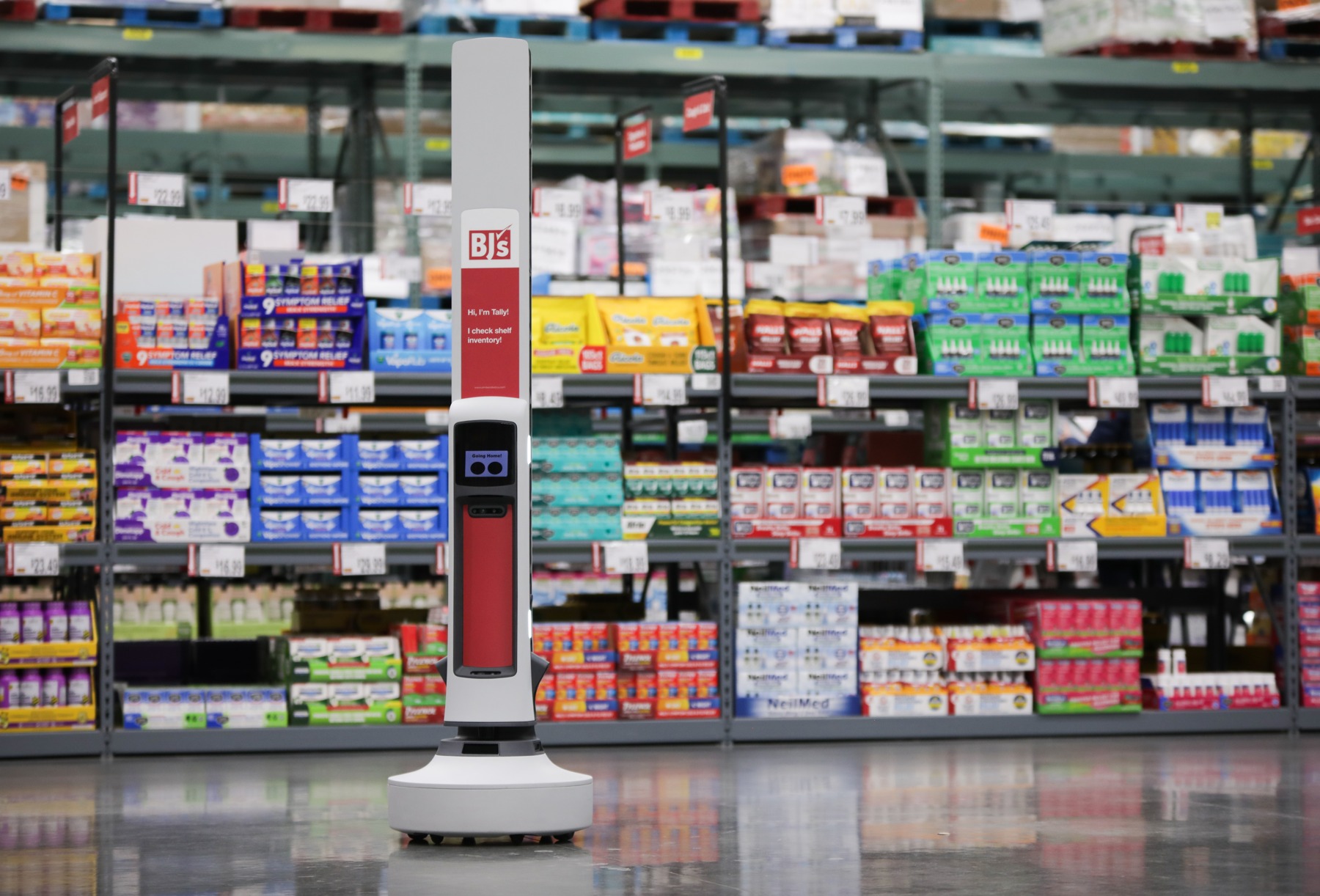
Convenience has an unglamorous requirement: the thing you came for must be there. In 2023, BJ’s announced a chainwide rollout of Simbe’s Tally, a robot that travels aisles checking shelf conditions. Its work concerns missing products, misplaced merchandise and pricing accuracy. The machine looks futuristic; the disappointment it is supposed to prevent is ancient.
The phone handles another part of the trip. ExpressPay lets members scan eligible goods and pay in the app, with receipt checks at the door and restrictions on certain purchases. Pickup and same-day delivery serve people who would rather skip the aisles. A DoorDash partnership announced in 2022 added another delivery route. Each option reduces a different piece of shopping friction.
“We take care of the families who depend on us.”BJ’s stated purpose
A New England habit goes to Texas
By its second fiscal quarter of 2026, BJ’s reported 8.5 million members. Expansion is testing how far its proposition can travel: Texas became a new market in 2026. The company projected roughly $800 million in fiscal 2026 capital expenditures for new clubs and distribution investments. That is a spending plan, not a completed bill or the price of one club.
A shopper can borrow the discipline without borrowing the warehouse. Compare unit prices on repeated purchases. Count what gets thrown away. Include the drive and the membership fee. BJ’s advertises savings of up to 25% on a representative basket of branded groceries against traditional supermarkets; that is not a promise about every item or household.
For someone with little storage, infrequent visits or a long journey, the arithmetic may disappoint. For a family that regularly uses the groceries, fills the tank and returns for fresh food, the fee has more chances to earn its keep. The useful question is what the next trip actually saves.