In December 2025, a grocery store in Williston, Florida, opened under the Winn-Dixie name just 43 days after the company acquired the location. That is an unusually brisk interval for a business whose history now spans a century. It also captures the peculiar moment Winn-Dixie occupies: leaving markets, changing owners, and opening doors. The chain is getting smaller. Inside the smaller map, it still intends to grow.
- A conventional supermarket built around fresh food, familiar brands and weekly deals.
- A regional reset centered on Florida and southern Georgia.
- A proposed C&S majority deal, expected to close in early 2027.
01 / The name came later
Winn-Dixie began without either half of its name. In 1925, William Milton Davis bought Miami’s Rockmoor Grocery with a $10,000 loan from his father. Davis and his sons built the business through acquisitions. The stores became Table Supply; the family later acquired Winn & Lovett. In 1955, the purchase of Dixie Home Stores produced the name shoppers recognize today.
That origin matters because acquisition was part of the operating logic, not an occasional detour. Buy stores, connect territories, build scale. A grocery chain’s map records decisions about warehouses, purchasing and the distance between customers and dinner. For decades, adding more dots was a plausible answer. Eventually, Winn-Dixie had to confront what those dots were costing.
02 / When more stores stopped helping
By 2004, the company had more than 1,000 stores and financial difficulties. It filed for Chapter 11 in 2005. The federal court’s account describes a reorganization involving the announced sale or closure of 326 stores and the reduction of more than 22,000 jobs. The operating problem came first: unprofitable stores, alongside the need to improve service and sales at surviving locations.
Winn-Dixie emerged from bankruptcy in 2006. Its later parent, Southeastern Grocers, went through its own restructuring in 2018. These episodes make an important distinction visible. A familiar name can survive while the organization behind it changes repeatedly. For employees and neighborhoods losing a store, that continuity is less comforting than it looks on a shopping bag.
03 / The map gets a boundary
Aldi completed its acquisition of the Winn-Dixie and Harveys operations in March 2024. In February 2025, an investor consortium led by Anthony Hucker, including longtime supplier C&S Wholesale Grocers, acquired the retained business: approximately 170 grocery stores and the liquor-store operation. Aldi kept a separate program to convert approximately 220 former Winn-Dixie and Harveys locations, expected to finish in 2027.
Then came another reduction. An October 2025 plan covered the transition of 40 stores outside the core territory and described a future footprint of roughly 130 grocery stores and 140 liquor stores. Those were planning figures, rather than today’s live store count. The strategic boundary was clear: Florida and southern Georgia. In January 2026, Southeastern Grocers became The Winn-Dixie Company.
The company’s stated reasoning was to reinvest where its roots ran deepest. That is a resource-allocation argument: a narrower territory can concentrate management attention and store spending. It also asks customers in departing markets to accept a different grocer. Focus is an attractive word at headquarters. At street level, it can mean a new sign above your usual entrance.
04 / Dinner is the actual product
For the customer, the proposition remains refreshingly ordinary. Buy vegetables, visit the meat or seafood department, pick up deli food, replace the dish soap. Winn-Dixie serves households trying to assemble a week’s meals with manageable expense and effort. Prepared food, including its signature Lip Lickin’ Chicken, offers an answer when cooking from scratch loses its appeal.
Its business model is conventional retail: sell food and household goods, mix national brands with store brands, and encourage repeat visits. Publix, Walmart, Aldi and independent grocers offer alternative baskets. Winn-Dixie’s case rests on combining a full supermarket assortment with promotions and locally relevant departments. In June 2026, it completed eight Harveys conversions, with neighborhood-tailored selections including expanded Hispanic offerings.
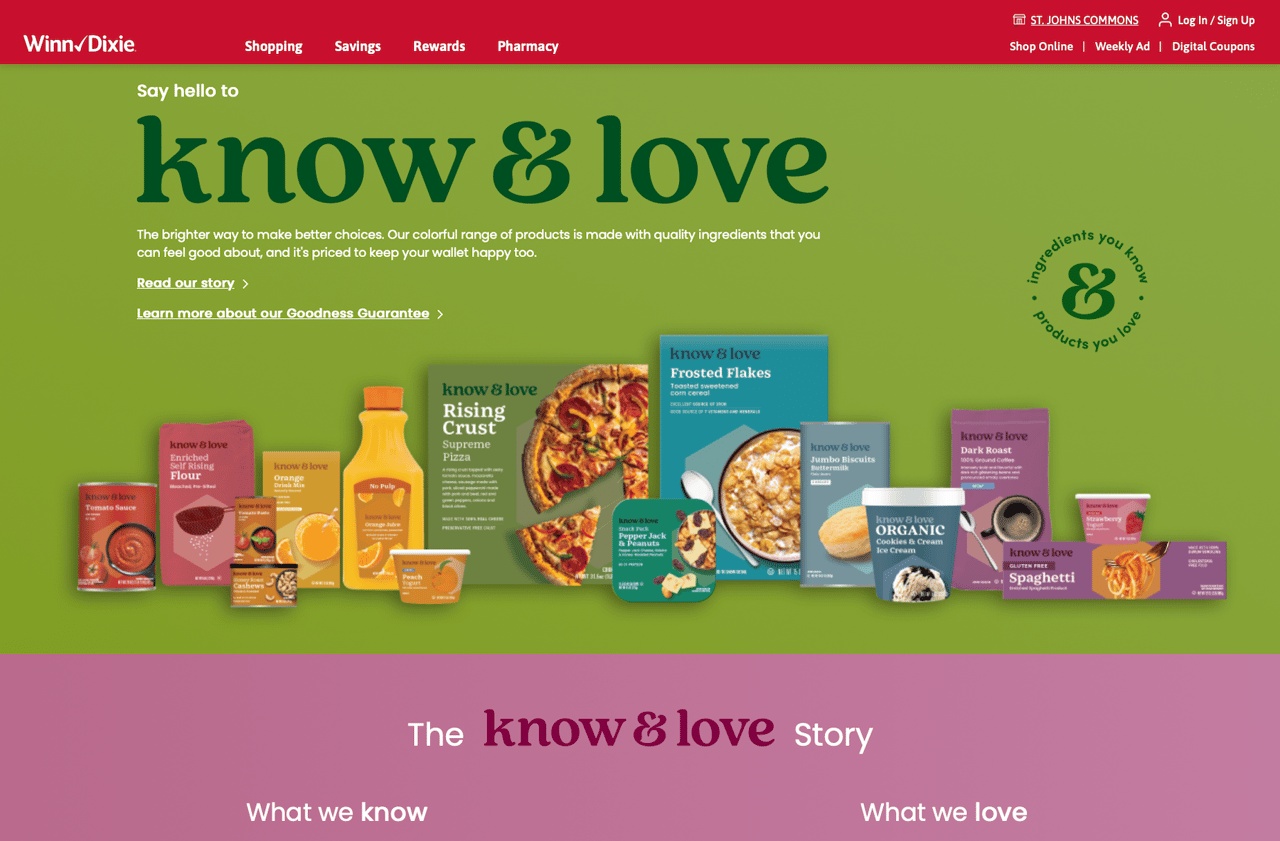
Private labels give that proposition something specific to sell. Know & Love, introduced in 2024, joins a broader own-brand portfolio. In May 2026, the company reported 18 national awards across products and customer experience, including recognition for tuna pouches, bacon and bakery pies. Awards do not settle the value question. They do give shoppers a reason to inspect something besides the national-brand box.
05 / Do the rewards arithmetic
Winn-Dixie Rewards is free, and its published terms put weekly sale prices and buy-one-get-one offers behind membership. The base earning rate is one point per $2 of qualifying spending; 100 points buy $1 in groceries. That works out to a 0.5% base return. Activated percent-back offers and digital coupons can change the calculation substantially.
Before bonus offers. Grocery credit, not cash. Eligibility and redemption terms apply.
The useful habit is simple: check the weekly ad, activate relevant offers, then compare the whole basket. Spending extra to collect points defeats the exercise. As of October 1, 2026, Winn-Dixie’s own ordering site stopped accepting orders. Delivery continues through partners, with availability, prices, fees and loyalty benefits varying by address and platform. Convenience needs its own arithmetic.
06 / A smaller map still needs money
The regional strategy has concrete commitments attached. Jacksonville approved up to $12 million in incentives in May 2026. Winn-Dixie committed to $65 million in capital investment: $48 million for Jacksonville stores and $17 million for headquarters, plus 200 additional headquarters jobs. These are commitments, not a claim that the money has already been spent.
“Bring Home More Good.”Winn-Dixie’s 2026 brand tagline
In August 2026, C&S proposed becoming majority owner, with closing expected in early 2027. Raymond Rhee became CEO pending completion. C&S identified structural costs and supply-chain capabilities as reasons for the combination. That rationale is plausible; its promised benefits remain something to deliver.
What can another business copy? Draw a boundary around the customers it can serve well, then make the investment visible in their next visit. The condition is unforgiving: a smaller network still needs enough purchasing strength, reliable distribution and compelling stores. Regional familiarity may earn Winn-Dixie a visit. The freshness, service and total bill must earn the next one.