In 2018, Relay looked like a pleasant parental compromise. The square, screen-free device gave a child one big button, a speaker, cellular service and GPS. It was a phone with the addictive parts removed. One unit cost $99, service cost $6.99 a month, and the pitch lived somewhere between a walkie-talkie and a very responsible toy.
The product was built inside Republic Wireless, the Raleigh carrier known for routing calls over Wi-Fi. Co-founder and CEO Chris Chuang described it as the device the team wanted for its own families. Children could roam without carrying an open window onto the internet; parents could talk to them and see where the gadget was. It was sensible. It was also not the business Relay ultimately became.
The more urgent customer was wearing a housekeeping uniform.
01 / The wrong customer was rightA toy-shaped wedge into the enterprise
Hotels began using Relay’s tiny communicators in place of two-way radios. The accidental fit was unusually clean. Housekeepers, security staff and engineers already understood push-to-talk; they did not need another app, inbox or training course. But conventional radios were heavy, tied to property-wide coverage and organized around noisy shared channels. Smartphones covered distance, but they were expensive, distracting and awkward when both hands were occupied.
Relay kept the gesture and changed the machinery behind it. Messages traveled over Wi-Fi and cellular networks. Managers could speak across buildings or properties. A worker could clip on a light device, press once and continue moving. During the pandemic, when hotels ran lean crews and a manager might cover multiple locations, that difference became budget-worthy. Relay Pro’s revenue rose a reported 1,600 percent in 2020.
The consumer idea did not fail because its technology was useless. It failed first as a question of market depth: families could like the device without building fleets of them or demanding operational software. Businesses could. Their complaints supplied a roadmap - indoor location for a worker in distress, panic alerts that reached the correct responders, message history, channels, device administration and integration with daily workflows.
02 / What the product becameThe button is the front door, not the house
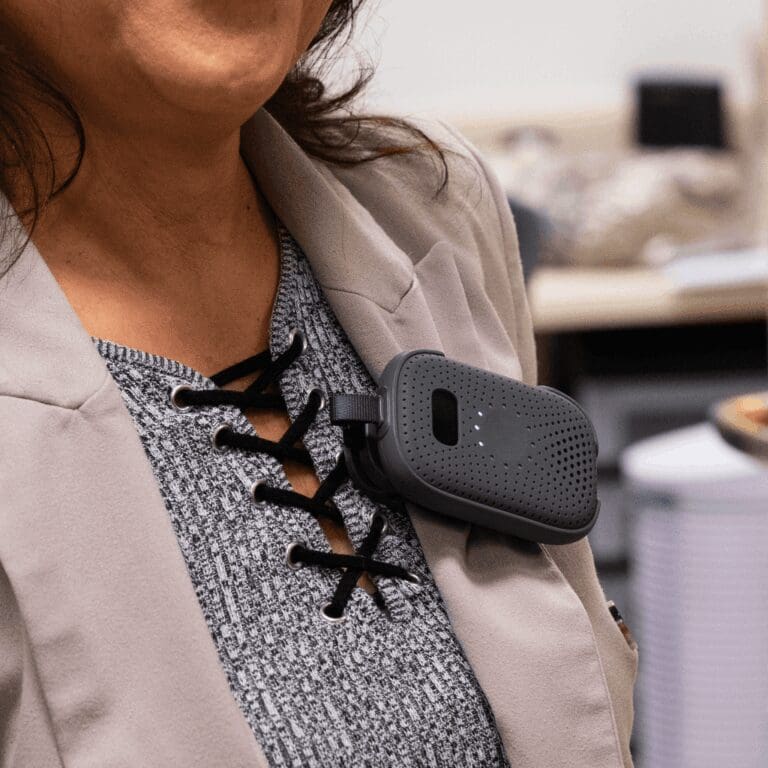
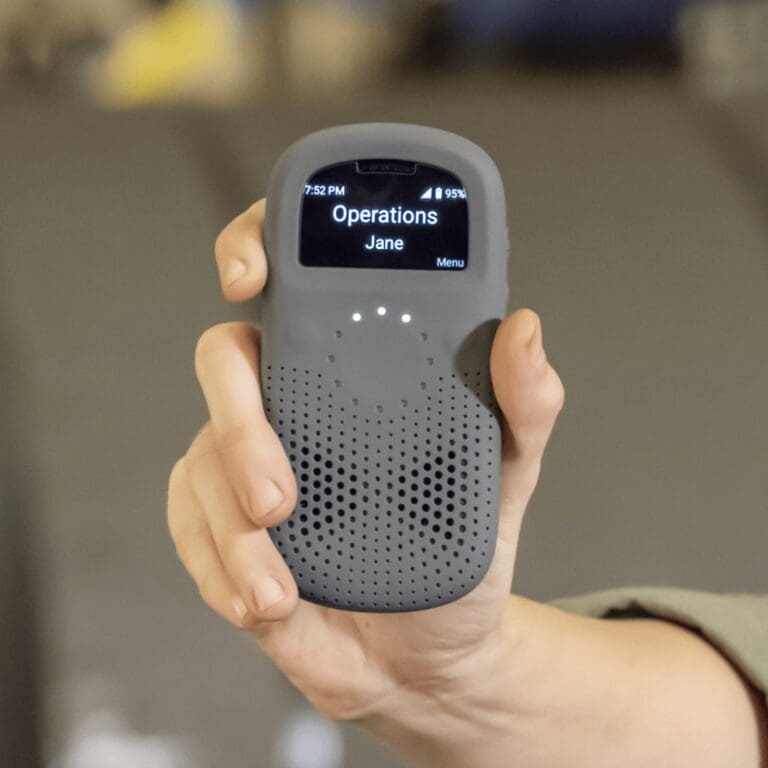
Today Relay is a managed communications platform with two principal hardware personalities. RelayX is the industrial one: a rugged handset with a small display, loud audio, active noise cancellation, 4G and 5G cellular service, Wi-Fi, GPS and indoor-location support. It carries MIL-STD-810H and IP66/IP68 durability claims. RelayM is smaller and more discreet, designed for settings such as luxury hotels and healthcare where a full industrial brick would look and feel out of place.
Both connect to software that matters more with every device added. Administrators can create group channels and one-to-one conversations, manage devices, review communication and see location. The system can send emergency or mass alerts. Rounds can record whether a guard or housekeeper reached scheduled locations and notify a manager when a check is missed. Mobile and desktop interfaces let supervisors join without carrying the dedicated hardware.
TeamTranslate is the more telling addition. A manager can speak English while configured devices replay the message in Spanish, Mandarin, French or another supported language. The company currently lists 32 languages for the channel-wide product. Translation is an add-on; a simpler face-to-face translate command comes with standard plans. In workplaces where the unofficial bilingual employee has become a full-time human middleware layer, the feature targets both delay and dignity.
“If the guest needs something from me, I can do it immediately.”Veronica Patricio Basilio, TownePlace Suites
The platform now serves hospitality, manufacturing, logistics and warehousing, healthcare, food service, facilities, schools, casinos and large venues. Public deployments range from Marriott and French Lick Resort to healthcare food-service teams and stadium operations. In 2021, Legends announced more than 400 devices for AT&T Stadium’s food-and-beverage staff, covering nearly 300 points of sale and 350 suites. That is not a family group chat with a business logo attached.
03 / The economicsWhat it cost - and what customers buy now
The historical price is charmingly precise: $99 for one consumer Relay, $149 for two or $199 for three, plus $6.99 per device per month. Current enterprise pricing is deliberately less tidy. Relay asks buyers about their industry, team and required features before providing a quote. The model combines hardware with recurring service for connectivity, software, support and updates; translation and some advanced capabilities can add to the plan.
That quote wall is annoying for a casual shopper but rational for the product. A quiet 20-room property does not need the same device, durability, indoor beacons or escalation logic as a factory with 100-decibel machinery. Accessories, charging docks and headsets also change the fleet cost. Relay’s job in a sale is to move the comparison away from “radio versus radio” and toward the full price of missed calls, dead zones, replacement units, slow guest requests and separate safety systems.
One Raleigh Marriott manager said the property saved more than 90 percent by choosing Relay over radios. Treat that as one customer’s result, not a universal calculator. Relay’s own hospitality research reported that guest requests were completed five minutes faster on average and that 84 percent of surveyed customers saw higher operational efficiency. The useful buying exercise is local: count devices, coverage infrastructure, replacements, response delays and software subscriptions before deciding what “cheaper” means.
04 / The moat and the marketBetween Motorola and the employee’s pocket
Relay sits between durable radio systems from companies such as Motorola Solutions, push-to-talk apps such as Zello, and the smartphone already in an employee’s pocket. Legacy radios can be excellent inside a known coverage footprint. Phone apps are flexible and cheap when workers are allowed to carry phones, have spare hands and can tolerate screens. Relay’s differentiation is packaging the device, multi-network connectivity, cloud control, location, safety and voice intelligence as one system.
That integration is also the risk. Hardware must survive drops and water. Cellular and Wi-Fi handoffs must feel invisible. Translation must be fast and accurate enough for real work. Location raises legitimate questions about worker privacy and management discipline. A software outage is irritating; a silent emergency button is categorically worse. Relay sells simplicity at the surface, which means it inherits complexity underneath.
The company raised $13 million in Series A funding in 2023 and $35 million in a 2024 Series B led by G2 Venture Partners. It said revenue grew 120 percent in 2023. In 2025 it reported 461 percent growth across the period measured by Deloitte, reached No. 175 on the Technology Fast 500 and No. 920 on the Inc. 5000, launched RelayM and hired a new chief marketing officer and chief financial officer. Valuation and verified revenue remain private.
What another builder can steal
- Watch for customers using the product outside the intended story. Urgency is better evidence than compliments.
- Preserve the learned behavior. Relay kept push-to-talk and replaced the network, controls and outcomes behind it.
- Turn complaints into a software roadmap. Dead zones became multi-network coverage; language gaps became translation; panic buttons gained location.
- Sell the cost of the workflow, not the object. A radio’s sticker price ignores delay, infrastructure, replacement and safety systems.
05 / Boundaries matterWhen the playbook does not work
Relay is a poor fit when a team is small, quiet and always in the same place; when existing radios already cover the site reliably; or when employees can use ordinary phones without safety, privacy or distraction problems. Translation does not remove the need for shared procedures, and location data cannot repair a confused emergency plan. The system also asks a company to accept another device fleet, subscription and vendor dependency.
| Condition | Relay is stronger when… | Another tool may win when… |
|---|---|---|
| Work | Hands are busy, rooms are loud and response is immediate. | Most communication is detailed, asynchronous and screen-friendly. |
| Coverage | Teams cross buildings, properties or cellular dead zones. | A basic radio already covers one compact site. |
| Operations | Safety, location, translation and administration belong together. | The team only needs occasional voice calls. |
There is a pleasing loop in Relay’s history. The company first removed the screen because children did not need another one. It now makes the same argument for adults whose work happens in hallways, kitchens, loading bays and patient rooms. The market changed; the constraint survived. Relay’s larger lesson is not “pivot to enterprise.” It is narrower and more useful: when an unintended customer pulls hard, keep the part they understand immediately and rebuild everything that prevents them from using it at scale.