When Andrew Bernstein researched a potential donor for the YMCA of Greater New York, his first stop was a database. In a 2014 account, the major gifts director described turning to Relationship Science before the familiar slog through search results and social profiles. Fundraising had always rewarded people who knew people. Here was software offering to remember the connections on their behalf.
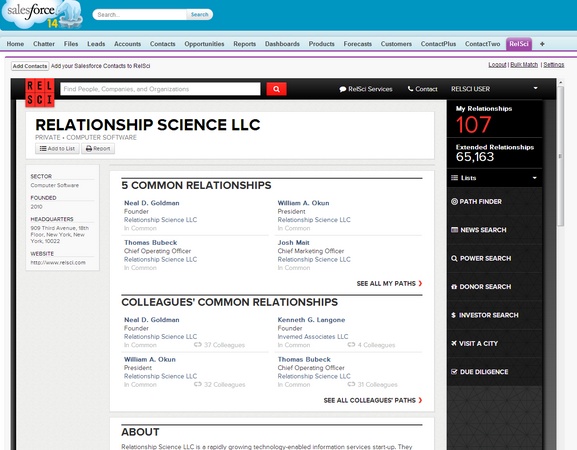
- RelSci maps possible introductions to donors, clients and decision makers.
- Its profiles draw on public research, with tools for search, alerts and CRM integration.
- It now belongs to Altrata, where relationship intelligence sits beside wealth and executive research.
The company’s proposition begins with a distinction anyone seeking a meeting will recognize. Knowing a person’s name does little for the unanswered email. Knowing that your colleague served with that person on a charity board might change the next step. RelSci sells a way to uncover that second piece of information. The valuable discovery is often the intermediary.
01 / The address book with a memory
Neal Goldman founded Relationship Science in 2010, having previously co-founded Capital IQ. The public platform arrived in early 2013. The move made a certain sense: financial databases organize information about businesses; RelSci organized information about the people around them. Employment, education, board service and other affiliations became material for a searchable network.
RelSci calls this asset “relationship capital.” Its stated approach favors research aggregated from hundreds of public sources over unconfirmed user contributions. That makes it different from a social network whose usefulness depends on people joining, connecting and keeping their own biographies fresh. Someone can matter to a RelSci search without having volunteered to maintain a profile.
The customers explain the emphasis. Investment bankers seek deal access. Wealth managers seek clients. Lawyers and consultants seek business. Nonprofits and universities seek donors and trustees. Each needs information about influential people, but the working question is more specific: which person in our existing circle might help us approach them?
02 / A route, with qualifications
Path Finder traces connections between people and organizations. Search tools filter potential targets by criteria such as industry, location, role and cause. Alerts help users follow changes around relevant names. Together, these functions turn prospect research into a sequence: identify someone worth meeting, inspect the available routes, then decide which acquaintance to ask.
The qualification matters. A shared institution can suggest familiarity without proving friendship. Two people who attended the same university may never have met. Even a genuine connection may be too distant for a favor. The map supplies a reason to investigate; its user must judge whether the relationship can bear the request.
“There’s work to be done after you’ve used this tool.”
Josh Mait, then RelSci chief marketing officer, 2014
LinkedIn provides an obvious alternative for discovering professionals and mutual contacts. Introhive occupies the relationship intelligence market too. RelSci’s particular pitch is the combination of researched influential-person profiles and access paths. For a buyer, the sensible comparison is practical: can this system find a useful connection that our current research process misses?
03 / The price of getting into the room
In March 2014, LawSites reported an individual RelSci subscription at $3,000 a year. That historical price hints at the intended economics. A professional researching valuable engagements could justify a subscription through saved time or useful access. A casual networker would have a different calculation. Today’s buying process begins with a sales conversation or demonstration.
Reported individual subscription price. A historical benchmark, not a current offer.
The business model combines paid software access with enterprise data delivery. Salesforce integration puts research inside a familiar customer system; the API brings data into other applications. Those options address a mundane obstacle: useful information is easier to act on when it appears where the team already works.
RelSci also attracted substantial backing. It announced a $30 million round in 2013 and a $31 million Series D in 2015. Its legacy public website describes approximately $120 million raised. Euromoney’s annual report records a 2021 acquisition for $8.5 million covering RelSci’s trading assets and Indian subsidiary. These figures describe different transactions; they do not establish an investor return.
04 / When the calendar becomes a clue
Radar, launched in October 2023, tackled the labor of maintaining relationship records. It uses Microsoft Exchange interactions, including email metadata, calendars and contacts, to estimate relationship strength and automate mapping. Rather than relying entirely on someone remembering to log a connection, it draws clues from ordinary working activity.
Frequency offers evidence of contact, though it cannot establish trust. That is an editorial caution, not a measured product failure. The attraction is nevertheless clear: a colleague may have the relevant relationship, and the rest of the organization may have no convenient way to discover it. Radar makes that search less dependent on memory.
05 / Check the donor before the courtship
The END Fund’s experience gives the idea a useful complication. In a 2024 Altrata case study, the nonprofit described fundraisers already being mid-conversation before running due diligence. It sought global prospect coverage and a stronger research process, using Wealth-X and RelSci together. Relationship mapping helped broaden donor discovery, particularly around events.
The change was about order as much as reach: examine the prospect earlier. A plausible introduction can accelerate a conversation before anyone has checked whether it ought to proceed. The case study reports a greater focus on due diligence. It offers a workflow lesson, without furnishing a quantified fundraising return.
06 / The connection still belongs to you
RelSci became one of five offerings brought under the Altrata identity in 2022. Altrata now publishes migration guidance for legacy RelSci integrations moving to its unified platform. The direction is toward combining related research tools, rather than asking users to assemble separate pieces of intelligence themselves.
The habit a reader can copy requires no purchase: before approaching a target, check the people around them and your own team. Ask the possible intermediary how well they know the prospect. Confirm the fit. Offer a specific reason for meeting. A thin network or an unwilling intermediary limits the method. Software can reveal a path; someone must decide to walk it with you.