In 2009, Reese Travis was on the customer side of a franchise agreement. A year later, he and his partners bought the company behind it. Orange Leaf had 15 stores when the purchase closed on April 2, 2010. The headquarters moved from San Francisco to Oklahoma City. It was a considerable promotion for someone whose original ambition had been to open a few yogurt shops.
That change of position is the useful place to begin with Travis. Today he is the founder and CEO of Tribune Capital, an Oklahoma City investment firm focused on real estate. Before apartments, there were yogurt machines. Before yogurt machines, there was football. Across those settings, he has kept returning to a practical question: how do the people doing the daily work help an enterprise grow?
A franchisee experiences a brand from the shop floor. The equipment must work, the location must attract customers, and the instructions arriving from headquarters must make sense. Buying the parent company puts those same problems on the other side of the desk. Travis had occupied both seats. His career becomes more interesting when you follow that movement, rather than treating each job title as a separate beginning.
A lineman learns to count on other people
At the University of Oklahoma, Travis played on the offensive line and finished his football career as a member of the 2000 national championship team. An offensive lineman's work is unusually dependent on coordination. A spectacular individual effort cannot rescue every missed assignment around him. The position offers a rather unsentimental education in why the person beside you matters.
Travis has credited coaches and older mentors with helping him develop, both in business and personally. By January 2011, when Orange Leaf was expanding under its new ownership, he was describing the corporate team's job in terms of making stores and franchisees successful. The people running individual locations were helping build the wider business. Headquarters had responsibilities to them.
There is a temptation to turn every former athlete's subsequent career into an extended locker-room speech. Travis has supplied a more human detail. In 2011, he admitted that he repeated sayings from his playing days around the office, and suspected his colleagues might tire of hearing them. Anyone who has worked for a sports enthusiast can probably hear the familiar phrase approaching before it reaches the meeting room.
He linked those habits to work ethic, discipline and dedication, and said he wanted the atmosphere of a team working toward the same goal. The joke about his own repetition makes the philosophy easier to picture. It belongs to an actual office, with actual coworkers, rather than a motivational poster that has never had to attend a budget meeting.
The cup came before the company
Orange Leaf appealed to Travis and his partners after they examined competing concepts and considered developing their own. In 2009, he opened shops in Wichita Falls, Texas, and in Norman and Lawton, Oklahoma. The next year brought the acquisition. His route into leadership began with testing the business at the level where customers actually encountered it.
The product gave customers an unusually active role. They dispensed their own yogurt, chose toppings and paid by weight. In a 2012 interview, Travis described a typical arrangement of eight machines offering 16 flavors. A customer could make a restrained little dessert or assemble something that required structural engineering. Both passed through the same checkout.
Behind that freedom sat a fairly exact system: equipment specifications, cleaning, refrigeration, preparation and supplier relationships. Travis spoke about efficiency and the value of dependable service providers. The customer saw a wall of flavors. The operator had to see what would happen when a refrigerator needed attention. The charm of the concept depended on rather uncharming things being done reliably.
He also valued franchisees' knowledge of traffic and customer patterns in their own markets. A national brand still needed someone who understood a particular street. Location selection put local judgment inside the expansion model. It is a recurring distinction in Travis's working life: an enterprise can spread geographically while the reasons people choose it remain close to home.
Operating locations at acquisition and the announced 200th opening. These are dated milestones, not today's store count.
Two hundred stores, one customer at a time
In September 2012, Orange Leaf announced its 200th store, in Canton, Massachusetts. Its first international location had opened in Australia in December 2011. The 15-store acquisition had become a much larger network in a little more than two years.
The celebration took the form of double loyalty points for customers on a designated day. There was something fitting about marking a corporate growth milestone at the register. A franchise network becomes a large number through many small purchases, each taking place in a store someone has to open, staff and maintain.
Travis thanked customers and spoke about new stores, flavors and experiences. Those were the ambitions of that period, with expansion still very much underway. The opening announcement captures a moment in the business's history. It also shows how the company translated an achievement into an offer customers could understand without reading a corporate presentation.
His own dessert preferences were less orderly than a growth chart. In 2011, he described moving from combinations of chocolate, peanut butter and a richer third flavor to tart yogurt with granola and Cocoa Pebbles. It is a pleasingly specific glimpse of a CEO participating in the experiment he was selling. Even the person running the chain reserved the right to change his favorite.
The people who stayed in the picture
Travis wrote about team building in December 2014. His argument gave colleagues a central place in the business: a product or idea needed people to make it work, and interaction and feedback helped an organization improve. He resisted ranking departments by importance. The work was shared, even when a particular project began with one person.
That perspective supplies a way to read the next chapter. Shelby Norman, who worked in strategic development at Orange Leaf, joined Travis in launching Tribune Capital. Chad Berry, Orange Leaf's former chief financial officer, also became Tribune's CFO. Familiar colleagues appear across the transition from consumer retail to investing. The subject matter changed while some of the working relationships continued.
A company launch can sound like a solitary act when reduced to a founder's biography. These connections give Travis's move into real estate a different shape. He was building with people whose work he already knew. Experience accumulated within the group as well as on his own résumé.
In January 2016, he was named among six new directors elected to three-year terms on the YMCA of Greater Oklahoma City's board. The appointment identified him as both Orange Leaf's executive chairman and Tribune Capital's founder. For a time, those two professional identities sat side by side, rather than one neatly replacing the other.
A telephone building gets another conversation
By November 2018, Tribune was working on Central Exchange, a redevelopment of two early twentieth-century buildings near Broadway Avenue in Oklahoma City. Their previous uses belonged to Pioneer Telephone. The project brought a different kind of activity to the old structures: offices in one building and a food hall in the other.
Parlor was announced as the first tenant, with plans for seven kitchens and two bars. The attraction extended beyond a meal. A food hall could give people a reason to visit the development and make the neighboring offices more appealing.
“We want to make Central Exchange a destination.”
Reese Travis / 2018
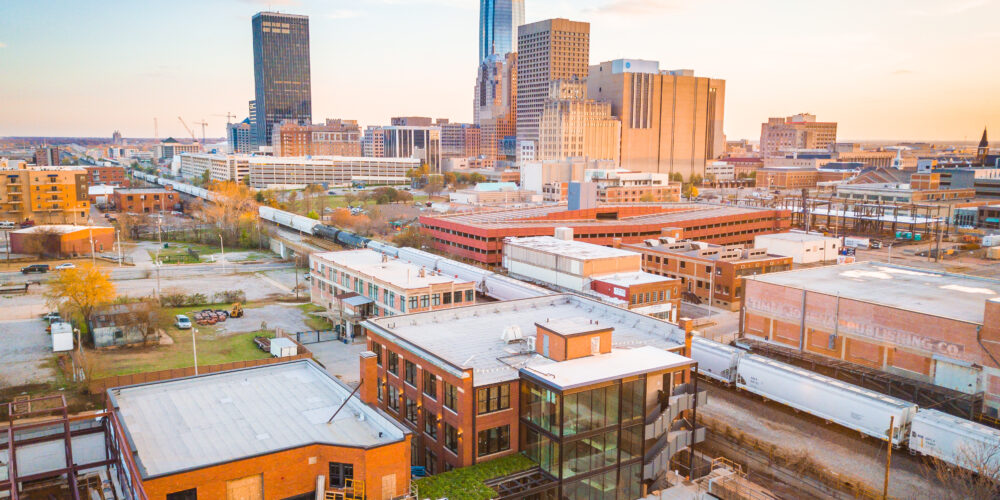
The proposal brought Travis back into the business of places where people gather. Orange Leaf had offered an informal setting for choosing a dessert together. Central Exchange involved a much more substantial redevelopment, but the appeal of a place that people wanted to visit remained part of the plan.
By July 2019, the architectural details included circular forms recalling telephone switch plugs and a yellow lightning-bolt graphic discovered in an old AT&T safety manual. The past supplied design material as well as brickwork. Offices, kitchens and outdoor spaces were being fitted around buildings with an earlier working life.
Travis discussed parking, patios and greenery as attractions for prospective office tenants. These are practical considerations, especially when the romance of an old building meets someone's weekday routine. A handsome address still has to be usable. His pitch paid attention to how people would arrive and what they would find once they did.
Reading the neighborhood
Another transaction shows the less theatrical side of his investment work. In January 2019, Tribune's purchase of the 150-unit Cross Timbers Apartments in south Oklahoma City was reported at $16.13 million. The property was 96 percent occupied at the sale and had been built in 2015.
The apartments had not been listed for sale. Brokers David Dirkschneider and Michael Massad helped bring the opportunity to Tribune. Travis spoke about the stability of the Oklahoma City market and the cash flow properties could offer. He also pointed to nearby employers, including Hobby Lobby, Amazon and the airport.
Those details make a useful counterweight to the downtown redevelopment. Central Exchange involved changing how old buildings could be used. Cross Timbers was already heavily occupied. The two projects asked different questions about demand. One concerned attracting activity to a reworked site; the other concerned an established residential property within a particular employment and school geography.
Tribune's stated approach combines renovations with property operations, including maintenance responses and resident events. In that model, the work continues after the purchase. An apartment community has to function for the people living there. Travis's career has repeatedly placed him near that junction between an ownership decision and the everyday experience it creates.
Back where the questions begin
In October 2024, Northeastern Oklahoma A&M College welcomed Travis, an alumnus, for Leadership Day. Business and technology students, along with nearly 70 students from local high schools, heard him speak and had an opportunity to ask questions.
It is a modest but revealing scene to end on. Earlier in his career, Travis described learning from older people and coaches. Here he occupied the other side of the exchange, facing students with questions of their own. The direction of the advice had changed.
His path gives them several starting points: a championship football team, a franchise purchase, a growing retail network, continuing partnerships and buildings put to another use. The connection is visible in the work itself. Travis has spent years moving between the whole enterprise and the people who make a single location succeed. A shop, an apartment community, an office building: eventually, someone has to choose to come through the door.