Buying a convenience-store chain gives you authority over an impressive number of small things: the signs, the shelves, the coffee, the software. When Thomas N. Trkla’s Yesway bought Allsup’s in 2019, customers had a clear view about the limits of that authority. Leave the burrito alone. Trkla understood. “Of course you’re not going to touch the burrito,” he said.
It is an agreeable sentence to hear from a private equity executive. There are occasions when the most useful thing a new owner can bring to the counter is restraint. Allsup’s customers had already supplied a verdict on the product. The buyer’s job included recognizing what was working.
Trkla had come to convenience retail through investment management and commercial property. His career was built around examining businesses, committing capital and deciding what could be improved. Allsup’s presented a particularly interesting version of that problem: a company could require investment while selling something its regulars considered quite satisfactory already.
That tension makes his story worth following. It runs from a long investigation of an unfamiliar industry to a regional acquisition, then to a Nasdaq bell. Along the way, a familiar paper wrapper retained its place in a business increasingly concerned with scale.
A long apprenticeship in the ordinary
Trkla founded Brookwood Financial Partners in May 1993. Years of property investing preceded the convenience-store company he would help establish in 2015. He approached the new business with colleagues accustomed to evaluating locations, assets and the timing of an investment.
The search was deliberate. His team wanted a business connected to real estate whose demand might prove less vulnerable to economic cycles. Convenience stores offered a fragmented field of owners and a collection of everyday purchases to study. Brookwood worked with design agency CBX on the new Yesway brand, down to its colors and uniforms.
There was considerable homework before the shopping. The team conducted an 18-month industry study, visited more than 1,000 stores and spent another year testing its assumptions. Food, loyalty programs, staffing and merchandise were all part of the investigation. A thousand convenience stores is a fairly serious commitment to understanding where people buy coffee.
The preparation offers a clue to his temperament as a manager. He was willing to enter a business he had not grown up in, but he wanted to examine its routines first. The eventual expansion could look sudden from outside. Its preparation had been slow enough to accommodate questions.
Convenience stores visited by Trkla’s team while researching the industry before Yesway’s launch.
The values before the valuation
Ask Trkla about his influences and the answer becomes personal. He has credited his parents, who started with little, worked hard and moved so their children could attend good schools. He described the social and civic obligations they taught him as principles that extended into running both Brookwood and Yesway.
His education took him to Princeton, then Northwestern’s Kellogg School of Management, where he graduated in 1984. He later completed Oxford’s Strategic Leadership Programme in 2004. His continuing connections include a board position with Princetonians for Free Speech and involvement with education and land conservation organizations.
Those affiliations put a wider frame around a career usually described through transactions. The important distinction is between an executive’s stated values and the work required to express them. Trkla has explicitly connected his family’s example to community responsibility. Retail gives that claim a practical setting: a company’s decisions arrive in places where people shop repeatedly.
Recognition followed the building of the business. In 2021, he received an EY Entrepreneur Of The Year Southwest award. His response spread the credit across family, friends, colleagues, partners and employees. For someone whose job includes assembling management teams, the choice of people to thank was consistent with the work.
Buying the bigger company
The defining acquisition arrived in November 2019: 304 Allsup’s locations. Yesway was the smaller buyer. Allsup’s had been built by Lonnie and Barbara Allsup over decades, with roots in Clovis, New Mexico. Its geography and customer relationships came with a history that Yesway’s much younger brand could scarcely manufacture on demand.
The deal pushed Yesway from number 43 to number 17 in CSP’s store-count ranking between 2019 and 2020. More consequential than a position on a list was the acquired company’s food offering. Yesway retained the Allsup’s name and its deep-fried burrito, giving the combined business two retail identities.
Integration involved shared technology and bringing teams together. In 2020, Yesway announced a Fort Worth headquarters to consolidate staff from Clovis, Des Moines and Abilene, while maintaining Beverly for corporate shared services. The purpose was practical collaboration across a business that had become much larger.
A purchase can be completed on a date. Bringing the people and daily systems together takes longer. The two brands made that work especially visible: the new owner could pursue common operating practices while keeping a name that customers recognized. For Trkla, growth now required decisions about continuity as well as change.
- 1993Brookwood founded
- 2015Yesway established
- 2019304 Allsup’s stores acquired
- 2026Nasdaq debut
The customers had already voted
Allsup’s food carried a cultural attachment that extended beyond the store. Its burritos and sauce packets appeared in art and tattoos. The beef-and-bean burrito’s brown-and-orange wrapper kept its 1970s look. Few acquisitions offer a clearer reason to consider the cost of an unnecessary redesign.
Trkla described the food as a reason for customers to make a deliberate trip. His decision to preserve the brand followed that understanding. The business implication was straightforward: a customer could choose the store for lunch, with the other purchases following.
“When you have a brand that is well-known, revered, and iconic, you don’t change it.”
Thomas N. Trkla, 2024
In 2022, the company tested that idea in a particularly direct way. An Allsup’s Express pilot near Texas Tech University in Lubbock offered the food without fuel pumps. It had twice the fryer and cooler capacity of a regular Allsup’s. The experiment separated a familiar offering from the forecourt normally attached to it.
Trkla was pleased with the early response but wanted to observe the first location before expanding too quickly. Hours, staffing and the operating model still needed refinement. There is a useful modesty in that sequence: put the idea in front of customers, see what happens, then decide how far to take it.
A good address still matters
As Yesway matured, Trkla increasingly emphasized building stores. His real estate background had obvious applications: choosing a site, getting permissions, managing construction and determining how much to spend. The next location had to make sense as a building and as a business.
Geography imposed discipline. Nearby stores could use existing suppliers and be managed more easily. Rural and suburban markets were his stated focus. In his account, a collection of scattered stores would create logistical problems that a neat national map might conceal.
He also discussed adapting the assortment to local demand. Some Allsup’s Market locations carried a broader grocery selection, including produce and meat. Acquired Ranglers stores had their own locally familiar merchandise worth retaining. The larger company still needed to pay attention to the individual place.
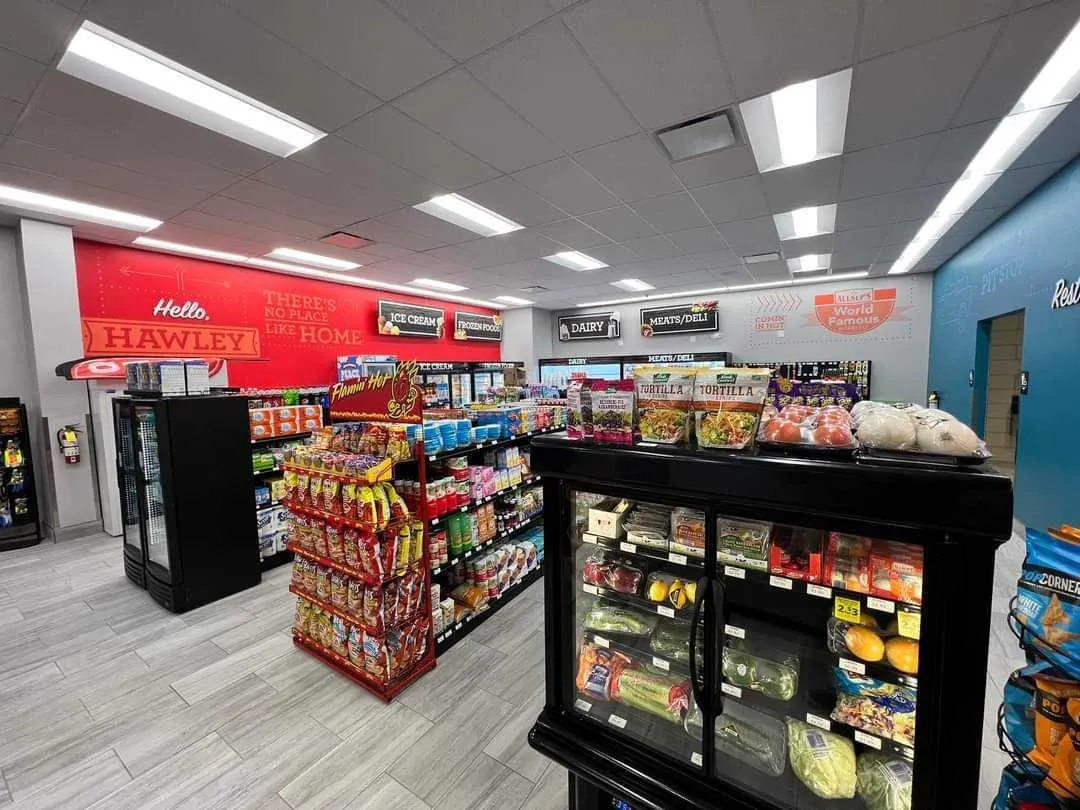
A September 2026 opening in Odessa, Texas, put the construction strategy into concrete form. The 5,630-square-foot Allsup’s had ten multi-product fuel dispensers, five diesel lanes and eleven truck parking spaces. Inside were the familiar food and everyday grocery basics. Yesway called it its 93rd new-to-industry store in roughly five years.
The details describe the customers the location was designed to serve: residents buying essentials, travelers stopping for food and drivers needing room for a truck. A site plan is also a set of choices about whose visit will be easy.
The bell, and the morning after
On April 22, 2026, Trkla rang Nasdaq’s opening bell for Yesway’s IPO. The shares began trading as YSWY. The offering priced fourteen million shares at $20 apiece, representing $280 million before underwriting discounts and expenses. Years of building a private company now had a conspicuously public milestone.
The route had taken longer than the company’s earlier plans suggested. Yesway explored an offering in 2021 and paused in 2022 amid uncertain markets. By the eventual debut, Trkla framed the public listing as a way to improve access to capital and support acquisitions and new-store development.
November 2019
June 30, 2026
Reported September 2026
Yesway reported 450 stores at June 30, 2026. Its second-quarter adjusted EBITDA reached $70.9 million, a non-GAAP measure. Management raised its full-year outlook for that measure, while its expected openings for 2026 remained six to eight stores. A public company’s expansion story comes with a calendar and numbers against which it can be judged.
In October 2026, Allsup’s entered Arizona with a store in Willcox. The footprint kept moving. The recurring question remained close to the one that had greeted the Allsup’s purchase: what should change when the business grows, and what has already earned the customer’s confidence?
Trkla’s career gives that question an unusually tangible object. Investors can debate the value of a brand for hours. At Allsup’s, a customer can unwrap one. The next store, however carefully financed and placed, will still have to give that customer a reason to return.