There is a useful way to understand Yesway that begins not with gasoline or private equity, but with lunch. The Allsup's beef-and-bean burrito is assembled, fried and handed across a counter in a paper sleeve. It is portable, inexpensive and, in parts of New Mexico and West Texas, freighted with the sort of regional feeling usually reserved for football teams. When Yesway acquired the Allsup's chain in 2019, it bought more than 300 stores and a working foodservice system. It also bought a habit. About 20 million of those burritos had been sold that year.
The buyer was only four years old. Brookwood Financial Partners, a real-estate-focused private-equity firm, had created Yesway in 2015 and assembled it through purchases of smaller convenience-store portfolios. The broad thesis was tidy: the American convenience market was large, fragmented and full of stores that could benefit from scale, better purchasing, cleaner facilities, consistent branding and sharper operating data. Allsup's made the thesis tangible. A spreadsheet could identify an underused forecourt. It could not invent 50 years of appetite.
A grocer with gas pumps
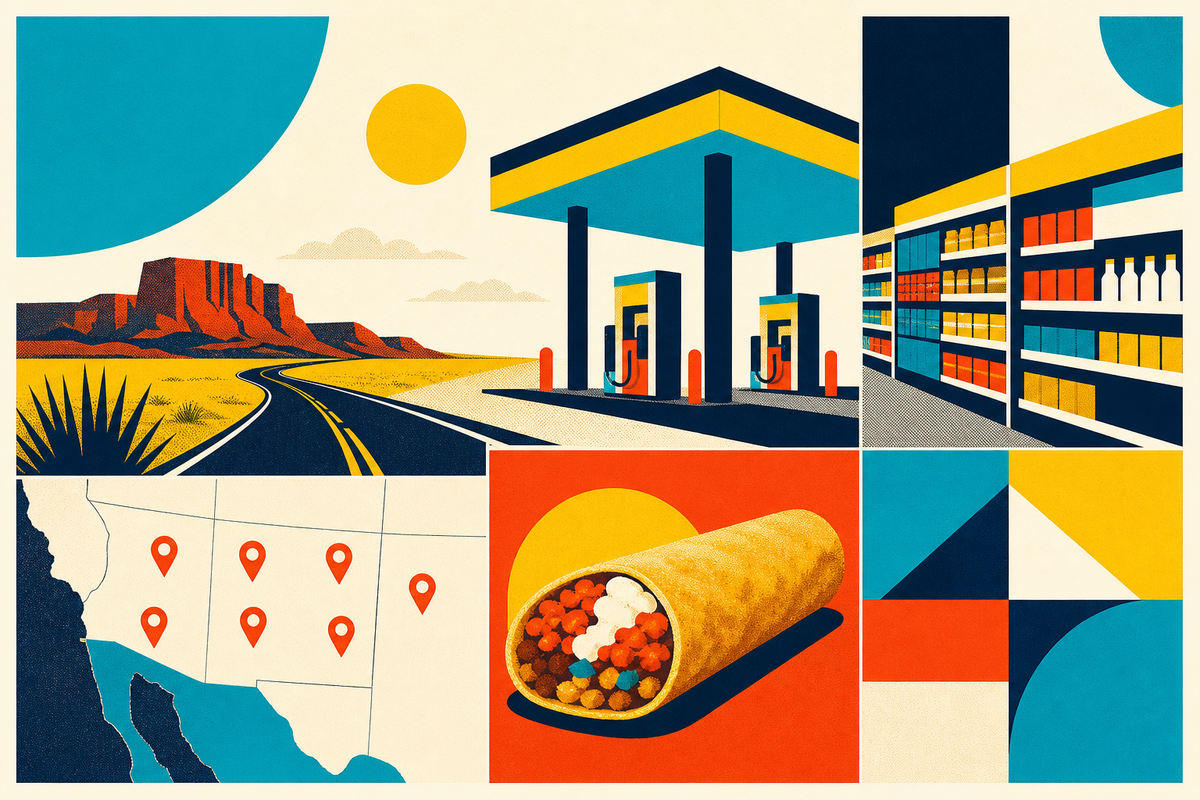
Yesway now operates under two names - Yesway and Allsup's - with 449 stores reported in June 2026 across Texas, New Mexico, Oklahoma, Iowa, Kansas, Missouri, Nebraska, South Dakota and Wyoming. Most are in communities with fewer than 20,000 residents. That geography changes the job. In a large city, a convenience store competes for an impulse. In a small town, it may also be the reliable place for milk, bread, eggs, coffee, cash, a hot meal, a restroom and a full tank after the supermarket has closed.
The customer base is correspondingly broad: local households, commuters, road-trippers, shift workers, construction crews, farm operators and professional drivers. Large-format stores add high-flow diesel lanes, wide turns, beer caves and basic financial services. The rewards program turns packaged-goods promotions into fuel savings. Professional drivers receive tiered benefits based on monthly gallons. Fleet customers can link drivers to corporate programs and widely used commercial fuel cards.
This is a practical answer to several ordinary problems at once: distance, time, hunger and price. Yesway does not beat e-commerce at home delivery. It operates in categories delivery handles poorly or cannot handle at all - motor fuel, hot fountain coffee, lottery tickets, regulated products and food needed now. Low population density makes the economics of delivering a small basket worse. A well-placed store on a local arterial road simply waits for the customer to pass.
The pump gets traffic. The fryer gets preference.
Fuel remains the largest revenue line. In the first quarter of 2026, Yesway recorded $464.3 million in fuel sales and $213.7 million in inside-merchandise sales. Yet revenue does not explain where the attraction lies. Fuel is conspicuous, frequently purchased and locally price-sensitive. Prepared food, private-label snacks and groceries carry a different margin profile and give a driver a reason to choose one canopy over the next.
Allsup's supplies the hero product. Its foodservice menu centers on frozen-to-fresh fried items - burritos and chimichangas prominent among them - designed for speed and repeatability. In a newer store layout, the preparation and frying station occupies about 115 square feet inside a 360-square-foot central checkout area. One worker can tend the fryer and registers when needed. Across the portfolio, the company averaged 2.6 employees per shift in 2025. The romance of a cult burrito sits on top of decidedly unsentimental labor engineering.
“We didn't grow up in this industry.”Tom Brown, Brookwood and Yesway executive, on the founding team's outsider view
The outsider line matters because Yesway's expertise is not just retail theater. Its founders came from real estate and investment. They looked for fee-simple properties, operating businesses and portfolios where redevelopment could raise sales. By the end of 2025, the company owned roughly 65 percent of the real estate beneath its stores. It had completed 27 acquisitions and opened 90 new stores from 2020 through that December.
That background produces a repeatable growth sequence: find a market, control or structure the site, build or rebuild a modern store, expand fuel capacity, install a standardized assortment and food program, then monitor performance in real time. Yesway says a new self-funded store can cost roughly $10 million to $12 million; build-to-suit structures reduce its upfront investment. New stores with a full year of applicable performance data had achieved an average return on investment near the company's 15 percent target.
Modernize the store, not the memory
Acquirers of beloved regional businesses often reach for a single national identity. Yesway kept both. Allsup's remains the dominant name across its Southwestern heartland, while Yesway continues elsewhere. The company extended Allsup's food into Yesway locations and invested in the chain's technology, but it did not pretend that a newly coined name carried the same local meaning.
This makes Yesway different from a pure fuel discounter and from a generic roll-up. The back office can become more uniform while the customer-facing attachment stays specific. Point-of-sale systems, reporting, fuel procurement, merchandise contracts, hiring models and store layouts reward consistency. The burrito, World Famous Burrito Day and the Allsup's name reward continuity. The company is effectively standardizing what customers do not need to love.
Its smaller experiments show the same flexibility. The first Allsup's Express opened in 2022 near Texas Tech University as a roughly 3,000-square-foot bodega aimed at students. A 1,600-square-foot grab-and-go shop at Texas Motor Speedway used mobile checkout for spectators who wanted to return to their seats. The full new-build store goes the other direction: 6,277 square feet, open around the clock, with groceries, hot food, fuel and services for a town-sized catchment area.
Where the machine fits
The United States had roughly 152,000 convenience stores at the end of 2025, and 63 percent were controlled by operators with ten stores or fewer. That leaves room for consolidation. It also ensures that scale alone does not settle local competition. Yesway faces national networks such as 7-Eleven and Circle K, regional operators including Casey's and QuikTrip, fuel-led retailers such as Murphy USA, truck-stop networks, independent stores, supermarkets and quick-service restaurants.
Its chosen position is between the independent and the giant: enough scale to negotiate, automate and finance development, but concentrated enough in smaller markets to become the first or second convenience operator in many of them. The company ranked 15th among U.S. convenience-store operators by store count in the ranking it cited for 2025. That is meaningful scale, though still modest beside the largest chains.
Community work helps defend the local side of the equation. Yesway and its suppliers have raised money after wildfires and floods in New Mexico and Texas. It has recurring programs with Operation Homefront, the NACS Foundation and relief organizations. In 2025, its fifth annual Golf & Clays Classic raised more than $630,000. These campaigns are philanthropy, customer participation and local presence bundled together - particularly relevant when the store is a town's visible, always-open institution.
Public-market daylight
In April 2026, Yesway sold 16.1 million Class A shares, including the underwriters' option, at $20 each. Net proceeds were about $301.1 million, much of which moved through its holding-company structure to redeem preferred interests and reduce revolving debt. The listing put YSWY on Nasdaq and moved the roll-up into the quarterly glare of public ownership.
Its first report as a public company arrived with strong comparisons. Revenue for the March quarter rose 13.9 percent to $683.6 million. Net income was $30.2 million, against a $5.6 million loss a year earlier, and adjusted EBITDA reached $59.2 million. Same-store inside sales increased 4.5 percent. Those figures also carry a caution: fuel margins move with wholesale prices, local competition and the lag between cost changes and pump pricing. A convenience business can feel steady to a customer while its quarterly economics remain volatile.
Yesway's next problem is therefore more delicate than collecting stores. It must keep new builds productive, manage debt and public shareholders, improve merchandise margin and preserve the local recognition it paid to acquire. The company expects to sell 29 Iowa and Kansas stores by the end of 2026, a reminder that expansion can include pruning as well as opening.
The transferable lesson is not “buy a famous burrito.” It is to identify which part of an acquired business should become standardized and which part should remain stubbornly itself. Yesway applies technology, purchasing power and real-estate capital to the hidden layer. At the counter, the old product still crackles in the fryer. For a customer crossing a long stretch of road, that continuity may be the most modern convenience of all.