Tay Brown’s introduction to venture capital cost $100. By his own account, he had already spent two years and a pile of personal money trying to build Redo. He was cold-calling ecommerce merchants from an unfinished basement, paying engineers and looking for evidence that the thing worked. A handful of beta customers finally gave him something to show. Then he offered $100 on social media for an introduction to a Utah investor. The introduction reached Pelion Venture Partners. The return on that particular referral was rather good.
- Redo helps merchants turn return requests into exchanges.
- Its free portal opens the door to paid commerce tools.
- The opportunity reaches beyond software into physical returns.
The interesting number is zero
Today, Redo sells merchants a way to manage the awkward stretch after checkout: wrong sizes, missing parcels, shipping questions and refund requests. Its customers are ecommerce brands, particularly in the Shopify ecosystem. The proposition starts with an unusual price. The returns portal is free to the merchant.
That sentence needs its small print. Shoppers can buy optional return coverage at checkout. Additional products carry usage fees. Free software can therefore be the entry point to a commercial relationship, rather than the entire commercial relationship. A merchant evaluating Redo needs to understand both the shopper’s offer and the store’s bill.
Redo’s published prices make the distinction concrete. Tracking costs eight cents per tracked order; support AI agents cost 85 cents per resolution. Checkout optimization is another paid module. These are different services with different billing units. “Free” describes the opening offer, not an unlimited entitlement to every product.
A wrong size is useful information
Consider the ordinary sizing return. Someone wanted the garment enough to buy it. The fit failed. Processing a refund efficiently solves the administrative problem, but it leaves the original demand unanswered. An exchange offers another chance to satisfy it.
Redo’s returns product uses the customer, return reason and available products to recommend alternatives. Its AI review tools can examine photographs, customer history and merchant rules. Product-level reporting lets the brand look for patterns in what comes back. Repeated fit complaints can become a reason to change a product description, rather than simply another line in a refund report.
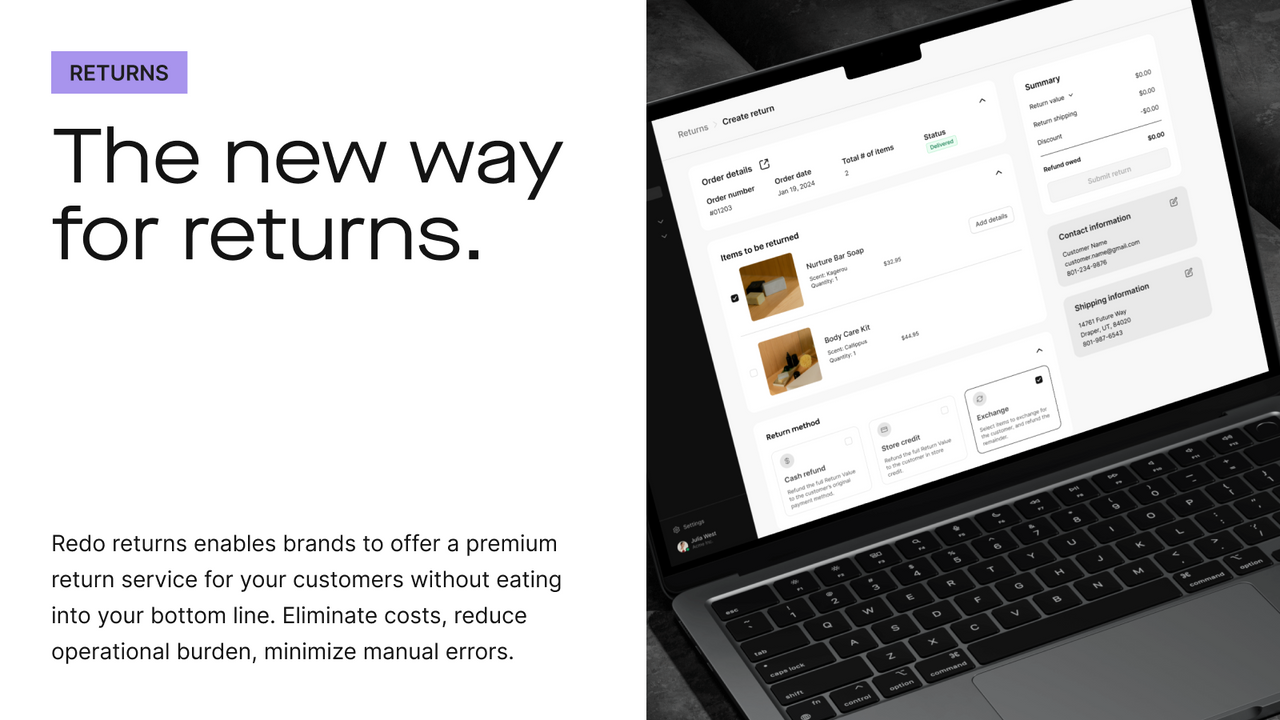
The useful expertise here is operational: knowing how a policy, an inventory record and a shopper’s preference fit together. Automation earns its keep when it removes a handoff without losing the detail that made a human handoff necessary.
The founder changed his own job
Brown’s early experiment did not immediately produce a working business. In his account, he responded by learning the jobs himself and selling directly to merchants. Customer trials supplied evidence before investors supplied capital. The lesson is wonderfully unglamorous: get close enough to the problem to discover what people will actually use.
He later made another consequential decision. After working with Sterling Snow for three months, Brown brought him in as co-founder and CEO in September 2023. Snow had been chief revenue officer at Divvy. He recruited former colleagues into Redo’s leadership. The careers page now promises early ownership and advancement based on impact. That is the company’s stated bargain with recruits: responsibility arrives early, and expectations travel with it.

Follow the order, find the next product
A return touches several systems. Support needs the order history. The warehouse needs the right instructions. The customer needs an update. Redo has followed those connections into shipping, tracking, support and marketing.
Its fulfillment software batches orders, merges suitable shipments and verifies packing with scans. Its support product brings channels into one inbox, with AI assistance or autonomous replies. Listed integrations include Gorgias, Klaviyo and NetSuite. A brand can connect existing tools while considering which functions it wants Redo to handle.
The newer Commerce Agent pushes that logic into a text conversation: answer a product question, build a cart, edit an order, track the parcel, process an exchange. Those are advertised capabilities, not proof that every customer interaction should be automated. Their usefulness depends on accurate product information and reliable access to the underlying order.
“When we started Redo, we thought we were solving returns.”Sterling Snow · June 2026
Eventually, software meets a cardboard box
Redo announced its ReturnBear acquisition in February 2026, adding international returns and reverse-logistics capabilities. Local receiving and inspection matter because a returned item is still a physical object. Somewhere, someone must decide whether it can be sold again.
In September, Redo added Happy Returns drop-off within its portal for eligible brands. The shopper selects that option, receives a QR code and hands the item to an associate. Many eligible returns need neither a printed label nor a box. The merchant keeps its Redo workflow while the shopper gets another way to complete the chore.
That is a useful reminder for anyone building commerce software. An elegant screen can remove friction, but it cannot inspect a sweater. Redo’s expansion increasingly connects those two kinds of work.
What the bigger check is buying
In June 2026, Redo announced an $81 million Series B led by Smash Capital, at a reported $1.25 billion valuation. It reported more than 4,100 brands using the platform and more than 1,750 merchants using multiple offerings. The second number explains the ambition: earn a place with one product, then become useful in more of the store.

Alternatives include Loop, AfterShip and Narvar. Merchants should compare actual workflows and total costs. A store with little return volume, a highly specialized stack or shoppers resistant to coverage fees may find less value in Redo’s approach. An exchange also needs a replacement the customer wants and stock the merchant can ship.
The part worth copying is the discipline: separate fit problems from product failures, make exchanges easy, and feed return reasons back into merchandising. Measure retained margin alongside retained revenue. A second sale is useful only if it leaves both the merchant and the shopper better off.