A recruiter has two names to keep in mind: the person who could do the job, and the person who will pay to have it filled. Between those names sits a small obstacle course. Resumes need tidying. Conversations need recording. Shortlists need sending. Somebody must remember what the client said last Tuesday. Recruit CRM has built its business in that space between knowing someone and getting something done.
- One workspace for candidates, clients, and placements.
- Built chiefly for recruitment and executive search agencies.
- Subscriptions buy access; some actions also consume credits.
The space between two names
An applicant tracking system follows people through a hiring process. A customer relationship management system follows commercial relationships. An agency needs both. Its candidate might suit several clients; its client might return with another vacancy six months later. Keeping those histories together is the point of Recruit CRM’s combined ATS and CRM.
In practical terms, a recruiter can bring in a profile through the Chrome extension, organize candidates into talent pools, track submissions, and keep the client conversation attached to the work. A manager can inspect the pipeline. The attraction is continuity: the next action begins with the information collected during the previous one.
- 01SourceFind the person
- 02QualifyKeep the context
- 03SubmitBring in the client
- 04PlaceClose the loop
Automation then turns a change in a record into an action: update information, create a task, notify a colleague, or pass data to another application. Recruit CRM distinguishes these workflows from outreach sequences, which organize follow-up messages. The distinction is useful. Sending an email and keeping an operation coordinated are different problems. An agency needs to decide which event should trigger which action before automation can save anyone time. Otherwise, a faster process can simply repeat an unclear instruction more often.
The family money footnote
The co-founders brought different kinds of familiarity to that problem. Ajay Mallapurkar had worked at Randstad India and led ADP India, after an earlier career in the Indian Army. His son, Shoanak, known as Sean, studied business information systems at Indiana University and started a venture-backed marketplace in the Bay Area. Recruitment’s routines met a younger software company’s expectations.
They started Recruit CRM in 2017. Sean later disclosed that his father supplied approximately $80,000 and office space during 2017-2019. That matters. A founder’s runway includes resources that never appear in a venture-funding announcement. Family support bought time to develop the product and make mistakes.

In a May 2026 Indie Hackers interview, Sean reported nearly $11 million in annual recurring revenue. He also described early underpricing, the difficulty of serving Western customers from India, and a wish to have recruited experienced leaders sooner. The useful lesson is operational: industry access helps, but pricing, communication, and management still need deliberate work.
“Access to capital is a privilege.”Sean Mallapurkar, on the company’s early family support
A shortlist is a working memory
Consider Group928, an executive recruitment business featured in Recruit CRM’s customer stories. Its team used hotlists to group candidates by skills or experience. A hotlist sounds modest. Yet it gives a recruiter somewhere to put the person who is excellent, available, and wrong for today’s assignment. That person can become relevant again.
Group928 reported doubling executive placements within 12 months of using the software. This is a vendor-published account, so the result deserves the boundaries of a customer example. It does not establish what another agency will achieve. The more transferable detail is the combination of easy retrieval, less administration, and support the team wanted to use.
Executive placements in 12 months. One customer’s experience, rather than a forecast.
The wider market includes Bullhorn, Vincere, Recruiterflow, Crelate, and JobAdder. Recruit CRM’s pitch rests on joining agency work together, approachable software, and live support. The buying question is specific: can your recruiters complete their ordinary work with fewer interruptions? A feature checklist alone will struggle to answer it.
The unglamorous work gets an agent
Recruit CRM’s ARC tools reveal where the company thinks time disappears. There are agents for extracting custom fields, formatting resumes, preparing candidate submissions, and drafting candidate pitches. These are the chores surrounding a recommendation: converting what a recruiter knows into something a client can understand and act upon.
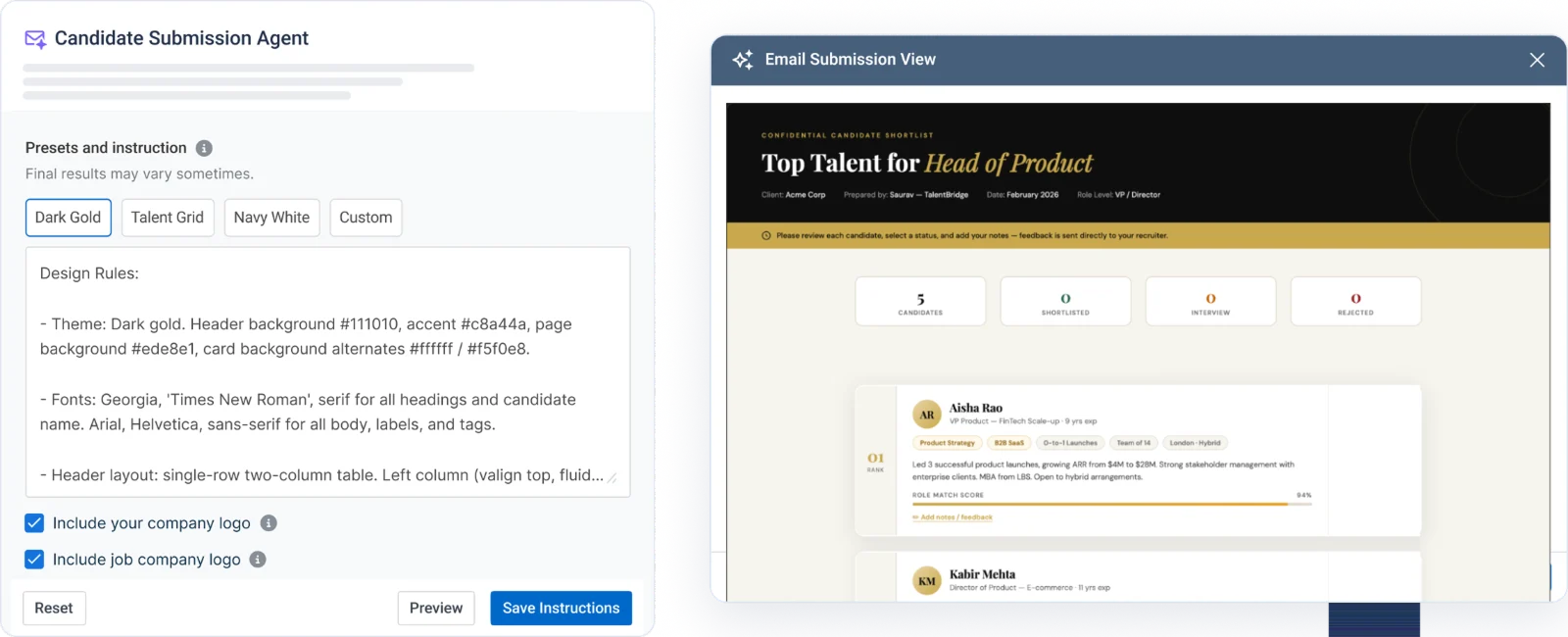
The company describes outputs that recruiters can review and edit. That arrangement suits work where a misplaced credential or an overconfident pitch can damage a relationship. Preparing a document and taking responsibility for it remain separate jobs. The software handles more of the preparation; the recruiter still owns what goes out.
September 2026 product notes also describe job-change alerts and a report flagging potential backdoor hires, where a previously submitted candidate appears to join a client without a recorded placement. Both address the same agency anxiety: information can become commercially important after everyone has stopped watching it.
The integration directory shows why a single workspace still needs neighbors. Honeit brings interview information into the record; Testlify connects assessment invitations and candidate status. For an agency choosing software, that suggests a useful second test: check whether the tools already embedded in its process can exchange the right information, rather than merely appearing on an integration list.
Read both meters
The economics require attention. The public pricing page displays Pro, Business, and Enterprise figures of $95, $135, and $215 per user per month, alongside monthly and annual billing options. Annual billing advertises a discount. Some features consume pooled credits, including sourcing, enrichment, messaging, and automation. A seat count is therefore only the beginning of a budget.
There is also work beyond permanent placements. Bill & Pay connects contractor timesheets, approvals, rate rules, and invoicing. Recruit Craft builds recruitment websites and career pages. Those extensions broaden the desk’s reach. A contract agency should still examine the whole billing journey: the Bill & Pay page marks accounting integrations as coming soon.
Copy the handoff audit
For a prospective customer, the useful experiment is one real vacancy. Import its awkward resumes. Build its shortlist. Ask a colleague to take over. Send a client submission. Inspect the feedback trail and the credits consumed. An agency that needs only occasional applicant tracking may find little value in this much machinery.
The same test gives other founders something to copy: watch the joins between tasks. Useful software often begins with a repeated transfer that everyone has accepted as normal. Recruit CRM’s opportunity is to make those transfers smaller, leaving recruiters with more time for the conversations that make a placement possible.