A floppy disk is an unlikely monument to a working life. Small, square and now mostly remembered as the save button, it promises very little drama. Yet it is a useful place to begin with Raymond F. Melissa. In 1985, when he founded the company that carries his surname, he sold ZIP Code databases on floppy disks. The proposition was straightforward: give mailers better information about where their mail was going. A business could buy the data, improve its addresses and get on with the business of reaching people.
Forty years later, Ray Melissa was at CES in Las Vegas, visiting his company’s booth and talking with attendees. Around him were colleagues demonstrating tools for checking addresses and other customer details. The disk had vanished from the transaction. The question behind it had survived rather well: will the information actually get you where you intend to go?
That question gives his career its shape. Melissa has worked in computer printers, postal databases and data verification. Across those changes, he has remained close to the awkward point where information has to become useful. An address can look perfectly respectable on a screen and still send something astray. It has excellent manners until the parcel fails to arrive.
Before the ZIP Code, the printer
Melissa earned a bachelor’s degree in electrical engineering at California State University, Long Beach in 1968. His early entrepreneurial work belonged to the physical machinery of computing. During the 1970s, he co-founded technology businesses including Eikon. In 1974, he helped launch Printronix, a computer printer manufacturer. In 1978, he co-established Trilog, which developed color printers.
Those dates place the founding of Melissa in a longer sequence. By 1985, he had already participated in several ventures. The company bearing his name was a new chapter in an established technical career. Printing and postal data also have a practical connection: producing a page is one task; giving it a useful destination is another. His work passed through both.
The engineering degree supplies a further point of continuity. Decades after graduation, Melissa would contribute to the same university’s engineering college, supporting work in data and computing. His career eventually connected two generations of technical education, with a lengthy interval spent finding customers for what technology could do.
CSU Long Beach
Printronix
Trilog
ZIP Code databases
Five digits, then four decades
The first offering at Melissa was ZIP*Data. Its customers needed accurate postal information, and the company supplied it in a format they could use. There is an appealing economy to that origin. The founding product did a specific job for people who already had a reason to pay attention.
The product history gradually becomes a history of how businesses use software. In 1993 came MAILERS+4, the company’s first address verification software certified under the United States Postal Service’s Coding Accuracy Support System. In 1997, Melissa released an address verification programming interface as a 16-bit DLL, a component other software could call. A free online lookup followed in 1998.
Each step moved the checking process closer to the place where someone needed it. A database could be consulted. Mailing software could process a list. A programming component could put verification inside another application. The customer no longer had to encounter the information in the form its supplier originally packaged it.
Melissa’s own explanation of the stakes is plain: “Contact data accuracy and excellence make all the difference.” The phrase fits a business where the error may occupy only a few characters, while the consequences travel through several departments. Marketing needs a usable contact. Fulfillment needs a destination. A customer expects the order to arrive without a small investigation.
Businesses served worldwide when Melissa marked its 40th anniversary.
In February 2012, the company reorganized around two divisions, one serving data quality customers and another concentrating on direct marketers. The distinction acknowledged that a developer building verification into software and a mailer preparing a campaign might need different ways into the same underlying expertise.
The old postal business continued alongside the newer applications. In 2023, Melissa acquired ZipInfo.com, another provider of ZIP Code databases and software developer kits. A company that began with ZIP Code data was still investing in it nearly four decades later. Expansion had left room for the original trade.
A company with the founder’s surname
Melissa’s name sometimes requires a small introduction. The surname belongs to Ray. The business also describes itself as family-owned and independent. John Melissa, its chief financial officer, has discussed that ownership and the company’s culture in an interview. The identity has a personal origin, even as the operations reach well beyond one person.
Ray’s responsibilities include corporate growth strategy, business development, new products, sales and marketing. That is a broad remit, but the visible company around him contains other long careers. Chief technology officer Phil Maitino’s interview describes more than thirty years running the programming department. Ray has also recorded an interview about long-serving employees and the working arrangements that encourage people to stay.
These details give the anniversary some human scale. Forty years contains many releases and plenty of changing terminology. It can also contain colleagues who remember the earlier versions. Institutional memory, in this case, has people attached to it.
“Bad data is bad business.”
Melissa’s company philosophy
The geography has been relatively steady, too. Melissa moved its headquarters to Rancho Santa Margarita, California in 1999. In 2024, Ray and John accepted recognition through the city’s Business Recognition Program. The occasion acknowledged the company’s work and its twenty-five years in the city.
International growth added a different kind of proximity. The company established offices abroad to provide local sales and support for customers operating across borders. Its account of the London office describes an expansion that included Germany and India. A global address business has an obvious reason to care about local knowledge: the details that make a record useful differ from place to place.
A familiar face among the new gadgets
CES 2025 gave this long-running company a new setting. It was Melissa’s first time exhibiting at the show. From January 7 to 10, the team operated at Booth 9417, explaining its services and letting visitors try lookup tools. Ray attended and spoke with people at the booth. A fortieth anniversary year can apparently still include a first.
The colleagues there included CIO Bud Walker and vice president of sales Lauren Sveen. Other executives attended the show as well. The demonstrations offered something concrete in a setting built for promises: enter an address and examine the result. Visitors could see the tools working rather than simply carry away a description.
The company also handed out caps and T-shirts. By the last day, both had run out. Even a business concerned with verifying destinations occasionally needs to replenish a box. The detail is a modest reminder that trade shows involve people, conversations and things someone must remember to pack.
For Ray, the appearance sits comfortably beside the earlier ventures. The products and surroundings had changed enormously since the printer businesses of the 1970s. He was still present where technical work met potential customers, joining colleagues in explaining what the company could help them accomplish.
Back to the engineering classroom
Melissa’s connection to Long Beach eventually became a contribution to its future. His gift to the College of Engineering’s Dean’s Excellence Fund supports curriculum development and research in data science, computer science and computer engineering. The intended work includes opportunities to connect computing theory with practical applications.
The connection is specific. An electrical engineering graduate from 1968 was helping an engineering college prepare for fields that had changed substantially over his working life. The contribution directed attention toward faculty and students, with room for new courses, collaborative projects and hands-on learning.
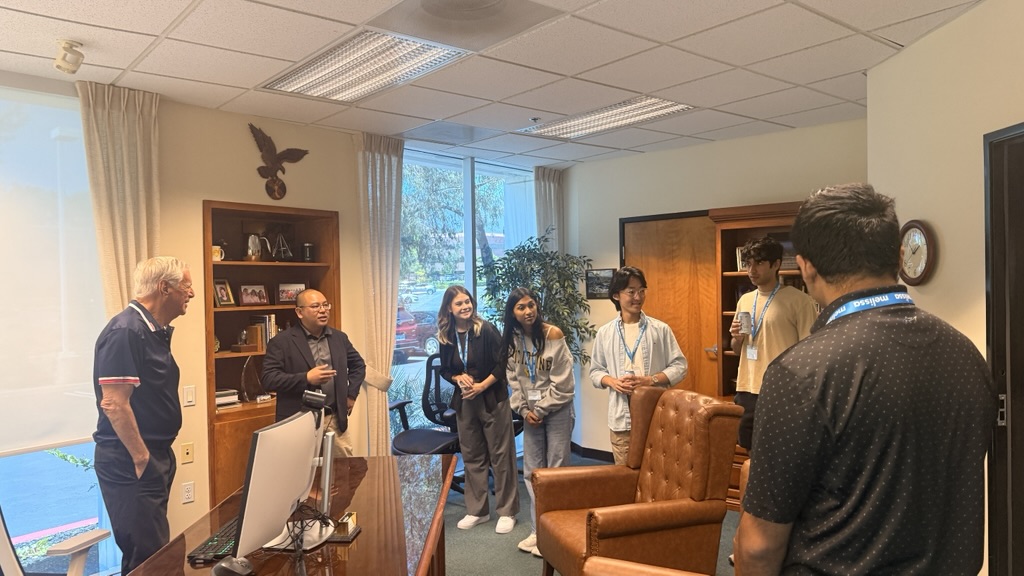
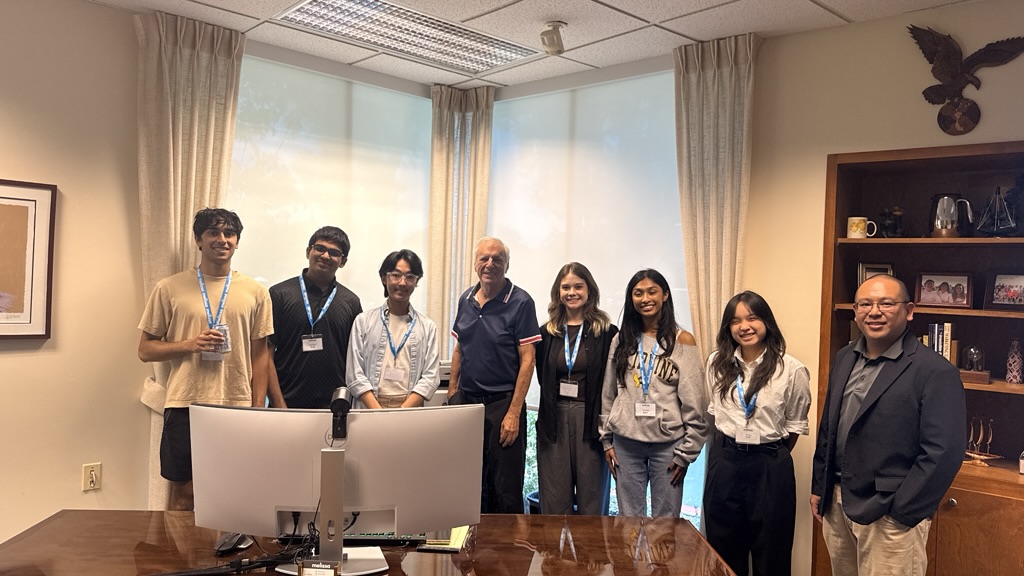
On May 8, 2026, another group of students came to him. Following datathons, Melissa Education welcomed participants to the Rancho Santa Margarita headquarters. Their afternoon included mock interviews, questions about careers and conversations with staff working across data, analytics, mapping, technology and sales.
They also met Ray. The photographs show the founder in an office with bookshelves, framed pictures and a large desk, standing among visitors wearing lanyards. There is no stage between them. The visit put students in the rooms where people work, with the opportunity to ask about the routes into that work.
A server room tour supplied the afternoon’s other practical view. Data services have a physical home, even when customers encounter them through a form or an application. For students thinking about technical careers, the visit joined the interview question to the equipment, the executive to the staff and the company name to an actual workplace.
That is a fitting place to leave Ray Melissa’s story for now. An engineer who worked on printers founded a business in postal data, stayed with it through successive software eras and welcomed another generation into the office. The floppy disk has become a historical object. The founder is still there, meeting the people who might build whatever comes after it.
Follow the address
INTERVIEWS · CONNECTIONS · FURTHER READING
- Melissa website
- Ray Melissa on LinkedIn
- Watch: how Ray got started
- Watch: long-serving employees
- Melissa on YouTube
- His gift to CSU Long Beach
- The May 2026 student visit
- CES 2025 in photographs
- Company milestones: 2026 catalog
- The 2012 company reorganization
- The ZipInfo.com acquisition
- Forty years of Melissa
- The London office story
- Ray Melissa: career biography