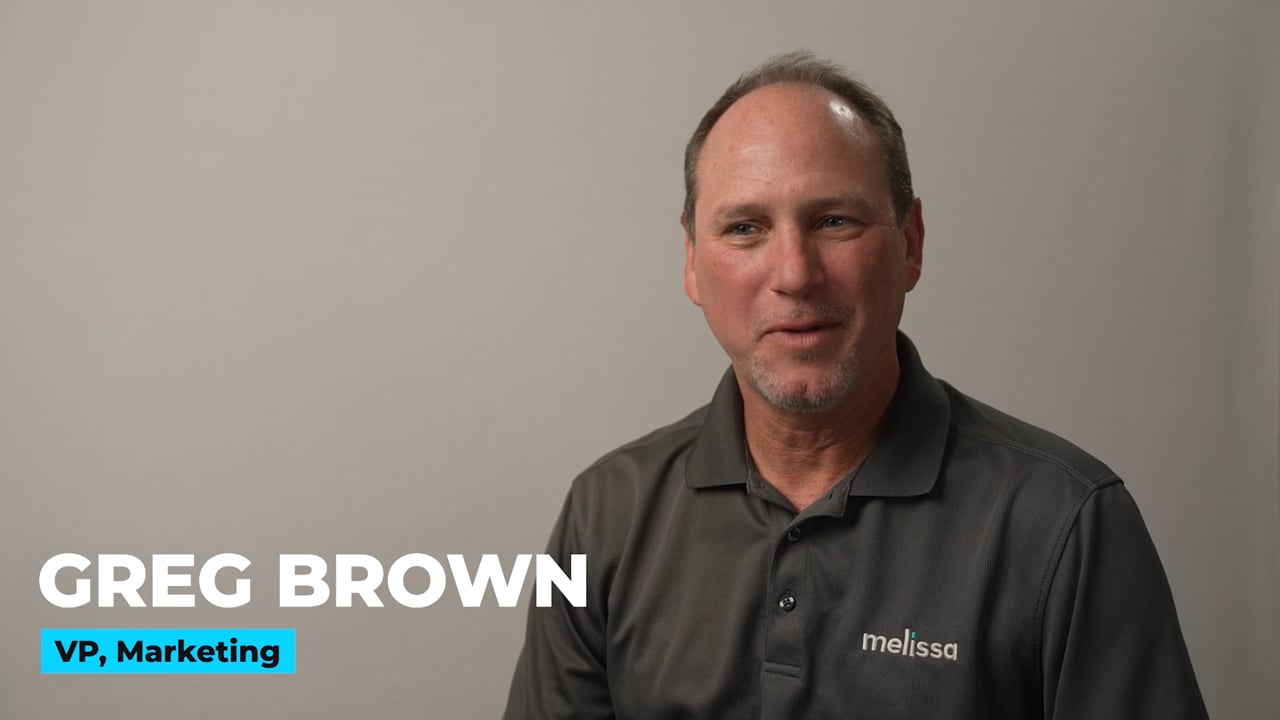
A bad address is almost comic in its smallness. One extra letter turns Main Street into Maine Street. The form accepts it. The database stores it. The map looks elsewhere. Somewhere downstream, a package takes the scenic route and a customer begins checking the porch with increasing suspicion. Greg Brown has built a career around the distance between that first quiet error and the expensive noise it eventually makes.
Brown is Chief Marketing Officer at Melissa, the data-quality company in Rancho Santa Margarita, California. He joined in 2006, when software still arrived more often in boxes and “the cloud” had not yet swallowed the business dictionary. By 2026, his tenure had reached roughly two decades. The tools moved from postal presort and batch cleaning toward APIs, autocomplete, geocoding and real-time identity verification. His central argument barely budged: information is useful only when it survives contact with reality.
It is an unshowy proposition in a technology market fond of fireworks. Brown's examples are wonderfully earthbound. Mail comes back. Materials are wasted. A shipment is late. A call takes longer. A marketer addresses the same person twice. When he says “data,” he is usually not far from a doorbell, a telephone or an irritated human being.
Six ways a record can betray you
Brown defines quality data as information “suitable and adequate for its intended use.” The wording matters. A record can look tidy and still fail the job. In his formulation, it should be complete, accurate, consistent, unique, valid and conformant. Six sensible adjectives, each guarding a different trap.
A customer entry may contain every required field and still contain the wrong address. Two accurate entries may disagree in format. One valid customer may appear several times. A field may obey its format while describing a phone number that has already been reassigned. The database offers a cruel little lesson in appearances: neat rows do not guarantee sound facts.
“Quality data is data that is suitable and adequate for its intended use.”Greg Brown, 2025
This is where Brown's background becomes intriguing. He earned a BA in English from the University of California, Santa Barbara in 1992, then a Juris Doctor from Western State University College of Law in 1998. Before Melissa, he worked as a creative manager at Newport Corporation. The public chronology does not offer a grand conversion scene. It offers something better: a marketer trained to notice language, definitions and consequences.
Law asks what a word covers. English asks what it means and how it moves a reader. Data quality asks whether a field describing the world actually matches the world. Brown's work sits tidily at that intersection. His most memorable explanations do not decorate complexity. They prosecute it.
The database has weather
“Customer data is always in flux,” Brown has said. People move. Phone numbers circulate. Households change. Forms mistreat accents and apartment numbers. Separate systems create separate versions of the same customer. The trouble with a database is not simply that it begins imperfectly. It ages while everyone is at lunch.
Brown has spent years giving this entropy a price tag. In an early data-hygiene article, he used the 1-10-100 rule: a dollar to verify a record when it enters, ten to clean it later and one hundred if nothing is done and the failure reaches the business. The precise bill will differ by company, but the dramatic arithmetic makes prevention memorable. A tiny field can accrue interest.
The quiet journey of one loud mistake
- A person mistypes an address.
- The record enters several systems.
- Shipping, service and marketing trust it.
- The customer receives the consequence.
His case for real-time verification follows naturally. Correct the entry while the customer is still present. Autocomplete can suggest a verified address as someone types, reducing effort as well as error. Brown has said the approach can cut address-entry time by as much as 75 percent. Clean data, in this view, is not administrative scolding. It is a shorter form.
That shift matters for marketing. A data-quality company can easily sound like a supplier of chores. Brown turns maintenance into experience: fewer keystrokes, fewer delayed orders, fewer awkward apologies. The feature is technical. The benefit wears shoes.
From the mailroom to the API
When Brown joined Melissa, the company already had a long history in mailing. Its first business was rooted in ZIP codes, postal preparation and address verification. In 2011, when Brown was marketing director, he explained how the firm had expanded into contact, property and mortgage information. At trade shows, he said, visitors routinely asked, “Where's Melissa?”
There was no absent Melissa to fetch. Founder Raymond Melissa had named the company after himself. It is the kind of confusion every brand strategist secretly treasures: harmless, repeatable and solved with a story. Brown had to introduce both the name and a category whose value often became obvious only after something went wrong.
By then he was already a public interpreter for the company. A 2007 investor interview carried his explanation of Melissa's origins. Over the following years, his byline and commentary appeared across ecommerce, call-center, software and data-management publications. The vocabulary widened: deduplication, enrichment, location intelligence, partner integrations, identity. Brown kept returning to ordinary outcomes.
“144 Maine Street is not the same as 144 Main Street.”Greg Brown on geospatial accuracy
That one-letter example, offered in a discussion of location data, is Brown's method in miniature. Geocoding is an imposing word. A driver at the wrong “Main” is a scene. Brown brings the category down to street level and lets the typo embarrass itself.
Brown joins Melissa Data after earlier creative work at Newport Corporation.
As marketing director, he explains the company's expansion beyond its postal-software roots.
A California-office conversation helps grow into the SD Times Data Quality Project and a survey of 202 developers.
Melissa lists Brown as Chief Marketing Officer, responsible for brand, B2B, internet and email strategy.
Making the engineers raise their hands
One of Brown's more revealing collaborations began with a conversation in Melissa's California offices. SD Times editor David Rubinstein had been writing about the industry's reluctance to admit its dirty-data problem. Brown helped turn the discussion into a developer survey. More than half of the 202 respondents said they were involved in data input, management, integration or choosing validation tools.
The result punctured the idea that quality belongs to a distant department with a mop and bucket. Developers influence the forms, pipelines and interfaces through which records are born. Marketers use them. Sales teams amend them. Operations acts on them. Customers suffer them. Brown's phrase for accepting poor quality as “the cost of doing business” captured the resignation the project wanted to challenge.
His partner pitch applies the same logic outside a single company. Train system integrators and resellers, give them technical support and a developer portal, and data quality travels inside the tools businesses already use. The glamorous strategy would be to demand a new kingdom. The practical one is to improve the plumbing.
A career in continuous correction
Brown's title has changed across the years: marketing director, vice president of marketing, vice president of global marketing and now Chief Marketing Officer. The progression mirrors Melissa's widening field, from mail preparation toward global data quality and identity verification. His remit, according to the company's management profile, spans brand management, business-to-business, internet and email marketing. He is also a DMA-certified Marketing Professional and brought experience from both client and agency work.
Yet the striking thing is continuity. In 2013, Brown described data hygiene as a practice rather than a one-time cleanup. His more recent writing makes the infrastructure version of the same point: support batch jobs, real-time checks, customizable APIs and software services so accuracy can persist as records move. The metaphor grew more technical. The habit stayed the same.
This may be why “hygiene” has endured in his vocabulary. A spotless database is a fantasy because the world refuses to hold still. The honest goal is a routine that catches change early enough to be useful. Perfection makes a fine poster. Maintenance keeps the parcel moving.
Brown's public life remains mostly professional. There is no need to invent a private mythology around it. The career itself supplies a clear character: long-tenured, definition-minded, interested in the moment technical accuracy becomes human relief. For two decades, he has marketed a category people notice mainly in its failure. His trick is to let the failure tell the story before the jargon can clear its throat.