In 1978, Ravi Ahuja took a course in network optimization at the Indian Institute of Technology Kanpur. The subject concerned paths, connections and the choices available when resources have limits. He stayed with it through his master’s and doctoral work, through university appointments and a book, and eventually into a software company. A classroom interest acquired railway customers. Then it acquired airline customers. Today, it reaches the dispatcher deciding which driver should carry which load.
There is a certain comedy in spending decades studying movement while remaining so faithful to one subject. Ahuja’s career has covered considerable ground, but its central question is remarkably consistent: given the resources available, how could this operation work better? The answer has demanded different skills at different times. A proof needs rigor. A software product needs customers. A planner needs something useful before the next decision is due.
The course that kept going
Born in Rampur, India, Ravindra K. Ahuja entered IIT Kanpur in 1972 to study mechanical engineering. He completed his undergraduate degree in 1977 and continued into graduate research. His 1979 thesis investigated flows through multicommodity networks, a title unlikely to be mistaken for light holiday reading. Behind the terminology was an enduring problem: several things need to move through a connected system, and the available routes must accommodate them.
He earned his doctorate in 1982 and joined IIT Kanpur’s faculty. Visiting appointments at MIT brought him into a research community working on related questions. With Thomas L. Magnanti and James B. Orlin, he co-authored Network Flows: Theory, Algorithms, and Applications, published in 1993. The three shared the Frederick W. Lanchester Prize for the book. It brought algorithms, mathematical theory and applications into one substantial treatment of the subject.
The table of contents supplies a compact map of his interests: shortest paths, maximum flows, minimum costs, assignments and matchings. These are useful ways of describing choices that appear in less scholarly clothing outside a university. A vehicle needs a route. A task needs an assignment. A limited asset has several competing uses. The vocabulary changes when the customer arrives; the relationships between the decisions remain available for mathematical study.
A railway yard is an exacting examiner
Ahuja joined the University of Florida in 1998. Two years later, he founded Innovative Scheduling, the business eventually renamed Optym. Its early work brought network optimization to North American railroads, including CSX, BNSF and Norfolk Southern. The transition gave his research a different audience. Someone responsible for moving freight has a particular interest in whether an answer survives the conditions under which it must be used.
Railroad blocking became one of the practical problems associated with his work. Cars have to be grouped so they can travel through a rail network. Each grouping decision affects work elsewhere. In 2006, Ahuja shared the Daniel H. Wagner Prize for work titled Solving Real-Life Railroad Blocking Problems. The title has the pleasant directness of an engineer who would rather fix the railway than spend another afternoon naming the project.
Recognition continued with election as an INFORMS Fellow in 2008. The Railway Applications Section honored him as a distinguished member in 2013, recognizing contributions that included student research and the development of rail analytics. His academic and commercial lives were now closely connected. Teaching people to investigate a problem, building methods to solve it and persuading an operation to use those methods were different parts of the same working life.
Ten years before the ribbon
There was also the patient business of housing a company. Optym spent ten years in Gainesville’s GTEC incubator before moving into its own headquarters. It purchased a three-building complex in 2014 when only the shells were complete. Build-out and renovation followed. At the opening, clients joined seminars and panel discussions, and Florida Governor Rick Scott presented Ahuja with the state’s Business Ambassador’s Award.
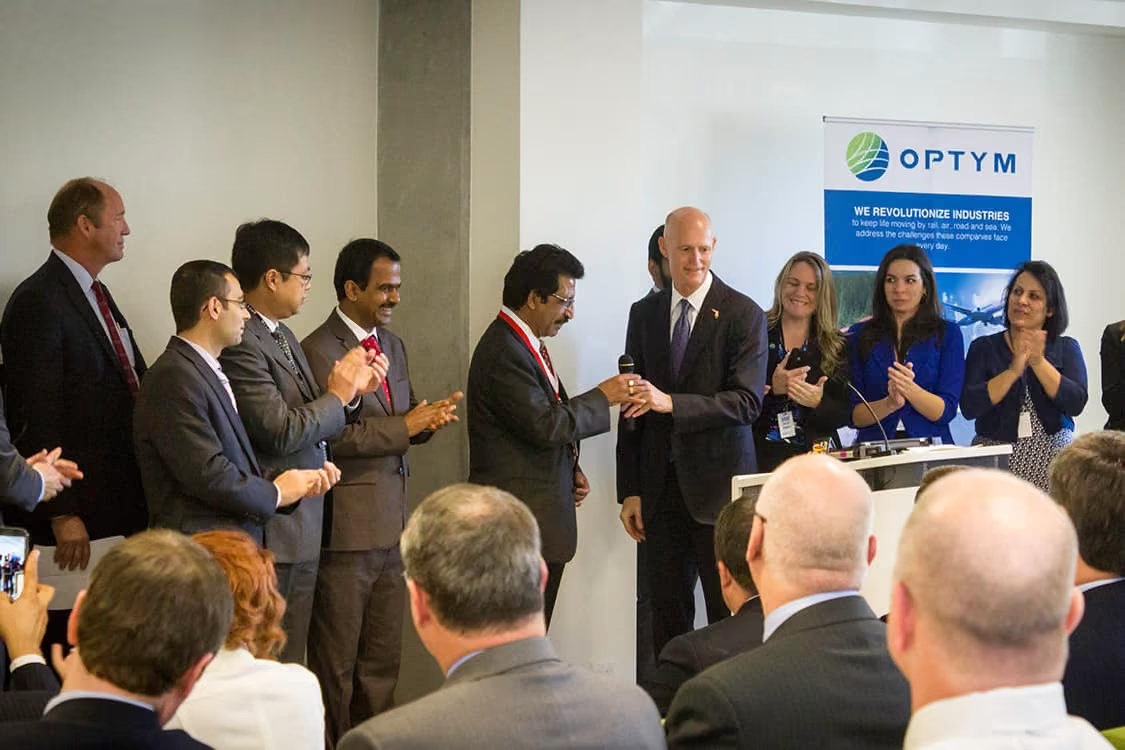
The building had its own small lessons in accommodating real users. Designer Pauline Forgeard-Grignon and creative director Sam Ahuja worked on the layout and features. The facilities included a meditation room and microwaves designated for different dietary needs. These are modest details beside the mathematics, but memorable ones. A workplace is another system whose occupants arrive with requirements; some are easier to express in equations than others.
The company had changed its name to Optym in 2014. Ahuja explained that its expanding work needed a name with room to grow. Innovative Scheduling had been descriptive, but the business now covered planning, simulation and other decision tools. The change recorded a wider scope rather than a new fascination. He was still looking at connected operations, only with more kinds of customer standing at the other end.
The mathematics gets a boarding pass
Southwest Airlines became a partner in 2013, engaging Optym to develop network planning tools. The collaboration produced Sky Suite. Here, the relationships were between flights, aircraft and schedules, with profitability and reliability among the concerns. A decision about one part of an airline’s network could affect the usefulness of another. For a researcher trained to think about connected choices, aviation offered plenty to think about.
Optym and Amadeus worked together for three years before Amadeus acquired the Sky Suite business on January 31, 2020. Southwest, easyJet and LATAM were among the airlines served through their partnership. Amadeus’s financial reporting recorded €36.2 million in cash for the acquisition. The transaction concerned the airline network planning business; Optym continued operating. An academic specialty had become software that another technology company wanted to own and develop.
Ahuja was serving as chief science officer at the time, following Vic Keller’s appointment as CEO. Current Optym materials again identify Ahuja as founder and CEO. The intervening title changes belong in the story because building a company involves more than a permanent nameplate. His work has moved between research leadership and executive responsibility while the products have moved between different parts of transportation.
A company at the family table
One connection is more personal. His son Shaman is Optym’s deputy CEO. The two appeared together on The Bootstrapper’s Guide to Logistics, discussing Ravi’s move from academia into entrepreneurship and the experience of working as father and son. A conversation about a company’s future carries an extra dimension when the person sitting beside the founder also grew up with him.
In a separate interview, Shaman recalled asking his father, while still in high school, which field would allow him to make an impact. Ravi pointed him toward computer science because computers were becoming part of so many industries. Shaman later studied at Carnegie Mellon and worked at Goldman Sachs before joining Optym. The advice connected a broad view of work with a very particular family possibility, though his son first took a route of his own.
When Optym marked its 25th anniversary in 2025, Ravi’s public reflection emphasized clients, partners, colleagues and family. That list is a useful corrective to the solitary picture suggested by a founder’s biography. The book had co-authors. The products had customers and teams. The company’s next generation has its own experience to contribute. Even a career devoted to optimization is full of relationships that cannot be reduced to a single person’s output.
The dispatcher gets the last word
Trucking brought the problem closer to the daily assignment board. Optym developed tools for less-than-truckload networks and expanded into full truckload operations. In this setting, matching a driver to a shipment is one choice inside a larger sequence. The software has to consider the operation as a whole. A useful recommendation also has to make sense to the person who knows the customer, the equipment and the work.
Conceptual illustration of the planning process. No performance figures implied.
Ahuja’s public comments return to the importance of that experience. He has described how quickly an organization notices a late shipment compared with a less obvious assignment that could have been better. His observation is about attention as much as computing. An event with an obvious consequence gets a response. Small decisions can repeat quietly, accumulating costs without becoming anybody’s emergency.
“Our attention is built for the dramatic.”
Ravi Ahuja
That perspective helps explain his interest in ordinary operational improvements. Transportation carries the things people use every day; a modest change, repeated across many movements, can matter. It also explains why a usable interface belongs in the same conversation as a sophisticated algorithm. The recommendation must reach a person, be understood and survive contact with the working day. There is no prize ceremony for that particular sequence. There is simply another decision waiting.
Choosing what to keep
In September 2026, Optym announced that Alvys would acquire its LoadOps customer base. Both companies would support the transition. Optym retained LoadAi and said it would concentrate resources on optimization products. Ahuja described the partnership as a way to focus on the transportation problems the company had been built to solve. After years of adding capabilities, there was another choice to make about where effort belonged.
The announcement gives his long career a current, practical ending, though hardly a final one. A course became research. Research became a book, then software and a business. Along the way came co-authors, students, customers, colleagues and a son with a role in the company’s future. Ahuja is still concerned with how a complicated operation might use what it already has more effectively. The next version of that question will be waiting wherever the trucks go tomorrow.
Follow the connections
Books, conversations and the next chapter.
Optym Company website ↗Ravi Ahuja on LinkedIn Posts & professional profile ↗It’s All Networks Optym University · YouTube ↗Ravi & Shaman Ahuja in conversation The Bootstrapper’s Guide to Logistics ↗Awards and academic recognition INFORMS ↗The September 2026 Alvys partnership FreightWaves reporting ↗Railyard Optimization 2024 chapter with Krishna C. Jha ↗Ravindra K. Ahuja Biographical overview ↗