The expensive thing about an empty truck is that it looks so much like a full one. There is still a driver, a tractor, a trailer, a fuel bill. From the roadside, activity appears indistinguishable from productivity. A transportation planner has to notice the difference before the accountant does.
- Optym builds software that helps freight operators choose routes, loads, schedules and asset assignments.
- Its customers include Saia, Estes and Southeastern Freight Lines. Its roots are in railroad planning.
- The useful trick: model the whole network, then test a change before putting it on the road.
Optym has built a business around this distinction. It sells optimization and simulation software to the people deciding how transportation networks should operate. The question is larger than which road to take. It includes which shipments to combine, which driver can take them, when a trailer should leave, and what that departure does to the rest of the system.
A map will tell you where Dallas is. It will not tell you whether sending a truck there tonight leaves another terminal short tomorrow. That is the territory Optym occupies: the consequences hiding behind a perfectly reasonable individual decision.
01 / When more business becomes a planning problem
In 2023, Yellow’s shutdown sent freight looking for new carriers. For the companies receiving it, the opportunity came with a practical nuisance. The shipments arrived with different origins, destinations and delivery obligations. An increase in volume could change the shape of a network, not merely the number of trucks passing through it.
Saia was already an Optym customer. In Optym’s account of the period, it used HaulPlan to examine freight volumes, load density and network changes; DriverPlan to adjust driver schedules; and RouteMax to organize pickup and delivery. Those jobs belong together. A clever linehaul plan is less useful if the driver schedule cannot support it, or if freight reaches the terminal too late.
Saia, Q2 to Q3 2023, as reported in Optym’s case study. These are carrier results during the disruption, not a controlled measurement of the software’s effect.
The appealing part of this example is its lack of tidiness. Customers changed. Lanes changed. New drivers had to fit into new schedules. Optimization was useful because the planning problem kept moving. Buying more equipment would still have left someone responsible for deciding where it belonged.
“HaulPlan has empowered our planners to easily see the network impact of our decisions.”Jeff Owen · VP of Linehaul, Saia
02 / A professor gives the equation a destination

Optym’s founder, Ravindra K. Ahuja, came to this work through operations research. He coauthored Network Flows, a textbook whose subject is the mathematics of moving things through connected systems. In 2000, he founded the company that began as Innovative Scheduling. The Optym name arrived in 2014.
The early work was with railroads. It is an instructive starting point. Trains share tracks. Locomotives have to be available where they are needed. Maintenance occupies time and space that traffic also wants. A railroad cannot wish these conflicts away; it has to arrange them into a workable plan.
The company later applied related expertise to airline scheduling and trucking. Its history describes a Southwest Airlines development partnership beginning in 2013, alongside the opening of its Bangalore engineering center. Today its work spans road and rail, with the largest engineering team in Bangalore and its headquarters in Dallas.
That background gives Optym a specific position in the crowded conversation about freight AI. Its central task is choosing among constrained alternatives. Simulation lets an operator rehearse a proposal. Optimization searches for a better combination. The new language of AI sits around a much older, stubborn question: what is the best use of the resources available?
Illustrative process, not a product screenshot. A cheap trip must still make sense inside the larger plan.
03 / The rehearsal before the expensive decision
Estes faced a different version of the same problem: adding terminals. Optym’s case study describes a network of 278 terminals and an opportunity to assess more than 120 competitor facilities. A new terminal can shorten one journey and complicate several others. Its value depends on the network around it.
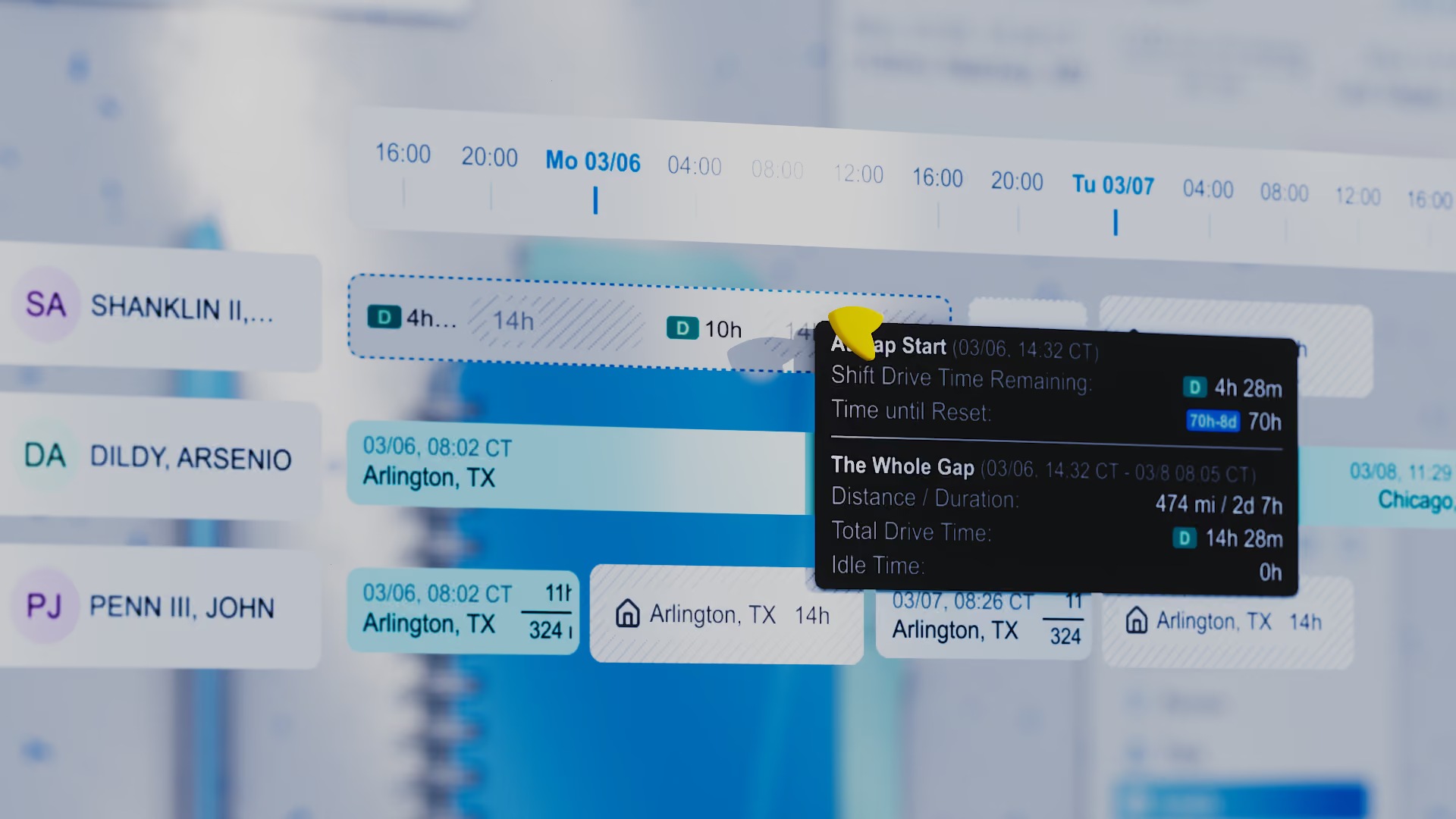
HaulPlan offered two approaches. In evaluation mode, planners could introduce a proposed change into a digital representation of the network and examine freight flows and costs. In recommendation mode, the software could suggest changes and rank their effects. The case study says Estes used HaulPlan and DriverPlan while adding 24 terminals.

There is a useful idea here for anyone responsible for operations. Separate proposing a change from evaluating it. The person enthusiastic about an acquisition should be able to inspect its effects on routes, schedules and costs before enthusiasm becomes a purchase order. A model provides somewhere to argue with a plan while changing it is still cheap.
04 / Small percentages, substantial bills
One of Optym’s more revealing examples concerns Towne Air Freight. Its linehaul plan had grown incrementally with the business, and empty miles were above industry norms. Optym describes rebuilding day-of-week plans with HaulPlan after checking and cleaning the data, calibrating the model, and reviewing its output with the carrier’s planners.
The reported result was more than a two-percent reduction in linehaul costs and more than six-percent additional freight movement without extra hub capacity. Those percentages do not have the theatrical appeal of a tenfold improvement. They do have the attraction of applying to recurring operating costs.
Towne Air Freight’s reported result, alongside >6% more freight moved without additional hub capacity.
The sequence matters as much as the result. Clean the records. Encode the actual rules. Compare recommendations with historical operations. Train the people using them. Incorporate their feedback. A model can propose an elegant solution to the wrong problem; a planner can explain why a seemingly available truck is not available at all.
For a buyer, this means treating implementation as operating work. Integration, data preparation and staff time belong in the cost calculation alongside the software contract. Optym’s truckload evaluation process starts with a free proof of value using two to four weeks of historical TMS data, followed by a results review and a possible live trial. That is an invitation to compare actual freight decisions before making a commitment.
05 / Choosing a load, choosing a business
The products divide the problem into manageable pieces. In LTL, HaulPlan and DriverPlan handle network and driver planning; LiveHaul supports daily linehaul decisions; RouteMax handles pickup and delivery. DockAi addresses cross-dock work. Prysm extracts and validates bill-of-lading data. Rail tools cover service design, train movements, locomotives and maintenance.
For truckload carriers, LoadAi focuses on planning and driver assignment alongside the TMS they already use. That relationship matters. A transportation management system records and coordinates the work. An optimization layer helps decide which work should happen next. A carrier might consider TMS providers such as Trimble or McLeod while also evaluating tools that connect to those systems.
Optym’s own portfolio has moved along that boundary. Amadeus acquired its SkySuite airline network-planning business on January 31, 2020. The buyer’s financial review records €36.2 million in cash. In January 2024, transportation-focused fund Venture 53 announced a strategic investment in Optym.
Then came two closely spaced moves. In August 2026, Optym bought Fleetline’s load-planning platform and customer subscription agreements from Axel AI. The announcement pointed to integration methods and capabilities intended for LoadAi. In September, Alvys announced it would acquire Optym’s LoadOps TMS customer base. Optym said the partnership would let it concentrate resources on optimization.
Read together, the decisions suggest a company choosing where its expertise is most useful. The commercial model remains enterprise software and subscriptions, supported by the configuration and integration needed to make recommendations usable. The operating bet is that carriers will pay for better decisions within their existing workflows.
06 / Give the planner something worth trusting
There are limits to what that bet can deliver. Bad data distorts a model. Missing restrictions make a plan impractical. Driver preferences and service commitments have to survive the search for savings. Historical results can also flatter a system if the comparison ignores what planners knew at the time.
The sensible evaluation uses the same freight, realistic rules and a fair baseline, then tests recommendations in live operations. Measure empty miles, coverage and service together. Ask planners which suggestions they reject and why. A cheaper schedule that routinely needs rescuing has merely moved its costs off the screen.
Optym’s distinctive promise is a place to examine those trade-offs. Its story began with network mathematics and keeps returning to the network, even as the product names change. The truck will still need fuel. The driver will still need to get home. The worthwhile improvement is a plan that takes both facts seriously.