A forklift is an unusually honest introduction to business. It offers few opportunities to disguise a late shipment with an elegant presentation. Raul Villarreal’s introduction to Source Logistics included driving one. In the company’s early days, its founders unloaded trucks and handled the work themselves. Before there was a national network to manage, there were goods to move and customers waiting for them.
Villarreal and his cousin Marcelo Sada started Source in 1999, with a small group of industry colleagues and a 20,000-square-foot warehouse. Their purpose was specific: help Latin American brands build a business in the United States. That meant understanding the products and the people behind them, then doing the practical work required to get those products into a much larger market.
The family connection gives the origin story warmth; the warehouse gives it weight. A cousin may forgive a missed birthday. A customer awaiting inventory tends to be less sentimental. Source grew around trust, consistency and relationships, with the founders close enough to operations to understand what those words cost in daily effort. Villarreal began as chief operating officer, a role he would hold through the company’s long first chapter.
Twenty-five years before the new title
In July 2024, Villarreal became CEO. The promotion followed a quarter-century inside the same business. Sada, previously chief executive, moved to president of corporate development, taking responsibility for acquisitions, new locations and strategic partnerships. The cousins were dividing an expanding job between them, with Villarreal responsible for execution and the relationships that made expansion possible.
The change followed Palladium Equity Partners’ majority investment in November 2023. For a business the founders had financed themselves, it opened a different phase of growth. There was capital available to add facilities and capabilities, and a leadership structure intended to make those additions work. Villarreal’s operational history was central to the arrangement: the executive taking charge had helped construct the business he was now being asked to enlarge.
His official brief includes customers, employees and other stakeholders. He lives in Houston with his family, and his professional biography remains closely tied to Source. It is an unusually continuous career story: co-founder, operating chief, then chief executive, with the same underlying task of helping brands find their way into American distribution.
The year measured in pallets
Villarreal’s account of 2024 came with a useful antidote to corporate vagueness. Source processed more than 2.5 million pallets that year, up 30% from 2023. Two additional buildings contributed 800,000 square feet, bringing its storage footprint to 3 million square feet. Pallets make rather poor cocktail-party conversation. They do, however, establish whether a logistics company’s year was busy.
He also described the less visible preparation: experienced leaders joining the team, changes to technology and processes, and investment across operations. Physical capacity was only part of the work. More space creates room for inventory; a growing organization also needs people and systems capable of keeping track of it.
His phrase for the company’s collaborative character was “a spirit of collaboration and drive.” The modest attraction of that description is its relationship to the numbers. Moving more goods asks more of the people receiving, storing and dispatching them. Villarreal’s year-end message put their contribution alongside the expanded buildings, treating the workforce as part of the explanation for growth.
A border town, a larger bet
The next January brought a 425,000-square-foot facility in Laredo, Texas. Its location near the Colombia Bridge placed it close to an important crossing for trade between Mexico and the United States. The announcement put Source at 14 facilities and more than 3.2 million square feet. For Villarreal, the new building joined infrastructure to the company’s longstanding specialization in Latin American trade.
The customer example was ARCOR. Federico Devalis described Source’s expertise and locations as useful to the brand’s expansion in the United States. It was a concrete illustration of the business Villarreal had been building: a producer seeking more customers, paired with a distribution company investing in the places its goods would need to pass through.
By March 2025, Villarreal was also describing a new Dallas facility and investment in inventory visibility and tracking. Laredo addressed an entry point; Dallas extended the distribution network. Together, they showed how his growth plan connected locations to the work customers needed done. A warehouse can be impressively large and still be inconveniently situated. Geography has a way of editing the sales pitch.
Chicago changes the menu
The acquisition of LaGrou Distribution’s warehousing business, announced in March 2025, widened the assignment. Eight Chicago-area warehouses added more than 2 million square feet and brought refrigerated and frozen storage into Source’s offering. The transaction covered the warehousing business; LaGrou’s other businesses and transportation entities remained with their existing owners.
For Villarreal, this was expansion in capability as well as territory. The company could handle more temperature requirements while extending its Midwest presence. The announcement described a network of 23 locations and more than 5 million square feet, with same-day distribution reach covering over 75% of the U.S. population. Those figures describe the network at that moment, rather than a promise that every order would arrive the day it was placed.
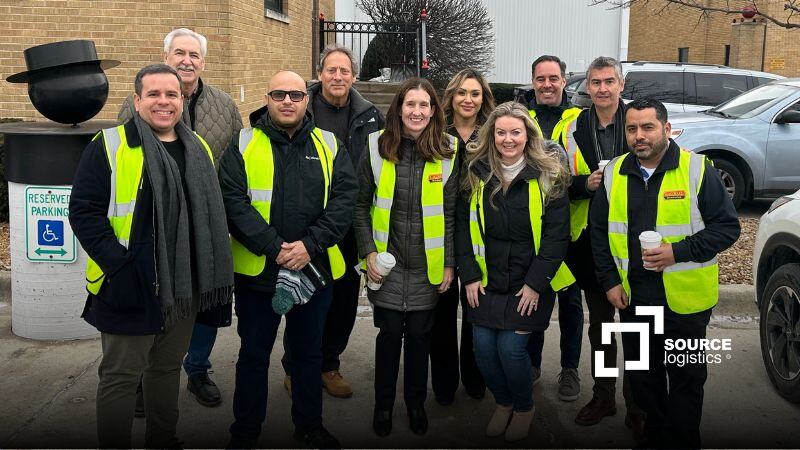
There is a human scale to an acquisition, too. The photograph of the Source and LaGrou group shows people outside a building in bright safety vests. It is an appropriate business uniform for the occasion: whatever the transaction paperwork says, the combined operation ultimately has to function at warehouse level.
A customer needs somewhere to grow
In an April 2025 interview, Villarreal explained his view of the relationship with expanding brands. The logistics partner must be prepared to expand alongside the customer and commit resources to that growth. He described each customer as having distinct challenges, particularly when bringing products from abroad into the United States.
That outlook gives his ambitions a useful customer perspective. More facilities make sense when they provide an expanding brand with somewhere to go next. He set an eventual objective of reaching 95% of the U.S. population through same-day transportation. It was an aspiration for the network, with further geographic work required.
By August 2025, the Southeast remained an expansion priority. Georgia and Florida were logical possibilities, with acquisitions among the options under consideration. Asked about the venture after so many years, Villarreal offered a pleasingly direct answer: “We’re far from tired of this venture.” His career had already supplied evidence of staying power. He was discussing additional territory.
The work after the handshake
A year after welcoming LaGrou, Source described the work of bringing the organizations together. The May 2026 update covered a unified management structure, employees moving onto common personnel systems, and the effort to preserve expertise and customer relationships. For a chief executive with Villarreal’s operating background, these were consequential details.
The account also described transportation coordination through Source Freight, warehouse-management upgrades and improved electronic data exchange with customers. Packing, repacking and preparing goods for retail were part of the expanding service mix. The acquisition had created possibilities; integration was the work of making them useful across the network.
This is where a founder’s long familiarity with the original business meets the demands of a larger one. A shared operating model must carry knowledge between teams while preserving the customer understanding that made those teams valuable. The word integration is compact. The list of tasks beneath it is considerably less so.
His argument begins with the map
Villarreal’s public writing in 2026 gave a clearer account of his broader thinking. In an essay about North American supply chains moving closer to home, he argued that manufacturing geography deserves greater attention. Tracking systems help, but long, dispersed networks still expose companies to delays and interdependence.
He advocated treating regionalization as a network-design decision. Moving production closer to customers requires distribution centers, customs arrangements, carriers and warehousing to fit together. He also called for connected inventory information and the ability to serve retail and direct-to-consumer orders from the same inventory pool.
The argument suits his working history. Villarreal has spent years building the facilities and relationships that such a network requires. His essay puts that experience into a strategic proposition: shorter distances and coordinated operations can reduce the burden placed on contingency plans. A map, in this telling, deserves a place beside the dashboard.
“We’re far from tired of this venture.”
Raul Villarreal · August 2025
The people inside the square footage
In August 2026, Source announced its seventh Inc. 5000 appearance, at No. 2,425, with 136% revenue growth over three years. Villarreal’s response began: “This honor is really about our people.” He connected the recognition to execution, reliability and accountability, continuing the emphasis of his earlier year-end message.
By October, he was making a more specific case for the workforce’s value. Different cultural perspectives, he argued, help teams respond to problems involving delayed goods, retail requirements and cold-chain exceptions. Employees who feel part of the business are more likely to offer ideas. His point concerned everyday decisions under pressure, where familiarity with a customer can matter as much as familiarity with a system.
There is a consistent thread from the founders unloading trucks to Villarreal’s current responsibility for a much larger organization. He wants Source to grow with its customers while preserving the judgment and relationships that helped it begin. The ambition is substantial. Its daily test remains agreeably concrete: somewhere, a customer’s product needs to move.