The first product Al Sharqi Shipping sold was not movement. It was certainty. In August 1989, after more than a decade at United Arab Shipping Company, Muhammad Rafiq opened a small office in Bur Dubai. One administrator and two outdoor field staff helped importers move documents through customs and cargo through the port. The promise was modest and useful: the paperwork would be right, the shipment would move, and someone would answer for it.
That proposition has aged well. A modern shipment may cross an ocean in a standardized steel box, but its journey remains a relay race. A carrier books the space. A broker clears the border. A trucker handles the container. A warehouse receives the inventory. Another team picks orders, and a last-mile network takes them to shops or homes. Every baton pass creates another chance for delay, damage, a missed filing or a customer wondering who is responsible.
Al Sharqi's answer is to own or coordinate more of those handoffs. Today the privately held company combines ocean and air freight forwarding, licensed customs brokerage, an in-house UAE transport operation, warehousing, distribution, trade advice and e-commerce fulfillment. Internationally, it works through agents and partners at major ports, a network the company says reaches roughly 190 countries. Locally, it brings the shipment closer to one operating system and one point of accountability.
A wedge made of paperwork
Customs brokerage is an unusually effective place to learn a customer's business. A broker sees where goods originate, what they are worth, which rules apply, when stock is needed and what happens when a document is wrong. That view naturally reveals adjacent problems. In 1991, Al Sharqi added its own transport division so delivery timing did not end at the customs gate. In 2003, it bought a container side-loader to make loading and unloading quicker at customer premises. The equipment was not glamorous. It solved a recurring wait.
The same pattern appeared in software. Al Sharqi says it was among the early companies to adopt Dubai Customs' Mirsal electronic clearance initiatives. In 2010 it implemented an ERP and connected its offices with online business tools. Technology entered as operating plumbing, not decoration: link the offices, reduce duplicate entry, show inventory, track a shipment, make an online order trigger a warehouse task.
“The adjacent pain point is often the next product.”Al Sharqi's expansion, in one sentence
The company opened its first overseas office in Karachi in 2008 and now lists locations in the UAE, Pakistan and East Africa. Yet its center of gravity remains Dubai, where seaports, airports, free zones and road links compress several trade systems into one city. Geography supplies the opportunity. Customs knowledge and operational control turn it into a service.
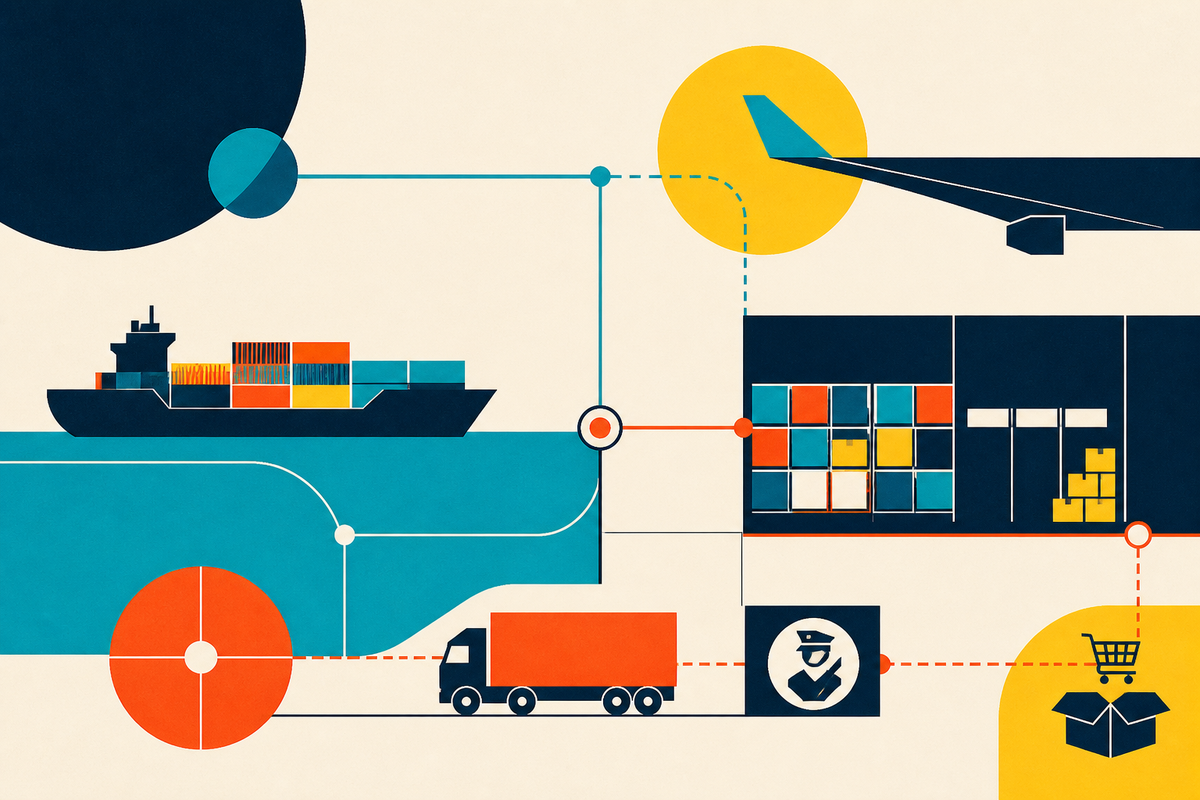
What customers actually buy
For an importer or manufacturer, the basic product is freight plus clearance: choose the route, book capacity, prepare documents, manage arrival and deliver the cargo. For a retailer or distributor, the job can extend through storage, inventory control, store replenishment and reverse logistics. For an e-commerce brand, Al Sharqi offers the steps after the purchase button - receive stock, connect orders, pick, pack, dispatch, deliver and process returns.
That last offer changes the unit of value. A freight forwarder traditionally sells the movement of cartons or containers. A fulfillment operator sells a reliable customer promise. If an online seller enters the UAE, it can avoid leasing a warehouse, hiring an operations team and stitching together couriers before the first order arrives. Costs shift toward storage, activity and shipment charges that can rise and fall with volume.
This is the heart of Al Sharqi's business model. Revenue comes from forwarding, clearance, transport and storage fees, plus longer contract-logistics and fulfillment relationships. Owned capabilities such as UAE transport and warehouse operations sit beside bought carrier capacity and international agent relationships. The result is asset-aware rather than asset-only: control the parts where local execution matters, and use partners where global scale matters.
The difficult cargo is the better test
Integrated logistics becomes more valuable when a shipment carries consequences beyond being late. Pharmaceutical and healthcare goods can require temperature control and precise compliance. High-tech products need secure handling, electrostatic-discharge precautions and careful returns or data destruction. FMCG inventory turns quickly and may involve shelf-life controls. Aircraft parts can be both urgent and awkward. Al Sharqi markets industry programs across these categories, as well as automotive, retail, food, fashion, energy and construction.
The expertise is not a single trick. It is the accumulation of route knowledge, commodity rules, packaging decisions, carrier options and warehouse procedures. Certifications provide some external structure. Al Sharqi lists ISO 9001 for quality management, ISO 14001 for environmental management and ISO 45001 for occupational health and safety, plus HACCP certification for dry foodstuffs. It has also listed FIATA and National Association of Freight and Logistics memberships.
Recognition from shipping lines offers another view of the operation. The company's history records years of top-customer awards from Maersk, CMA CGM and Hyundai Merchant Marine. Al Sharqi announced a Maersk Most Valuable Partner award for 2023 in June 2024, alongside a Maersk ECO Delivery certificate. A trade-event release later reported that the company received the 2024 MVP award in December 2025, marking consecutive recognition.
A regional integrator in a field of giants
Al Sharqi occupies the middle ground between a local broker and a global logistics conglomerate. DHL Global Forwarding, Kuehne+Nagel, DSV, CEVA and DB Schenker bring enormous networks and purchasing power. Aramex, GAC, RSA Global and other regional specialists bring their own Gulf expertise. A customer can also buy directly from carriers and assemble local vendors around them.
Al Sharqi's differentiation is narrower and more grounded: Dubai customs fluency, in-house UAE transportation, a broad service menu and enough technology to keep the pieces visible. Its scale can also make customization easier than it would be inside a global operator built around standardized contracts. The trade-off is straightforward. A regional company must prove that its partner network works as smoothly beyond its home market as its own teams do within it.
The company does not need to own every ship, aircraft or delivery van to make this case. It needs to design the route, choose the right capacity, keep documents and data aligned, and intervene when reality departs from the plan. Freight is full of reality: port congestion, a late supplier, a customs query, a temperature excursion, a sales spike or a return nobody expected.
“Connecting you to growth.”Al Sharqi Shipping's stated ethos
From cost center to growth center
Al Sharqi uses that phrase to describe the ambition for a customer's supply chain. It is most credible in e-commerce and market entry. Better inventory visibility reduces stockouts. Flexible storage absorbs peaks. Fast clearance gets a product on sale sooner. A connected returns process preserves inventory value. None is spectacular alone. Together they let a brand serve a new market without building a logistics company inside itself.
A useful example is a foreign direct-to-consumer brand testing demand in the Gulf. Its first logistics question may sound like a shipping-rate exercise, but the real list grows quickly: who will act as importer, where stock will sit, how online orders reach the warehouse, which carrier handles homes outside Dubai, how duties appear at checkout, and where a returned item goes. Buying each answer separately can be cheaper on one line of a spreadsheet and expensive in management time. Al Sharqi's integrated pitch is that one operating partner can make those choices together, then adjust the mix as orders grow. For a larger manufacturer, the same logic applies at container scale: consolidation, clearance, storage and scheduled distribution are planned around inventory needs rather than treated as unrelated purchases.
The culture visible from the outside mirrors the operating story: privately held, multi-generational and fond of process improvement. Corporate history credits a younger generation of the Rafiq family with taking a larger leadership role around 2015. Careers material describes an innovative logistics environment, while public videos feature employee life and women across the organization. The through line is not disruption. It is a family company learning to add software and specialist skills without losing the habit that won its first customers - staying accountable for the shipment.
That habit is also Al Sharqi's place in the market. It is not the vessel, the airport or the e-commerce storefront. It is the connective tissue among them. Thirty-seven years after a three-person customs office opened in Bur Dubai, the forms still matter. The larger product is everything the company has learned to connect around them.