Myriam Ibañez came for the prices. What kept her was something less easily displayed in a search result. The owner of My Travel Your Travel describes her experience with RateHawk this way: “At first, I chose RateHawk because of the rates, and now I am loyal to the service.” For a business built around hotel inventory, that is a revealing distinction. A cheap room gets attention. What happens after somebody books it determines whether an agent comes back.
- The customer: travel agents, tour operators and travel platforms.
- The offer: wholesale inventory, booking tools and support in one workflow.
- The catch: a large catalogue still needs accurate prices, clear terms and reliable confirmation.
RateHawk launched in 2016 inside Emerging Travel Group, the parent behind ZenHotels and Roundtrip. It occupies a particular place in travel: between the businesses supplying rooms and the professionals selling trips. Travelers may never see its name. Their agent can use its website or app; a larger travel company can connect its own system through an API.
Millions of rooms. One person to convince.
By October 2026, RateHawk advertised more than 3.3 million accommodation options. Its inventory combines external suppliers with directly contracted properties. That distinction matters. An agency gains access to an assembled supply network, rather than negotiating a relationship with every hotel it wants to sell.
The catalogue spans familiar hotels, apartments, guesthouses and campgrounds. Flights, transfers, car rentals and European rail extend the same working environment beyond the room. The attraction is partly administrative: fewer places to search, fewer systems to revisit, and a single workspace for more of the trip.
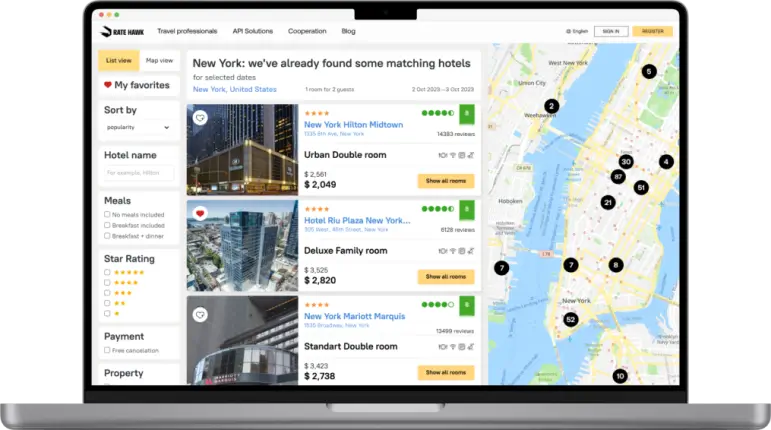
This puts RateHawk alongside B2B distributors such as Hotelbeds, WebBeds and TBO. Counting properties alone makes for a poor buying decision. Agencies need the right rooms in the destinations they sell, at workable prices, under terms they can explain. RateHawk competes with its combination of aggregated supply, direct contracting and tools for the person handling the client relationship.
The agent chooses how to earn
Registration is advertised as free. The commercial choice comes afterward. Under the net model, an agent buys at a net price, adds a markup and manages the customer’s payment. Under the gross model, the booking carries a commission. An agency can choose the arrangement that fits how it sells.
Free entry is useful, but the booking still has to make economic sense. A headline rate cannot tell an agent everything about cancellation conditions or the final price offered to a client. Nor does a free API key eliminate the work of connecting software. RateHawk’s published integration process includes certification before a partner unlocks the API’s benefits.
The more interesting product detail is Quotes. In April 2026, RateHawk added client likes, dislikes and comments, manual ordering of hotel and transfer offers, and direct hotel payments. An agent can put the strongest recommendation first, collect a reaction and let the client book and pay for a hotel from the shared Quote. The hotel-only payment limit is worth remembering.
A booking is a promise with moving parts
Here is where the catalogue meets reality. A rate can change between search and purchase. Availability can disappear. A professional seller needs to know whether the offer still exists when the client says yes.
In its April 2026 ANIXE case study, RateHawk describes introducing Pre-Book, a check of price and availability before final booking. The reported booking success ratio exceeded 93%, with fewer errors. That is a result from this particular collaboration, rather than a platform-wide guarantee. It nevertheless identifies a concrete problem and a concrete intervention: check again before turning a displayed offer into a transaction.
ANIXE collaboration after Pre-Book implementation, April 2026. Partner-specific result.
RateHawk also promotes a pre-check service that reconfirms reservations with hotels, alongside multilingual support around the clock and account managers. These measures address a different moment: after the sale, when the agent needs confidence that the guest is expected. The software transaction and the actual stay are connected by people, policies and several businesses.
Supply has its own bottlenecks. An October 2026 HyperGuest case study described how ETG’s independent-hotel expansion required repeated manual setup, content checks and room mapping. Connecting hotels already configured on HyperGuest reduced that work. The reported technical integration took three to four weeks. It is a reminder that adding properties involves much more than putting names in a database.
“Consolidation is one of our superpowers, I think.”
Astrid Kastberg · Managing Director, RateHawk
Even the bed deserves attention. RateHawk’s second-quarter 2026 API update added more explicit bed types and quantities, including multiple beds per room. That sounds like housekeeping for a database. For an agent comparing accommodation for a family, it is information that can change a recommendation.
The growth is real. Read the labels.
For 2025, Emerging Travel Group reported a 40% rise in RateHawk’s net booking value and more than 110,000 connected travel professionals, up 37%. Its API partner network exceeded 1,400 companies. Those are dated company-reported measures, and they describe different parts of the business.

The parent reported $4.8 billion in gross transaction value for the same year. That number measures travel sold across the group; it cannot be read as RateHawk revenue. Earlier, in July 2019, ETG raised $10 million to support expansion and development. RateHawk then served more than 9,500 travel professionals. The financing belonged to the parent, too.
The room can travel without the brand
On October 19, 2026, RateHawk announced that Agoda would source its hotel inventory through an API. Supply assembled for professional sellers can also travel into somebody else’s marketplace. The agent portal is one route to demand; connectivity supplies another.
There is a useful lesson here for anyone building a business tool. Gather what customers struggle to gather themselves. Let them keep control over how they sell. Then improve the troublesome handoffs: recommendation, payment, confirmation, arrival. RateHawk’s proposition depends on those details working in the markets an agency actually serves. Millions of rooms make an impressive catalogue. One successfully handled trip gives the agent a reason to open it tomorrow.