Imagine being able to fly across an ocean for little more than the applicable taxes and fees, then discovering that the difficult part is arranging a bed at the other end. An airline employee’s holiday can begin with a peculiar bargain: the flight is inexpensive, but the seat is conditional. The hotel, meanwhile, expects a decision. ID90 Travel has built a company in the awkward interval between those two facts.
- Airlines outsource staff ticketing and travel administration.
- Members book private hotel, cruise and car deals.
- Flight access follows employer rules; membership alone will not do.
This is a specific problem, with a surprisingly broad commercial shape. The people who help everyone else travel have an unusual relationship with certainty. Non-revenue travel, usually shortened to non-rev, means flying on a space-available basis. A departure can look promising and still leave someone at the gate. A useful booking service must understand that uncertainty before it starts recommending somewhere lovely to stay.
01A boarding pass with an asterisk
ID90’s roots reach back to founder Tristan Schukraft’s original travel portal, which a Gaingels profile dates to 2000. By 2006, it had evolved into ID90 Technologies, concentrating on e-ticketing. The early resistance was human as much as technical. Schukraft recalled concerns that electronic tickets would remove people’s jobs. His succinct verdict: “It was a struggle.” A simpler transaction could look rather threatening from the other side of the counter.

The company later put consumer booking and airline administration together. In October 2014, it announced a relaunch of its ticketing tools and discount website, reporting more than a million airline segments booked annually. The pitch was straightforward: employees deserved the usability they already expected from ordinary travel sites, while carriers could reduce the internal work required to deliver the perk.
02The holiday business behind the ticketing business
There are two customers here. An airline needs a system that can process staff travel, respect eligibility and manage exceptions. A traveler wants a holiday. ID90 sells contracted software and transaction processing to the first, and operates a members-only travel marketplace for the second. CEO Mike Stacy, who joined in 2011, brought experience from Travelocity and CheapTickets. In a 2017 interview, he described management priorities beginning with “our employees come first.”
That dual operation explains the product range. Staff can arrange travel on their own airline or another participating carrier. Airlines can administer duty trips and vendor travel. Members can shop hotels, cars and cruises. The marketplace extends beyond airline workers to eligible travel-industry employees and retirees, with friends and family entering through invitations. Flights remain a separate entitlement.
Membership is free. The bookings are paid. The company raised a documented $3 million Series B in June 2013, led by Gerbera Capital and Mexico Ventures, with Baroda Ventures and Thayer Ventures participating. That money was earmarked for product development and commercial expansion. It is a financing amount, not a price tag for an airline deployment or a member’s trip.
The attraction of a closed membership group is access to supplier rates withheld from the public. ID90 advertises average cruise savings of more than $800 per cabin and car-rental savings of 10 to 20 percent. Those are company averages, not a promise for a particular departure. A discount deserves the same scrutiny as any other booking: dates, taxes, cancellation conditions and the room or cabin you are actually buying.
03Four phases, one less administrative headache
Allegiant supplies a concrete example of what the enterprise side does. Its internal staff-travel system had become burdensome to maintain; separate workflows complicated employee, buddy-pass and business bookings. In ID90’s account, the airline needed room to support vendor and interline travel too. The pressure point was the administration of an existing benefit.
The rollout proceeded in four stages: employee ticketing, vendor access, configurable program features, then interline agreements. Single sign-on joined the web and app experience. Payment options, prorated guest passes and open enrollment gave the airline controls it could adjust. The sequence matters: replace the daily workflow, then widen what the program can handle.
Company-reported usage. Transactions are not unique travelers.
These figures describe use, rather than simply accounts created. They do not establish a causal improvement in retention. Still, they ask a sensible question of any benefits platform: did people actually use the thing? A beautifully worded employee perk is of limited value if obtaining it becomes another shift’s worth of work.
The mobile work also has a practical history. A March 2021 app update added social sign-on, dark mode and address auto-complete, alongside FLEX, a way for airline peers to exchange flight-load information. Each change addressed a small interruption between intention and booking. Put together, they suggest how much of travel software consists of removing repeated chores from a person already dealing with an unpredictable journey.
04A forecast is useful. A seat is better.
ID90’s Seat Prediction uses historical availability, real-time airline data and current booking trends to estimate flight fullness. Its Hotel Watchlist lets travelers save rooms before flying and book once a seat is confirmed. Both features accommodate the traveler’s timing. They help someone postpone a commitment intelligently, rather than pretend that a tentative flight has become a firm itinerary.
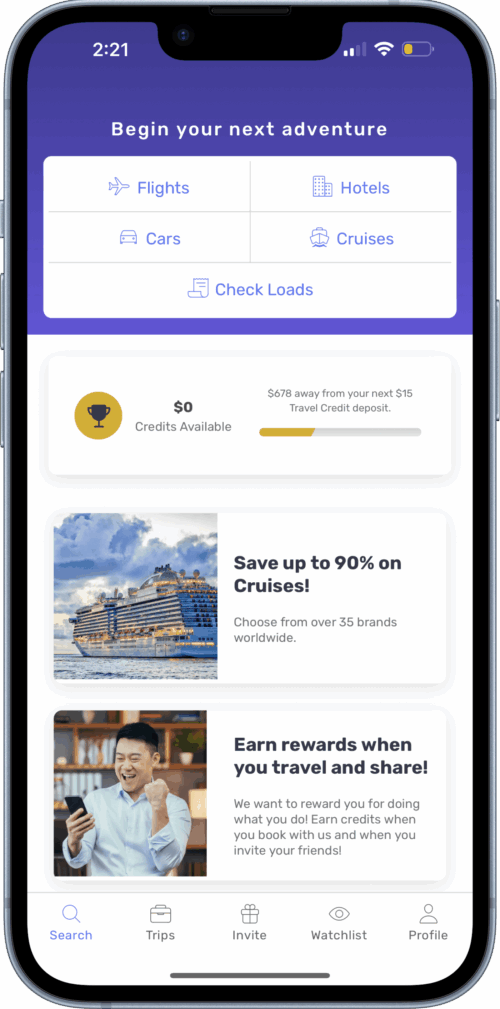
Access has boundaries. Flight booking requires a contractual relationship between ID90 and the employer, plus permission under the airline’s staff-travel policy. A friend invited to hotel deals does not acquire flight privileges. And myIDTravel, despite the confusingly similar name, is an independent company with separate accounts and support. StaffTraveler is another option for peer-supplied flight loads and deals. A member may need several tools, depending on the route, the employer and the particular booking.
The useful feature is the one that understands when you cannot yet make a decision.
05Copy the sequence, not the slogan
There is something to borrow here even if your business has never issued a boarding pass. Start with a customer’s constraint, build around the order in which decisions become possible, and measure completed use. ID90’s referral program follows that logic: the inviter earns a $20 hotel credit after the newcomer completes a stay. A sign-up alone does not trigger the reward.
For travelers, the same logic suggests a practical routine: check eligibility, assess the flight, shortlist rooms, and compare the full booking terms before paying. For employers, outsourcing makes sense when staff-travel administration consumes resources and policy can be expressed in software. Neither route removes the need for flexibility. The gate can still say no. ID90’s opportunity is to make the decisions around that answer less expensive, less scattered and more manageable.