YesPress Profile / Company / Clinical AI
RapidAI
The Stanford-born clinical AI that decided radiology shouldn't keep stroke patients waiting.
San Mateo, CA · founded 2012 · ~270 humans · one very impatient algorithm
The Stanford-born clinical AI that decided radiology shouldn't keep stroke patients waiting.
It is 2:14 in the morning at a community hospital somewhere in rural Texas. A woman in her sixties has been wheeled into the CT scanner because her left side stopped listening to her brain. The slices come out in seconds. Before the on-call radiologist has finished pouring coffee 90 miles away, an alert hits four phones at once - the ER attending, the neurologist, the neurointerventional team, the transfer coordinator. The alert reads: suspected large vessel occlusion - left M1. Attached are the images, color-coded, with the salvageable brain tissue measured in milliliters.
That alert was written by software. The software is called Rapid, made by a company called RapidAI, and on any given week it processes hundreds of thousands of scans like this one. It is, depending on who you ask, the most quietly important AI deployment in medicine - or simply the one nobody likes to talk about because the conversation is uncomfortable.
Every minute of an untreated ischemic stroke kills roughly 1.9 million neurons. The math is unforgiving and the math is the entire industry. For decades, the answer was a 4.5-hour treatment window, then a 6-hour window, then a stack of arguments about who counted as a candidate for thrombectomy. The arguments mostly happened in expensive academic centers. The patients mostly did not.
The bottleneck was never the surgery. It was the read. Every stroke patient produces a CT or MRI that has to be interpreted, then compared, then routed - all while the clock is doing its unsentimental work. The right neurointerventionalist might be a 45-minute helicopter away. The right read might be at the bottom of someone's queue. The right decision might depend on a perfusion map that nobody at this particular hospital has the software to generate.
This was the world. RapidAI looked at it and saw a software problem.
The original code came out of Stanford, where Gregory Albers - a neurology professor who still sees stroke patients - had spent years building perfusion-imaging algorithms that could tell the difference between brain tissue that was dying and brain tissue that was already dead. That distinction sounds academic. It is the difference between a successful intervention and a catastrophic one.
The company was incorporated in 2012 as iSchemaView. The branding, in retrospect, was an act of medical-literature politeness; nobody outside of a vascular neurology fellowship could pronounce it. In February 2020 it became RapidAI - a rename that, with admirable bluntness, told you exactly what the product did and exactly how fast it intended to do it.
The bigger bet came in January 2022, when Karim Karti became CEO. Karti had run a $9 billion imaging division at GE Healthcare. He had then helped scale iRhythm Technologies. He is not, by any reasonable definition, a man who needed another job. He took this one anyway, which is a sentence worth pausing on.
Most clinical AI companies build one model and call it a category. RapidAI built a portfolio because the human body is annoyingly multi-pathology. Below is the lineup. Read it the way a radiologist reads it: by what each one rules out.
First-ever AI cleared to detect both intracranial hemorrhage and large-vessel occlusion from a plain non-contrast CT. The triage tool for hospitals that don't have a stroke team.
Detects large-vessel occlusions on CT angiography and notifies the right phones, fast.
Quantifies salvageable vs. infarcted brain tissue from perfusion imaging - the math behind the 24-hour window.
Automated detection and notification for intracranial bleeds. The other half of the stroke decision tree.
The first neuroimaging product to win FDA CADx clearance. Scores early ischemic change so humans don't have to argue about it.
Detection, measurement, longitudinal tracking. Catches the thing that hasn't ruptured yet.
Flags suspected central pulmonary embolism on CTPA - a different killer, same urgency math.
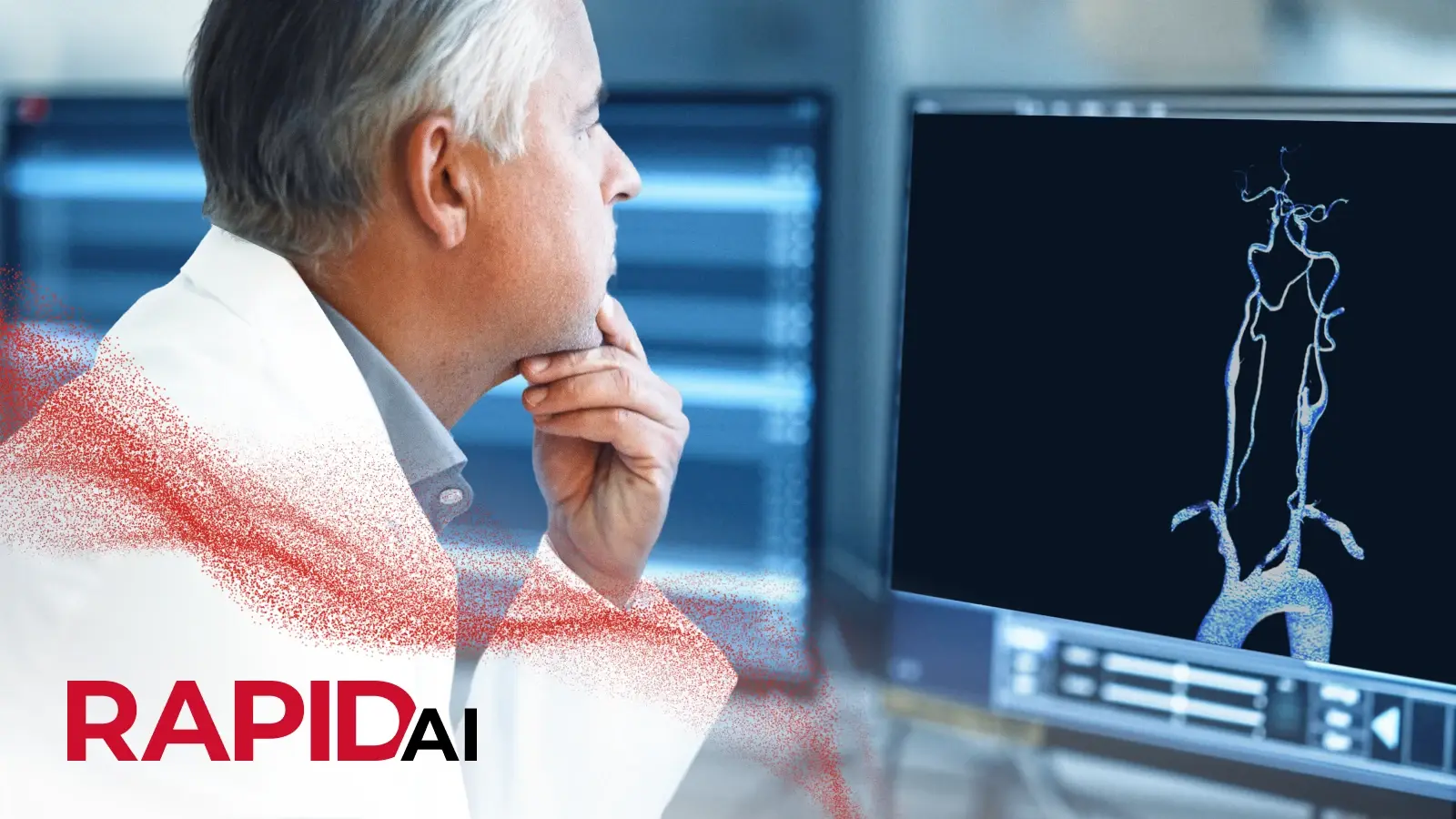
FDA-cleared AI 3D reconstruction of head-and-neck CTAs. Imaging that used to take a technologist now happens while the patient is still on the table.
The story RapidAI tells in sales meetings is not "our model is more accurate than yours." It is "our model has already been validated against the trials that wrote the guidelines you are using." That is a different kind of moat. It is also why the customer list reads like a directory of academic medical centers.
The partnership list is the other tell. Penumbra, the neurovascular-device company, integrates with Rapid for end-to-end stroke workflow. Medtronic and Stryker - the giants of the catheter-and-stent world - sit alongside in the imaging-to-treatment pipeline. This is the kind of company-keeping that signals you are no longer the disruptor; you are the layer everyone else builds against.
RapidAI's public language is heavy on the phrase "deep clinical AI." Pulled apart, it means three specific things. First: the models are trained on real clinical scans, validated in real clinical trials, and reviewed by real clinical regulators. Second: the integration is deep into the hospital's existing workflow - the PACS, the EMR, the on-call pager, the transfer coordinator's spreadsheet - rather than a side application nobody opens. Third, and this is the quiet one: the company has decided not to compete with the doctor.
That last choice matters more than it sounds. Plenty of medical-AI startups have tried to be the diagnosis. The ones that survive tend to be the ones that are content to be the alarm clock - the thing that wakes a human up at the right moment with the right context. Rapid is an alarm clock with a very specific job description: flag the things that kill people in the next hour.
The next few years for RapidAI are not, by the look of it, about a single moonshot model. They are about a list. More disease states - cardiac next, probably. More geographies - Saudi Arabia in late 2025, the rest of the Gulf shortly after. More integration with the catheter companies and the EMR vendors and the stroke-network coordinators. More FDA clearances per year than most labs file in a decade.
This is not the AI narrative the news cycle prefers. There is no chatbot writing poetry, no autonomous agent booking flights. There is, instead, a piece of software that turned a 6-hour clinical window into a 24-hour one and then quietly went looking for the next clock to break.
It is now 2:18 in the morning at that hospital in rural Texas. The patient has been in the scanner for four minutes. The alerts are out. A helicopter is being warmed up 90 miles away. The radiologist is awake now, looking at her phone, and the perfusion map is already loaded. The on-call neurointerventionalist is on speakerphone. The transfer coordinator is filling out the form. Nobody in this room knows the name of the company whose software is making all of this happen at once.
That is, more or less, the whole point.