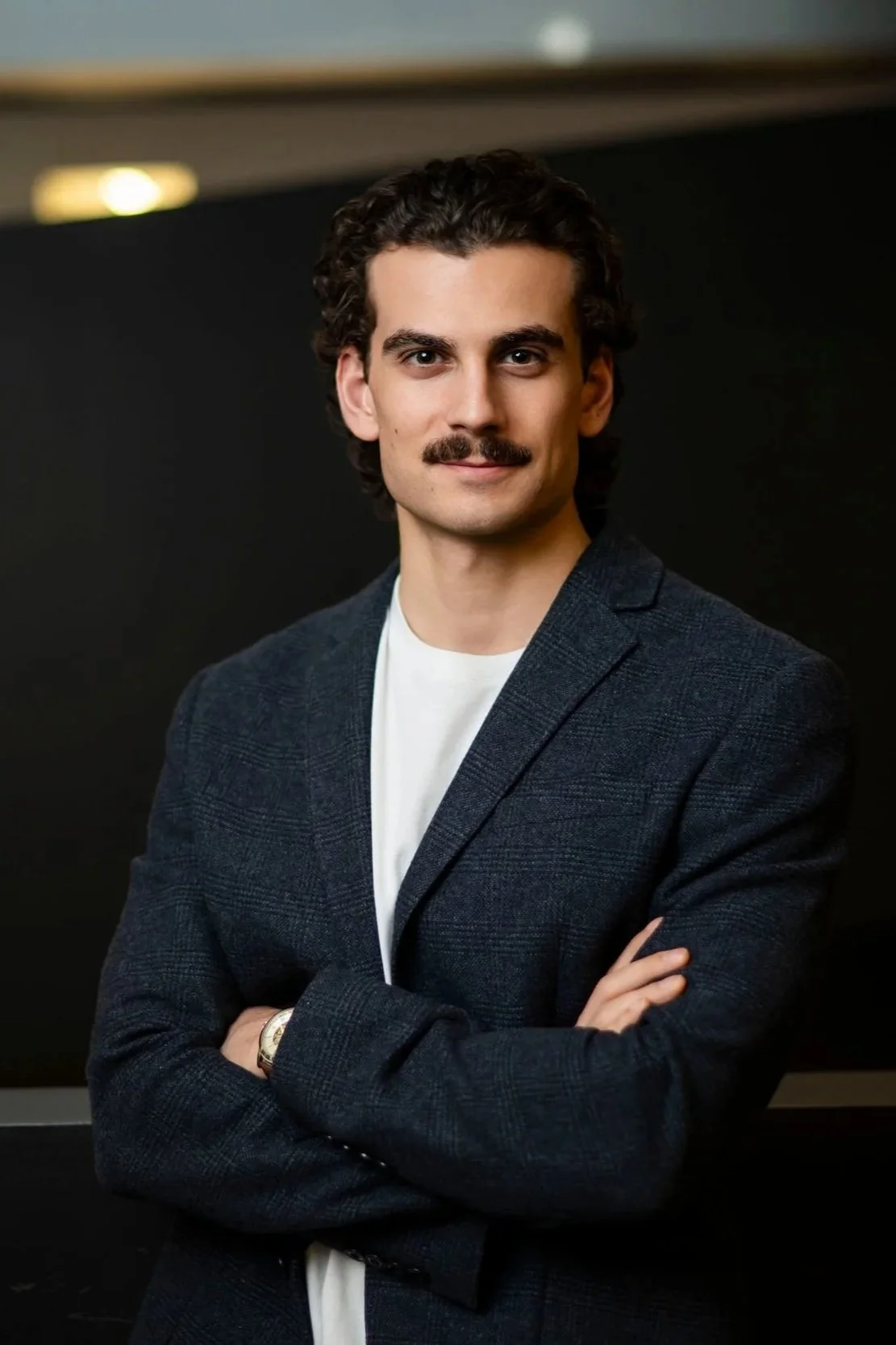
Founder and CEO of Clarity, a Franco-American neurotechnology company building a wearable VR headset that delivers personalized light and sound at gamma frequencies. He turned a master's thesis into a venture-backed company on two continents - before he turned 25.
Most master's theses end in a drawer. Raphael Certain turned his into a company. While studying at the Neurodegenerative Diseases Institute in Bordeaux, he wrote his thesis on a stubborn question: how do you take brain-wave stimulation research, the kind that lives in journals, and translate it into something a real person can use? The answer became Clarity.
Clarity is a Franco-American neurotechnology company, headquartered in two cities that rarely share a time zone gracefully - Paris and San Francisco. Its core product is a wearable virtual-reality headset that delivers personalized light and sound at precise frequencies, built to support and engage the aging brain. The pitch is deceptively simple. The engineering, the neuroscience and the company-building behind it are not.
"Why can we send rockets to space and bring them back, yet still struggle with the aging brain?"
That is the founding question Certain keeps returning to. It is the kind of question that sounds naive until you realize how much work it takes to earn the right to ask it. He earned it the long way - through a childhood lab internship, a marine-biology detour, a year in Quebec, a thesis in Bordeaux and a semester in Silicon Valley.
What makes him unusual is not the science alone. It is that he arrived at it sideways, taught himself the parts nobody assigned him, and then convinced investors, scientists and patients-in-trials to bet on a 20-something with a headset and a thesis.
Clarity's approach is built on a decade of peer-reviewed neuroscience and groundbreaking MIT research. The premise: deliver gentle, rhythmic light and sound at gamma frequency, package it inside an immersive VR experience, and make it comfortable enough that someone will actually keep using it. The number that keeps coming up is 40 Hz.
A wearable VR headset creates a focused, engaging sensory environment.
Personalized pulses of light and sound are delivered at precise gamma frequencies.
The stimulation helps train brain activity toward the targeted rhythm.
Biosensors track engagement and response, feeding a structured neural dataset.
Founder priorities, in his own framing - comfort and engagement matter as much as the science
At 13 he was already in a lab watching scientists study sleep and dreams. Most kids that age are chasing a different kind of screen time.
With no business background, he taught himself entrepreneurship by reading, networking with founders and launching small ventures.
His favorite part of the job is the creative act of turning underused scientific knowledge into something tangible and useful.
Aging grandparents and the universality of brain aging give his work an urgency he doesn't have to manufacture.
Marine biology to neurophysiology, France to Quebec to California - he treats a closed door as a redirect, not a dead end.
Clarity runs across Paris and San Francisco, with a scientific and medical advisory board spanning UCSF, Nottingham, Glasgow and Barcelona.
Before the brain, there was the ocean. He moved to a coastal city at 17 to study marine biology. The pivot to neurons came later.
His bachelor's year in Trois-Rivieres is one he describes as one of the best of his life - cold winters, warm memory.
The X-HEC Entrepreneurs program sent him to UC Berkeley, the on-ramp to building a company with a San Francisco footprint.
He builds in a field he was never formally trained in as a businessperson, learning the company-building craft entirely on the fly.