A rubber mallet is an oddly musical instrument for running a supply chain. Tap the side of a feed bin, listen to the sound and estimate how much is left. Somewhere else, a mill needs that estimate to decide what to manufacture and where to send a truck. The entire arrangement asks a considerable amount of a hammer.
Randall Schwartzentruber encountered this problem while working in automation. A feed mill wanted a warning when a farm’s bin fell below a quarter full. He did what a technically curious person might do: went home and searched Google. Three hours later, the question remained open. An evening’s research had become an invitation to build something.
BinSentry, the company he co-founded with Nathan Hoel in 2017, grew out of that invitation. Its early promise was modest enough to understand without a pitch deck: give the mill dependable information about feed sitting miles away. Getting the information, however, required a device that could live inside the sort of place electronics generally prefer to avoid.
There is a particular appeal to Schwartzentruber’s route into entrepreneurship. He had already worked in a church, a cheese factory and home automation before feed bins became his occupation. The sequence makes sense when viewed through the work itself: noticing a routine task, wondering why it requires so much effort, and trying to make the next attempt easier.
A childhood friend, a difficult room for electronics
Raised in Haysville, near New Hamburg in Ontario, Schwartzentruber spent time on his grandfather’s farm. He liked Lego and taking apart machines that had stopped working. Later came studies at Emmanuel Bible College and nearly a decade in youth ministry at The Gathering in Kitchener. Factory shifts in Tavistock helped support that work. In 2014, he moved into smart home automation.
The ministry years also supplied a connection that would matter later. Hoel was a childhood church friend and a software architect. Schwartzentruber invited him into the venture; Hoel initially declined, then reconsidered two months later. Their shared values came with different ways of approaching a problem. It was an unusually useful combination for a business facing both electronics and human habits.
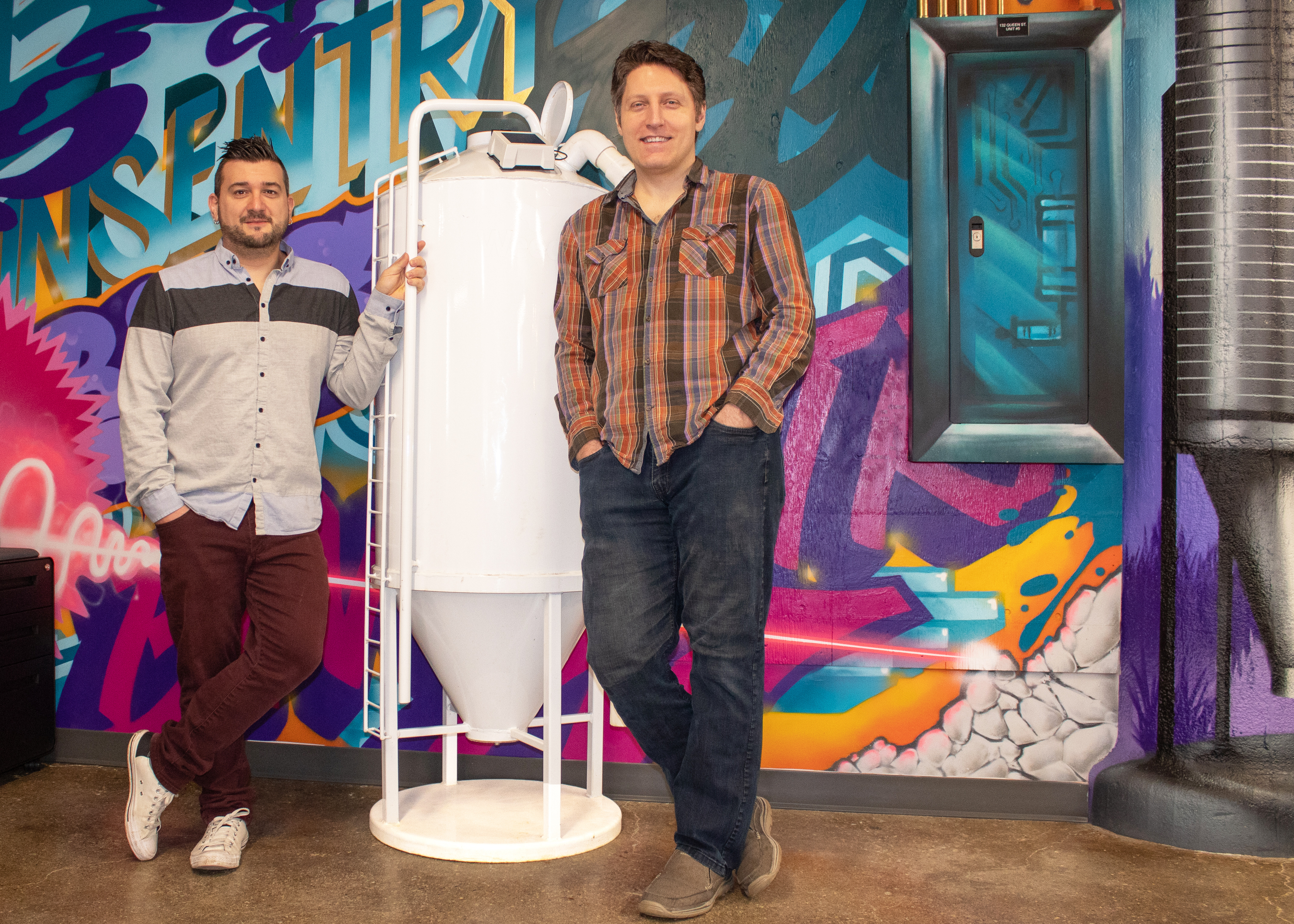
The feed bin was a demanding test chamber. Dust could defeat a sensor. Feed settled into uneven shapes, so a reading at one point could give the wrong impression of the whole pile. A device could produce a tidy number and still leave a mill with an untidy delivery problem. Schwartzentruber’s experiments had to survive both the environment and the geometry.
His early work involved trying available sensing technologies before developing a self-cleaning LiDAR approach. Later, BinSentry worked with INO on a machine-vision 3D sensor capable of mapping the bin interior. The progression tells you something about the job: measuring distance is one task; understanding what that distance means inside an irregular pile is another.
The customer bought the answer
Schwartzentruber took his developing idea to a poultry convention and spoke with feed-mill representatives. Their response encouraged him to ask his employer for time to refine it. That leave became a departure. Wallenstein Feed emerged as an early customer and supporter, giving the venture a practical setting in which to prove the idea.
What he was selling had to stretch beyond a clever piece of hardware. In a 2020 interview, he described a subscription priced by the number of bins monitored. The service included installation, connectivity and maintenance. Customers would see forecasts of days until empty, receive notifications and use an order calculator to plan deliveries. A sensor produced readings; the customer needed decisions.
That distinction shaped the relationship. Owning another gadget would mean acquiring another obligation: installation, upkeep, replacement and the possibility of discovering that nobody knew how to fix it. BinSentry offered to take those obligations on. Schwartzentruber’s argument was that customers should get reliable information without having to become hardware specialists themselves.
The service model also put a practical burden on the company. A subscription keeps returning to the same question: is the information useful enough to keep paying for? For a founder, this makes the unglamorous work part of the product. A functioning dashboard depends on a functioning device, a functioning connection and a customer who can do something with the result.
A farm has no patience for a missing signal
In the early system described by connectivity supplier Digi, a battery-powered, solar-assisted monitor sent data six times a day. The transmission was brief, conserving power. A backup battery could carry it through a prolonged loss of solar charging. The design sought to remove the need for separate farm power or an existing internet connection.
Cellular flexibility mattered too. Schwartzentruber valued being able to change communication technologies without redesigning the entire device. For a company hoping to move across regions, the network was part of the machinery. A sensor can be perfectly capable of measuring a bin and perfectly incapable of telling anybody what it measured.
As deployments spread, managing carriers became a separate operational problem. KORE’s account describes BinSentry consolidating that work through eSIMs and a connectivity platform. Over-the-air provisioning could reduce the need to visit a device simply to change its SIM. The useful innovation here was largely invisible to the person looking at a feed forecast.
These details help explain the founder’s increasingly broad view of the business. The original question concerned the contents of a container. Answering it reliably drew in batteries, optics, wireless coverage, software, installation and service. Each layer had its own way of interrupting a perfectly sensible idea. The bin, inconveniently, did not care which layer was responsible.
An award is useful when a mill remembers it
In September 2019, BinSentry was one of two winners of the THRIVE Midwest Challenge and received a THRIVE-Forbes Innovation Icon Award at the Forbes AgTech Summit in Indianapolis. For Schwartzentruber, the recognition had a specific commercial use: it could introduce the company’s reputation to potential customers beyond Ontario.
The prize package included a $100,000 investment from SVG Ventures and a place in the next THRIVE accelerator cohort. At the time, the company had ten full-time employees. This was a small team attempting to persuade an established industry to trust a new measurement system. A respected introduction could help open a door; the device still had to work once installed.
The financing grew with the ambition. In 2020, BinSentry closed a US$7.7 million Series A led by Lewis & Clark AgriFood, with participation from BDC Capital’s Industrial Innovation Venture Fund. The money was intended to develop the product and support international expansion. A US$1.6 million seed round had preceded it in 2018.
Capital offered the chance to turn an invention into a repeatable service. It also raised the stakes of the original promise. More deployments meant more places where a missed reading could matter. Schwartzentruber’s business was acquiring the familiar demands of a growing technology company while remaining attached to a very physical transaction: a truck arriving with feed.
The people on either side of the dashboard
By 2022, his writing showed how much attention had moved toward the people using the data. In an interview he conducted with former Belstra Milling business analytics manager George Slater, the questions concerned interpretation, coordination and action. Slater described how sensor information helped the business project feed demand 24 to 72 hours ahead.
The exchange also made room for the work after installation. Someone has to learn the tool, understand the numbers and take responsibility for changing a process. Departments need to understand one another’s constraints. This is a particularly human complication for an automation business: better information becomes valuable when people decide how to use it together.
Schwartzentruber’s own July 2022 essay argued for technology that removes tedious tasks and supports agricultural workers. He described customers as partners who could guide the next useful product. His recollection of his grandfather’s dairy farm stressed hard work, creativity and looking out for other people. Those were the qualities he wanted to bring into the company’s relationships.
His ambitions extended to employees eventually creating businesses of their own. The former youth minister saw mentoring as a continuation of his Christian commitments and wanted to pass along the help he had received. That gives his idea of growth a personal dimension: the company could develop people who might one day carry their skills elsewhere.
“Personally, I cannot wait to have the opportunity to pay that forward.”Randall Schwartzentruber, on mentoring entrepreneurs, 2021
Leaving the CEO chair for the workbench
On July 27, 2022, BinSentry announced Ben Allen as its new CEO. Schwartzentruber would move into the chief product officer role. The change put a different kind of experience at the head of the company and directed the co-founder’s attention toward building products. His public explanation emphasized the value of assembling a capable team.
“It’s the right time for a change,” he said. In the same announcement, he described agriculture as a community close to his heart. The transition fits the interests visible throughout his career: finding a technical problem, working with people who bring different skills and staying close to the process of making something useful.
The company continued to grow after the handoff. In August 2025, it announced a US$50 million Series C led by Lead Edge Capital. At that point, BinSentry reported monitoring more than 40,000 bins across North America and Brazil, with customers including Cargill, Wayne-Sanderson Farms and Hanor. These are milestones for the company he helped start, under its subsequent leadership.
The distance between that scale and an evening spent searching for a sensor is considerable. Yet the original problem remains easy to picture: feed inside a metal bin, somebody who needs to know how much, and a delivery that will be better planned if they do. Schwartzentruber made a career out of taking that small question seriously. The hammer had enjoyed a long run.