The least glamorous gauge in agriculture may also be one of the most useful. Feed mills know what leaves their plants. Farmers know what their animals eat. Between them stand thousands of metal bins whose contents have long been estimated with a rubber mallet, a ladder, a sight glass or a hopeful spreadsheet. The method is primitive because the material is unruly: feed forms slopes, peaks and hollow channels called rat-holes. Look at one spot and you may be precisely wrong.
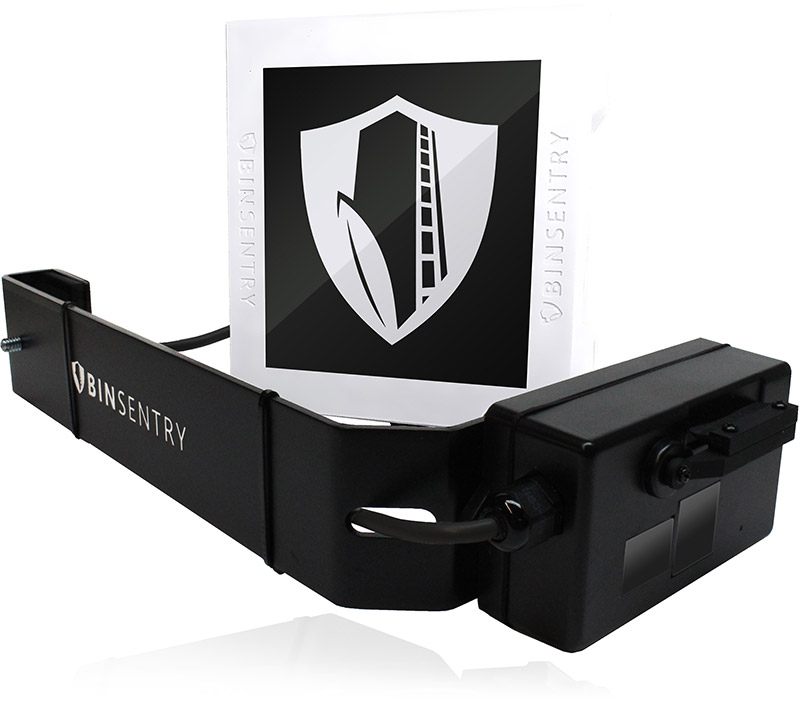
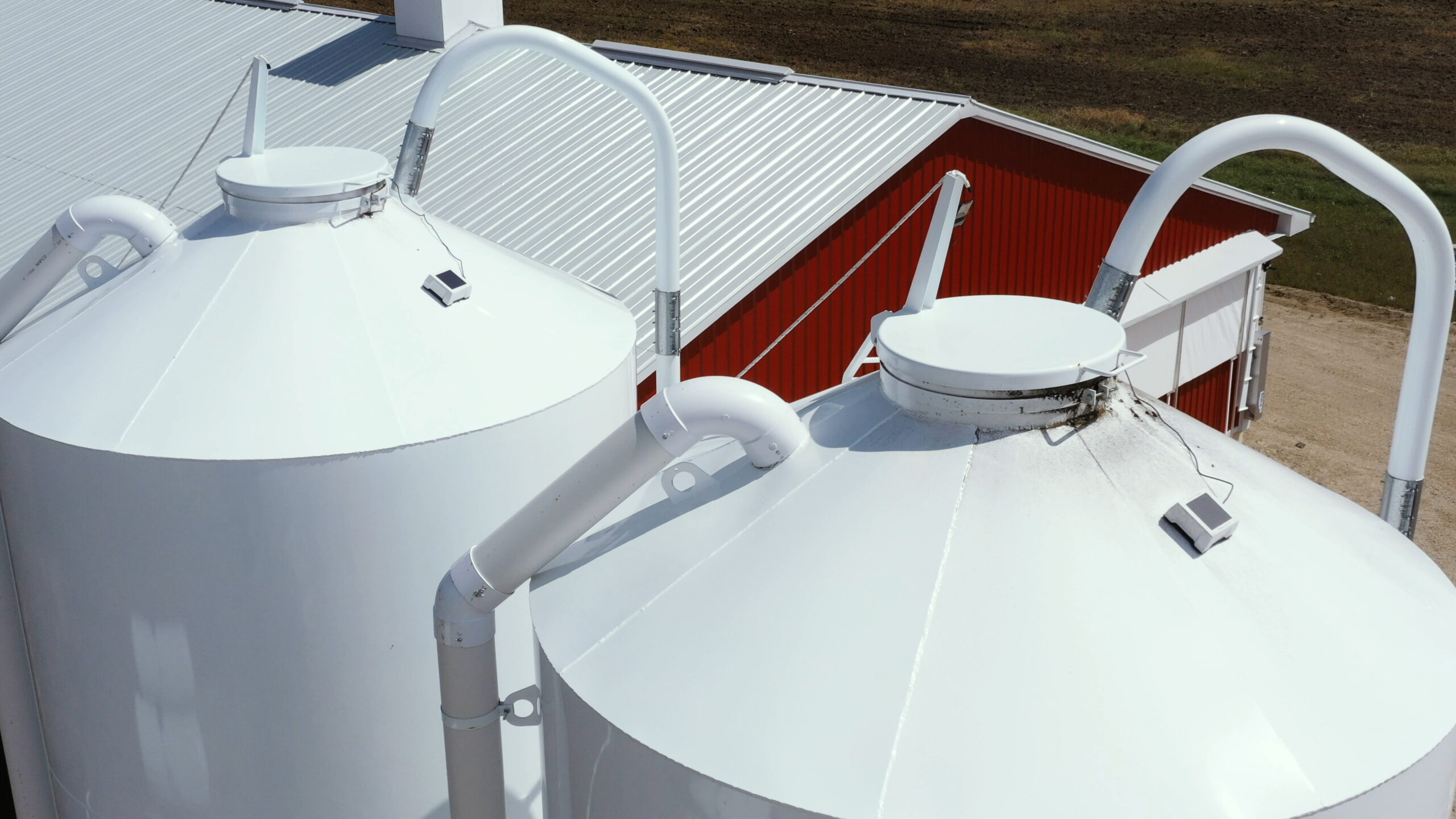
BinSentry built a business in that blind spot. Its hardware sits above a feed bin or commercial silo and uses optical machine vision to map the surface below. Its software converts the shape into inventory, follows consumption, predicts when the bin will empty, flags odd behavior and helps schedule the next order. The pitch is not “put AI on a farm.” It is more concrete: stop climbing, stop guessing and stop sending half-full trucks on emergency runs.
The question that fell into their lap
The company did not begin with a founder nursing a lifelong grievance. Co-founder and CTO Nathan Hoel has said the idea arrived through a farmer who asked someone in home automation whether a bin’s contents could be measured automatically. The team assumed the answer would be easy to find online. Existing technologies, they discovered, did pieces of the job but not the whole thing.
At an industry conference, the would-be founders peppered Wallenstein Feed and Supply with questions. The local feed company turned the interrogation around: did they have a solution? Before the team could properly answer, the prospective customer said it would buy thousands. This is the useful part of the origin myth. BinSentry did not polish a clever sensor and then hunt for relevance. A credible buyer exposed the pain and signaled scale before the product was ready.
“If you do, we will buy thousands of them.”Wallenstein Feed and Supply, as recalled by co-founder Nathan Hoel

The first cost was personal. Hoel had four children when he left a regular job to start the company. The first technical failure was the industry’s obvious shortcut: a single-point distance reading. Because feed is not a flat liquid, one beam cannot reliably infer the whole volume. Load cells can be accurate but are expensive and intrusive. Other methods need power, modifications or frequent attention. BinSentry’s answer became a non-contact, solar-powered, self-cleaning device designed to install in roughly 15 minutes and communicate over low-power cellular networks.
The hardware earns permission
BinSentry says its 3D sensor samples more than 9,000 points on the feed surface, including around rat-holes, and its on-farm system has reached roughly 99 percent accuracy. Early versions used time-of-flight or LiDAR sensing. Before the models could interpret bins reliably, developers and engineers manually reviewed tens of thousands of images. That dull, expensive labeling work is what makes the AI claim credible. The machine is doing a narrow job whose mistakes can be checked against deliveries, consumption and physical inventory.
The sensor, however, is merely the right to participate in the workflow. ProSense Feed turns readings into mobile dashboards, forecasts, feeding plans, late-order alerts and automated order management. Critical Event Management watches for empty bins and mismanaged slides. ProSense HD extends the method into ingredient bins and commercial silos as deep as 150 feet, with readings every five minutes. Control Tower, launched in 2026, gives a mill one screen for inventory, capacity and activity.
That progression matters. A point solution tells a manager what is in a bin. A system of record can tell the mill what to make, the dispatcher what to haul and the producer when an animal group’s consumption has changed. BinSentry found that more than 70 percent of the out-of-feed problems in its 2024 data came from slide management, not an empty supply. In other words, measurement uncovered a different failure than operators expected.
The customer they declined
The strategic turn came from saying no. CEO Ben Allen has described walking away from selling directly to individual farmers, even when inbound interest existed. The economics of acquiring and serving geographically scattered sole proprietors had disappointed him in an earlier business. BinSentry instead focused on enterprise feed mills, integrators and large protein producers. In the United States, that left an unusually small addressable list - Allen has put it at roughly 200 meaningful companies - but each buyer could deploy across thousands of bins.
This changed the product and the sales language. Large agricultural companies do not buy startup theater. They buy reliability, support, security, compatibility and an outcome that will not injure an executive’s career. BinSentry stopped treating speed and novelty as the headline. It sold fewer outages, fuller trucks, lower reclaim, better feed conversion and safer employees. The product arrived as a managed service, with hardware, connectivity, maintenance and software bundled into a recurring subscription.
Company-reported milestones. The 2019 figure refers to installed sensors; later figures use monitored assets or installed systems.
The published pricing is deliberately incomplete. BinSentry’s FAQ lists a $79 per-bin sensor installation fee and says monthly subscriptions vary with volume. Customers cannot simply buy the sensor. During an agreement, service and a lifetime warranty are bundled. The omission of a public monthly rate signals negotiated enterprise deployments, not a self-serve farm gadget.
Distribution is part of the machine
Cargill began distributing BinSentry in North America in 2020, pairing bin readings with its Nutrition Cloud. In 2025 the companies formalized an exclusive distribution arrangement in Brazil. BinSentry adapted the product to Wi-Fi for regions where cellular coverage was inconsistent and officially launched there in early 2026. Soracom and KORE have supplied the less photogenic but essential layer: multi-carrier connectivity for remote devices.
The company also publishes integrations with Format Solutions, MTech Systems, Agriness and Boehringer Ingelheim, among others. Trouw Nutrition Canada tested the system at selected facilities, reported fewer disruptions and better coordination, then expanded it nationwide in 2026. That pilot-to-fleet pattern is the commercial engine: prove one operational saving, then spread across facilities.
Capital followed the deployments. A $7.7 million Series A in 2020 was led by Lewis & Clark AgriFood. Spring Mountain Capital led a $15 million financing announced in 2024. Lead Edge Capital led a $50 million Series C in August 2025, when BinSentry reported 100 percent year-over-year growth and no customer churn. CIBC Innovation Banking supplied another $25 million in debt financing that December. Add a reported $1.6 million seed round, and disclosed funding approaches $100 million.
“AI is real, but you need to be thoughtful about how you apply it. Not everything needs to be solved with AI.”Nathan Hoel, co-founder and CTO
What operators can actually do
A feed-mill manager can see how much product every farm bin will accept before assigning a truck. A producer can schedule several days of orders against forecast consumption. A dispatcher can avoid sending a partial load that will not fit. A livestock team can receive an alert when consumption flatlines or when two slides remain open. A commercial mill can watch ingredient shortages, finished-goods capacity and bin activity from the same screen.
The results depend on context. BinSentry cites an average six-times return in poultry and swine and a three-times monthly return for ProSense HD, plus examples of savings from shrink, demurrage, labor and outage prevention. Those are company figures, not guarantees. The strongest economics belong to multi-site operations where emergency loads, manual checks, inaccurate deliveries and outages already have measurable costs. A farm with a handful of bins, simple routes and reliable visual checks may not save enough to justify an enterprise service.
What a builder can copy
- Find a job that is dangerous, frequent and attached to an expensive downstream decision.
- Use hardware to collect proprietary data, then sell the workflow and outcome around it.
- Let a committed buyer shape the minimum useful product before chasing polish.
- Choose the customer whose fleet makes support and sales economics work.
- Expand only after the first measurement earns operational trust.
The approach also fails when the organization treats the dashboard as decoration. Accurate inventory cannot fix a dispatcher who ignores the forecast, a barn team that leaves a slide closed or a mill whose systems cannot exchange order data. Rural connectivity still matters, even with multi-carrier and Wi-Fi options. Dust, geometry and product differences demand calibration. Most of all, enterprise adoption moves slowly. As BinSentry CFO Ben Van Straten puts it, change in agriculture happens at the speed of trust.
BinSentry’s place in the market is therefore narrower and more interesting than “smart farming.” It is hardware-enabled enterprise software for a physical supply chain. Its competitors are sensor makers and feed platforms, but also the mallet, the ladder and the spreadsheet. The moat begins with seeing the bin accurately. It widens with years of consumption histories, integrations and the institutional habit of checking BinSentry before making feed.
A fuel gauge sounds inevitable only after someone has made it work. The company that began in a rented New Hamburg garage now says it analyzes 151 billion measurements a day with a team of more than 120. The original question remains refreshingly small: what is inside this bin? The business grew because the answer changes what happens next.