A cash office is an unlikely place to begin a story about artificial intelligence. It is, however, a useful place to begin a story about Ramesh Lokre. Before he became the co-founder and CEO of Saicon, he worked in Walmart’s Information Systems division on cash-office automation and point-of-sale implementation. Software there had an unromantic assignment: help an enormous retail operation function. The checkout line offers a fairly direct review of a computer system. Nobody in it has come to admire the architecture.
Years later, Lokre is talking about a different kind of technical work: engineers embedded with customers, helping turn AI experiments into operating systems for a business. The distance between the two assignments is considerable in technology and rather shorter in purpose. Both place software close to an everyday operation. Both invite an awkward question once the installation is complete: does this actually help the people using it?
Between those chapters sits Saicon, founded in 1998 in Overland Park, Kansas. Lokre built it alongside co-founder and president Swati Yelmar. The company’s expansion now reaches across American staffing markets and Indian engineering centres. To follow his career is to follow the practical business of bringing technical expertise closer to a customer, then working out what that proximity ought to accomplish.
A mathematician encounters the cash register
Lokre’s education combines two disciplines with different ways of checking an answer. He earned a master’s degree at the Indian Institute of Technology Bombay and an MBA in Finance at the University of Pune. IIT Bombay’s Director’s Circle lists him under the 1984 class with a mathematics qualification. Mathematics, finance and enterprise software make a reasonably coherent collection: each involves relationships between parts, and each can punish a small error with an unexpectedly large consequence.
His early professional work took him to iGate Global, where he worked on the design, development, implementation and management of large software projects for Fortune 500 businesses. Walmart followed. Later, as a senior ERP consultant at Capgemini, he worked on enterprise resource planning implementations. These were assignments inside established organisations, with existing processes and obligations. The software had to join a business already in motion.
That sequence gives his later interest in implementation some texture. Enterprise technology rarely arrives on an empty stage. It meets an accounting routine, a store operation, a purchasing decision, an employee with a job to finish. Lokre’s career passed through those settings before he became responsible for building a company of his own. The operational setting belongs near the beginning of his story because it keeps reappearing.
The map starts in Kansas
Overland Park remains Lokre’s public professional base. It also gives the Saicon story a particular geography: a Kansas company assembling a business across the United States and India. His leadership responsibilities have included internal expansion, alliances, joint ventures and acquisitions. Saicon’s history has consequently involved both building capabilities within the organisation and bringing existing teams into it.
In August 2022, Lokre announced Saicon’s acquisition of netPolarity, a staffing, consulting and services business headquartered in Campbell, California. The location mattered. It increased Saicon’s presence in Silicon Valley and advanced a coast-to-coast ambition. He described opportunities for associates as well as clients, and set out a revenue aspiration of $100 million. That figure was a goal in his announcement, a useful distinction when reading a founder’s account of expansion.
His language in that announcement tied scale to technology and the ability to serve customers across a wider area. The underlying transaction was concrete: a Kansas-based organisation adding a Bay Area business. Corporate geography can sound abstract until a client needs someone nearby, or an associate needs a new assignment. Acquisitions change the places where those conversations can happen.
“We’re building an organization that will serve clients coast-to-coast”
Ramesh Lokre, announcing the netPolarity acquisition, 2022
New Jersey brings its relationships
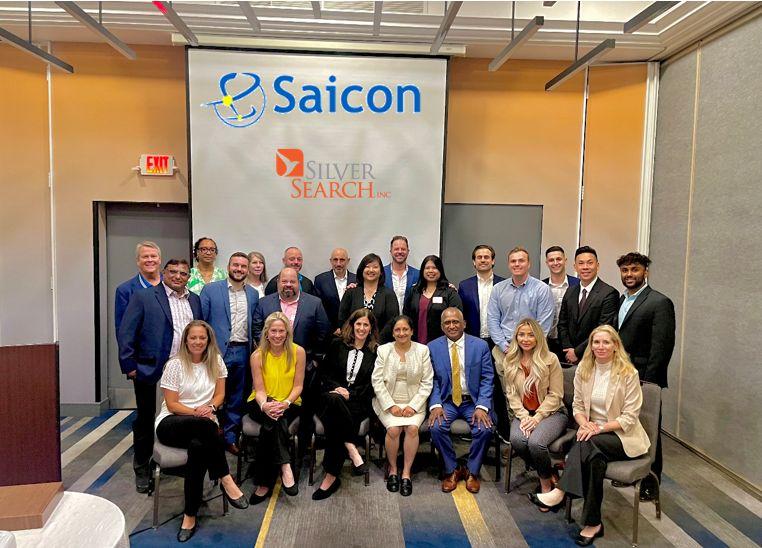
The next chapter has a particularly human detail. When Saicon acquired SilverSearch in 2025, Lokre met Alisa Silverberg and her team. His welcome focused on their culture, experience and client partnerships. A photograph from the gathering shows the combined group beneath a banner bearing both company names. It is the familiar ceremonial problem of every office photograph: persuading the standing row and the seated row to belong in the same frame.
The business fit was equally specific. SilverSearch, founded by Silverberg in 2000, brought a New Jersey base, established direct customer relationships and a contract-staffing operation. Saicon brought recruiting infrastructure. The sale was announced on June 30, 2025, with Momentum Advisory Partners advising SilverSearch. Financial terms were undisclosed.
Silverberg’s account of choosing a buyer emphasised finding someone who valued the business as a whole. Lokre, in turn, credited the adviser’s constructive work in completing the deal. Those are revealing details about this transaction: the appeal included the organisation already built, its customer connections and the people who maintained them. A staffing company’s relationships travel with people. An acquisition agreement can transfer ownership in a day; the working relationships still require attention afterward.
Nagpur adds engineering depth
In October 2025, Lokre announced another acquisition, this time of Valethi Technologies in India. Valethi brought more than 500 professionals and operations in Nagpur and Noida. Its capabilities included software development, cloud, AI, data analytics, quality assurance and enterprise technology. Saicon’s announcement put its combined workforce above 1,500 people.
Lokre travelled with colleagues including Yelmar, Saicon India CEO Uday Inamdar and senior vice president Raj Cherukumudi to meet Valethi CEO Rajeshwar Nagle and the team in Nagpur. Here, the geographic expansion added engineering capacity across several technical disciplines. The American customer footprint and Indian delivery operations were becoming a more substantial combination.
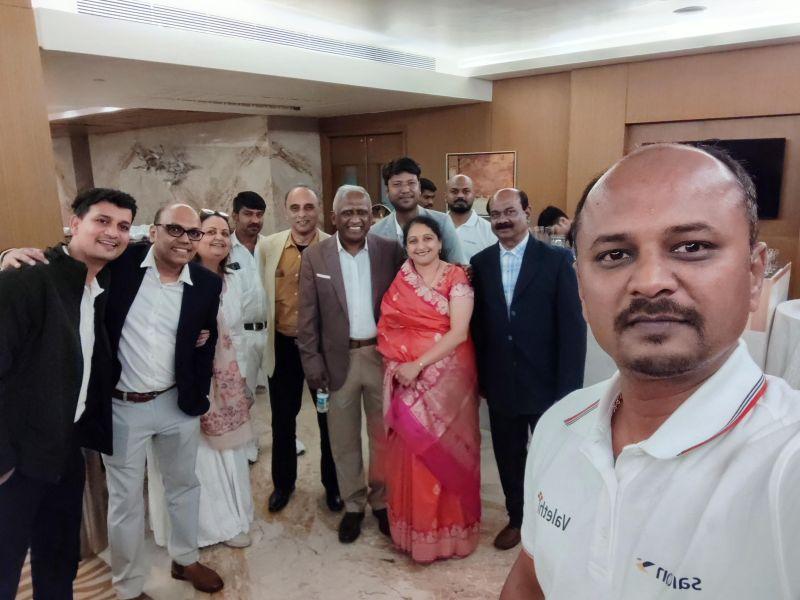
By December, the relationship had another occasion on the calendar: a management gathering at the Radisson Blu in Nagpur. Inamdar described Lokre speaking about opportunities in the coming year and how Valethi could deliver value. The photographs put faces around a transaction previously expressed in capabilities and headcount. These gatherings are part of the work of combination, even if they rarely fit neatly into an acquisition’s financial model.
- 2022netPolarityCalifornia · US presence
- Jun 2025SilverSearchNew Jersey · Client relationships
- Oct 2025ValethiIndia · Engineering capacity
- Jul 2026PragmatycIndia · Enterprise AI & AIoT
A return to Vidarbha, with AI on the agenda
Saicon added Nagpur-based Pragmatyc in 2026, extending its capabilities in enterprise AI, connected technologies, intelligent automation and digital engineering. For Lokre, described as an entrepreneur from Vidarbha, the geography gave the transaction a connection to his own region of origin. Nagpur was becoming a repeated destination on Saicon’s expansion map.
The July announcement described a business serving more than 80 customers, with over 1,600 employees and delivery operations in the United States and India. Pragmatyc’s specialisms included computer vision, predictive analytics and data engineering. Its founder and CEO, Praful Lichade, described combining that engineering expertise with Saicon’s customer reach. Lokre’s explanation likewise centred on bringing the acquired capabilities together with the larger organisation’s client relationships and delivery scale.
The progression is visible in the names on the map. netPolarity added a Silicon Valley presence. SilverSearch supplied established Northeast relationships. Valethi expanded delivery capacity. Pragmatyc deepened particular technical capabilities. Each deal brought a different piece. The managerial question grows along with the collection: how do those pieces work together when a customer has a problem to solve?
The engineer has arrived. Now what?
Lokre addressed that question directly in September 2026, writing about forward-deployed engineering. His argument identified four necessary capabilities: technical depth, understanding the customer’s domain, discovering the right problem and building a solution that can reach production. He also called for shared delivery support, preserving customer context and reusable knowledge. The measures he favoured included production results and a customer’s ability to operate independently.
Those choices carry weight coming from someone whose company supplies technical talent. Headcount is easy to count. The value of understanding a customer’s operation takes more work to establish. Lokre’s argument asks the organisation around an engineer to support that understanding, then carry it through to something the customer can use. An engineer’s physical location is only the beginning of the arrangement.
“it is ownership and enterprise mindset that make the role effective.”
Ramesh Lokre, September 2026
In his September comments on the industry’s effort to scale these roles, he warned against repackaging the traditional onsite-offshore arrangement. The warning fits the arc of his work: adding people and extending reach create possibilities, while responsibility for an outcome asks something further of the business. It is a demanding argument for a company expanding through acquired teams to make, because the organisation itself must learn to connect those teams.
A second set of responsibilities
Lokre’s organisational life also includes community work. He has served on boards including the Asian Chamber of Commerce of Kansas City and the Hindu Temple & Cultural Center of Kansas City. The Lokre Foundation lists him among its leadership, and its public filings identify him as president. For fiscal 2024, the foundation reported $15,309 in charitable disbursements and no officer compensation. Those are foundation figures, distinct from his business or personal finances.
His professional profile also lists Marathi, Hindi, English and limited working proficiency in Gujarati. Alongside the Kansas base, Indian education and recurring Nagpur visits, that detail gives the career a recognisable cross-border setting. The organisations change; the work keeps involving people with different responsibilities trying to understand one another well enough to get something done.
Lokre’s current argument brings the story back to the practical setting where it began. Whether the assignment involves a cash-office system, an ERP implementation or an AI application, someone eventually has to use the result. After decades spent expanding Saicon’s reach, he is asking a close-range question: what happens when the technical team meets the actual business? The answer has to survive the end of the meeting.