An introduction is easy to count. A customer is harder to win. Somewhere between the two sits a great deal of the technology business: the follow-up, the awkward question, the product that needs another feature, the buyer whose enthusiasm has yet to acquire a budget. Evan Witte has built a career in that interval. His work makes a useful subject for anyone who has ever discovered that knowing the right person and getting something done are separate entries on the calendar.
Witte is vice president of business development at Battery Ventures. His career includes engineering and commercial roles at Intel, product management at Active Network, enterprise sales at InVision and strategic partnerships at Contentful. He also co-founded two companies. The sequence moves between making a product, bringing it to market and helping someone else do the same. Read together, those jobs suggest a practical way to understand his work: keep the builder and the buyer in the same conversation.
Two companies, and both sides of the desk
Witte studied finance and entrepreneurship at the University of Arizona, attending from 2001 to 2005. His college activities included marketing, finance and management information systems associations. The combination fits the professional territory he would later occupy, where technical decisions and commercial decisions repeatedly turn out to be attending the same meeting.
In 2014, he co-founded Cursive Labs, a San Diego technology incubator, and Spoutable, an online advertising business. At Spoutable, his responsibilities included partner success. The company offered website monetization technology, combining advertising formats within a placement and using machine learning to optimize the experience. Proper Media acquired it in February 2018. That acquisition belongs to the company’s history; the operational role gives Witte’s own history a more concrete shape.
His earlier product work also has a recognizable everyday subject. His LinkedIn profile lists ActiveWorks Endurance, software for managing races, with registration, payment processing and participant administration among its functions. These are the parts of an event that have to work before anyone gets a finish-line photograph. A successful registration is rarely glamorous. An unsuccessful one is rarely forgotten.
The later InVision and Contentful chapters brought him into enterprise sales and strategic partnerships. Together with his founder experience, they put different sides of the software transaction into one career. A product team needs to understand its users. A commercial team needs to understand the organization buying the product. A partnership has to give each side a reason to continue.
The enterprise has its own clock
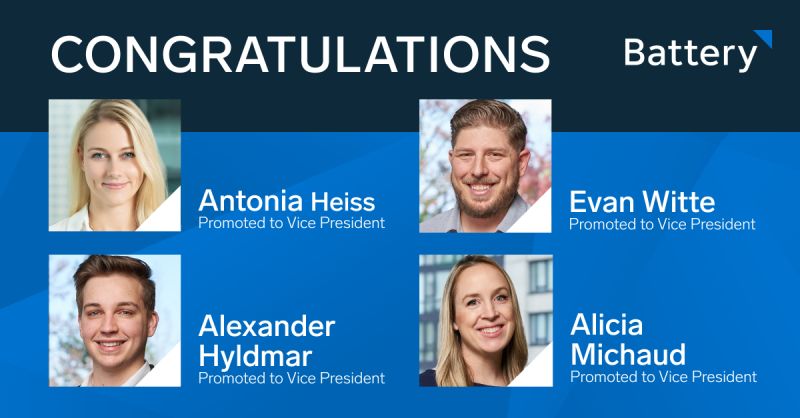
Witte joined Battery in 2020 as a director of business development. His work with Scott Goering connects the firm with developers, technologists and product-management executives at cloud-native businesses and large corporations. Battery subsequently announced his promotion to vice president alongside Antonia Heiss, Alexander Hyldmar and Alicia Halatsis Michaud.
Battery’s business-development practice describes a range of jobs that can sound modest until a company needs them: testing product features against enterprise requirements, introducing qualified technology executives, arranging technology partnerships and helping navigate new channels. The order matters. Useful customer feedback can arrive before a sale, and can change what a company chooses to build.
The firm’s enterprise-market guide, signed by Goering and Witte, addresses the difficulty of partnerships between young companies and established businesses. Their needs and internal processes differ. Readiness matters on both sides. A startup can be unprepared to serve a large organization; a large organization can be unprepared to work with a young vendor. Faster innovation does not remove the need to understand those differences.
This is the commercial setting for Witte’s work. The introduction has to survive contact with requirements, internal stakeholders and a purchasing decision. A meeting provides access. What follows determines whether that access was useful.
Bend belongs in the conversation
His LinkedIn profile places him in Bend, Oregon. In February 2021, he delivered a Central Oregon PubTalk keynote about why the next generation of startups could be remote. The subject had a local audience and a wider implication: places outside familiar technology centers could participate in building the next businesses.
PubTalk brings members of the business community together to exchange ideas and support local companies. Witte’s keynote considered why remote places such as Central Oregon were losing their second-tier status. For someone whose work involves connecting technology builders with larger organizations, the location question belongs naturally beside the access question.
The talk makes a useful stop in his story because it changes the map without changing the underlying work. A startup still needs feedback, relationships and customers. Being based somewhere different raises a practical question about how those connections are made. Witte was discussing that question in a place whose entrepreneurs had reason to care about the answer.
A network with something to do
At Battery, Witte leads community initiatives including the Battery Collective, which brings together people working in product, engineering and data. His role connects enterprise leaders with startups as those businesses work toward product-market fit and scale. The community is a way for the conversations to have a continuing home.
His public comments about networks are unusually specific about the desired outcome. Ahead of a VC Platform appearance, he described the familiar pattern of scattered introductions followed by a reset. He advocated structured communities, mapped relationships and programs that make demand more repeatable. The proposed change gives a network an operating purpose, rather than leaving it as a collection of names.
“If it doesn’t convert to revenue, product signal, or distribution… it’s just activity.”
Evan Witte, on turning networks into repeatable systems
The 2026 VC Platform Summit agenda put that subject into a discussion with Sean Dazet of Oyster: using partnerships and networks as repeatable business-development and dealflow channels. It is a topic about mechanisms. Which relationship helps a company reach a customer? Which conversation reveals something useful about the product? Which partner creates a route to market?
Those questions are more demanding than whether an event was well attended. They also explain why someone with product and partner-success experience would care about community design. The people need a reason to return, and the companies need a reason to value the exchange.
When the demonstration meets the contract
Artificial intelligence has brought new material to this old commercial problem. In August 2024, Witte and Goering examined the concerns enterprise buyers were bringing to generative AI negotiations. The list included employee training, vendor assessments, unfamiliar contract terms and restrictions on retaining corporate data.
Their argument gave those concerns consequences for sellers. Multiple assessments can extend negotiations. Managing different requirements consumes resources. Product teams can face competing demands from customers. An AI feature arrives with work attached to it, and some of that work has to happen before the buyer is comfortable proceeding.
They also considered an enterprise-built bot that could coordinate tasks across several applications. An employee might ask for time off through a single interface while software handles the associated services underneath. That changes the relationship between a software vendor and the person using its product. The application can remain essential while its own interface becomes less visible. For businesses accustomed to charging by the number of employee logins, the implications deserve attention.
The adoption curve, with the labels left on
Witte’s co-authored research tracks what buyers are actually doing. A September 2024 survey of 100 enterprise technology executives reported that only 5.5% of identified AI use cases were in production. The gap between potential applications and deployed ones was substantial. The figure measured use cases, an important distinction when reading later results.
By December 2025, another survey of 100 executives found that 74% of respondent organizations were already implementing generative AI. Agentic AI was in production at 33%. These figures describe organizations and should not be mistaken for the earlier share of use cases. Keeping the labels attached makes the story more useful than a single dramatic arrow pointing upward.
The June 2026 report, co-authored with Goering and Nick Elsner, covered 100 senior technology leaders representing more than $66 billion in annual technology spending. Forty-nine percent reported actively deploying agentic AI. The findings showed an expanding market, alongside questions about what those deployments were delivering.
Now show the return
In July 2026, Witte, Goering and Elsner examined the measurement problem more closely. Their follow-up reported that 53% of enterprise technology leaders saw clear returns in some areas of AI investment. Only 6% had a consistent organization-wide framework for tracking them. Seeing value and having a reliable way to account for it were evidently proceeding at different speeds.
The measures organizations used leaned toward efficiency: cost savings, employee productivity and delivery speed. Revenue attribution was less common. That finding matters to a business-development conversation because the buyer eventually needs to explain why the spending should continue. A productivity gain becomes more persuasive when someone can show where it occurred and how it was measured.
A companion July article examined the workforce. In that survey, 73% of respondents said AI was augmenting existing teams without reducing headcount or had no measurable hiring effect. The authors also described changing hiring priorities. Their findings concerned the surveyed enterprises, giving Witte’s research a bounded, practical view of changes often discussed in sweeping terms.
The thread running through his work is visible here. A product needs a user. A partnership needs an outcome. A budget needs an explanation. Witte’s career has brought him into each conversation, from the company-building side and from the enterprise side. The introduction opens the door. The interesting work starts when both parties decide what to do next.