A strawberry gave Jens Kruger a problem. In May 2026, he described an evening when his son asked an AI to count the letter E in the German word Erdbeere. There are four, counting the capital letter. Kruger expected a solvable glitch. He tried clearer instructions, slower reasoning, spelling the word out and counting step by step. The answer still refused to behave.
Father and son found it funny. Then, as Kruger put it, his “enterprise software brain switched on.” A confident mistake becomes a different proposition when software can change a business record or move an approval along. The family experiment had wandered into his professional territory.
Kruger, now co-CEO of NEWWORK Software, has spent his career close to the machinery beneath business applications. His work stretches from research associated with SAP HANA to product architecture at Workday. The strawberry is a small, useful introduction to his latest concern: how to let AI participate in work while keeping responsibility attached to its actions.
The business degree beneath the database
His education contains a pairing that helps explain the range of his work. Kruger earned a business administration degree at the Free University of Berlin and a doctorate in computer science at the Hasso Plattner Institute at the University of Potsdam. One discipline asks what an organization needs to accomplish. The other asks how to make the machinery accomplish it.
He joined Hasso Plattner’s research chair in 2006. Before joining SAP in September 2013, he served as a co-representative of that chair. He was also a founding member of the joint research project with SAP that built the first prototype of SAP HANA. That places him inside a collaborative research effort, with the practical demands of enterprise software close at hand.
His 2014 dissertation carried the title Enterprise-specific in-memory data management: HYRISEc, an in-memory column store engine for OLXP. It is a title with very little interest in making small talk. The subject, however, belongs to everyday business: organizing data so a company can use it efficiently.
Consider an order. It is a record that needs updating, but it may also belong in a much larger calculation about stock, demand or revenue. Business software must accommodate both kinds of attention. Kruger’s early research tackled the engineering behind that coexistence. Long before an AI could offer to handle an order, somebody had to decide how its information should live.
Rows, columns and the cost of waiting
In 2010, Kruger co-authored the HYRISE paper with Martin Grund, Hasso Plattner, Alexander Zeier, Philippe Cudré-Mauroux and Samuel Madden. The team explored a hybrid storage engine that kept data in main memory and varied how fields were grouped according to the workload.
The technical problem rewards a homely analogy. A complete customer file is convenient when you need several details about one customer. A neatly arranged list of just one detail is convenient when you need to examine that detail across thousands of customers. Databases face a related choice between keeping rows together and grouping values by column.
HYRISE investigated how to combine those arrangements rather than commit every workload to one. The paper reported performance improvements of 20 to 400 percent over pure row or column designs in its customer-derived benchmark. Those figures describe that experiment; they are not a promise about every database. The intellectual point is the fit between a system’s arrangement and the work actually arriving.
Read alongside his later career, this looks like an early version of a recurring question: where does the architecture force unnecessary effort? That is an interpretation of the sequence, rather than a claim that he planned his whole career around one question. Careers rarely arrive with such tidy documentation.
A research idea acquires customers
At SAP, Kruger’s remit grew to include financial product development and the Innovation Center in Potsdam. When the center officially opened in February 2014, he and Jürgen Müller led it. Both had previously represented Plattner’s chair at HPI. The movement from institute to company was unusually visible: people who had worked in the research environment were now leading a place meant to turn research into applications.
The center gathered 110 SAP employees and 28 students from 20 countries and roughly 18 disciplines. Its location near HPI made the connection between academic training and commercial development tangible. For Kruger, the work now involved an organization as well as an engine.
He became a senior vice president at SAP. His finance responsibilities put him close to systems where speed has to coexist with accounting requirements and customers’ established processes. A research result can be persuasive on paper. A product has to survive being used by somebody who has a reporting deadline and would quite like to go home.
He also wrote SAP Simple Finance and SAP S/4HANA Finance: An Introduction. The latter explains the technical foundation and deployment choices of the finance software. Writing about a product adds another obligation: making its design intelligible to the people expected to evaluate or use it. The database researcher had acquired both a development organization and readers.
From building the platform to explaining it
Kruger’s next stops included McKinsey Digital, where he was an associate partner, and Workday, which he joined in March 2019. As Workday’s CTO for Europe, the Middle East and Africa, he had a two-way assignment: explain the company’s strategy to customers and prospects, and carry market trends back into its development organization. He reported to global CTO David Clarke.
That role sits at a useful junction. Customers describe problems in the language of their businesses. Developers need requirements precise enough to build against. A person working between them has to translate without sanding away the inconvenient details. An elegant architecture is of limited comfort if the employee still cannot complete the task.
By 2021, Workday also identified him as chief product architect. In a company-published industry report with IBM, he argued that operational efficiency and innovation could reinforce each other with the right mindset. The idea makes sense beside his earlier work: reducing effort in the underlying system can create room for other activity.
It also puts a different weight on the word “technology.” In Kruger’s public career, technology includes research, product development, customer conversations and the decisions that connect them. His job titles changed. The requirement to explain how a design affects a working business remained.
“In SaaS, there is no ‘done.’”
Jens Kruger, 2021
A Friday is a release date
At Workday, he advocated a consistent cloud architecture and ongoing software delivery. In a 2021 interview, he described weekly updates alongside twice-yearly feature releases. He said roughly half of development effort went into the underlying technology and platform. The part customers did not see consumed a substantial share of the work.
His advice also reached beyond code. Organizations needed to adapt their working habits to software that kept changing. Customer usage and feedback would inform development. The installation was therefore one event in a continuing relationship, with a recurring obligation to deliver value.
There is a quiet comedy in the word “finished” when applied to business software. Finance departments do not finish having transactions. Employees do not finish needing access, approvals or information. A successful release meets a set of needs, and then the needs move. Kruger’s concise remark about SaaS captures that continuing obligation.
Across his research and cloud work, the architecture repeatedly appears as something that has consequences for people. How data is arranged affects waiting. How software is delivered affects maintenance. How a platform responds to changing requirements affects the work customers can attempt. The connection is practical, even when the vocabulary is forbidding.
The next job is between the systems
NEWWORK dates its project’s beginning to a gathering in Palo Alto in 2023. Its team brought together experience from SAP and Workday with AI development. Kruger now leads alongside Michael Jaszczyk: the company lists Kruger as CEO for Europe and Jaszczyk as CEO for the United States.
The company’s ambition concerns the gaps between business applications. Its Digital Workforce Platform combines AI agents and workflows, with an operating environment intended to coordinate actions across existing systems. That is the company’s proposed approach. It asks a buyer to think about how a process moves across software boundaries.
In April 2026, Kruger laid out his frustration with AI assistants that find information or suggest a next step while leaving the repetitive execution to employees. He argued for workflows that carry tasks forward and bring people in when judgment is required. Human approval remained part of the design he advocated.
The distinction matters to his story because it carries the architect into a fresh set of dependencies. Connecting an action to a workflow means deciding what can happen next, who has authority and where an exception goes. The space between applications contains work of its own. Kruger’s current ambition is to make software take on more of it.
- UnderstandContext and business rules
- ActA workflow advances
- AskHuman judgment when required
- RecordA trace of the action
Still close to the research room
In May 2026, Kruger appeared at the launch of the AI Fabric institute in Plauen as chairman of its advisory board. He delivered a greeting at an event connecting the institute with the Duale Hochschule Sachsen. Rainer Gläß, the institute’s managing director, and university rector Frank Schweitzer signed the cooperation agreement.
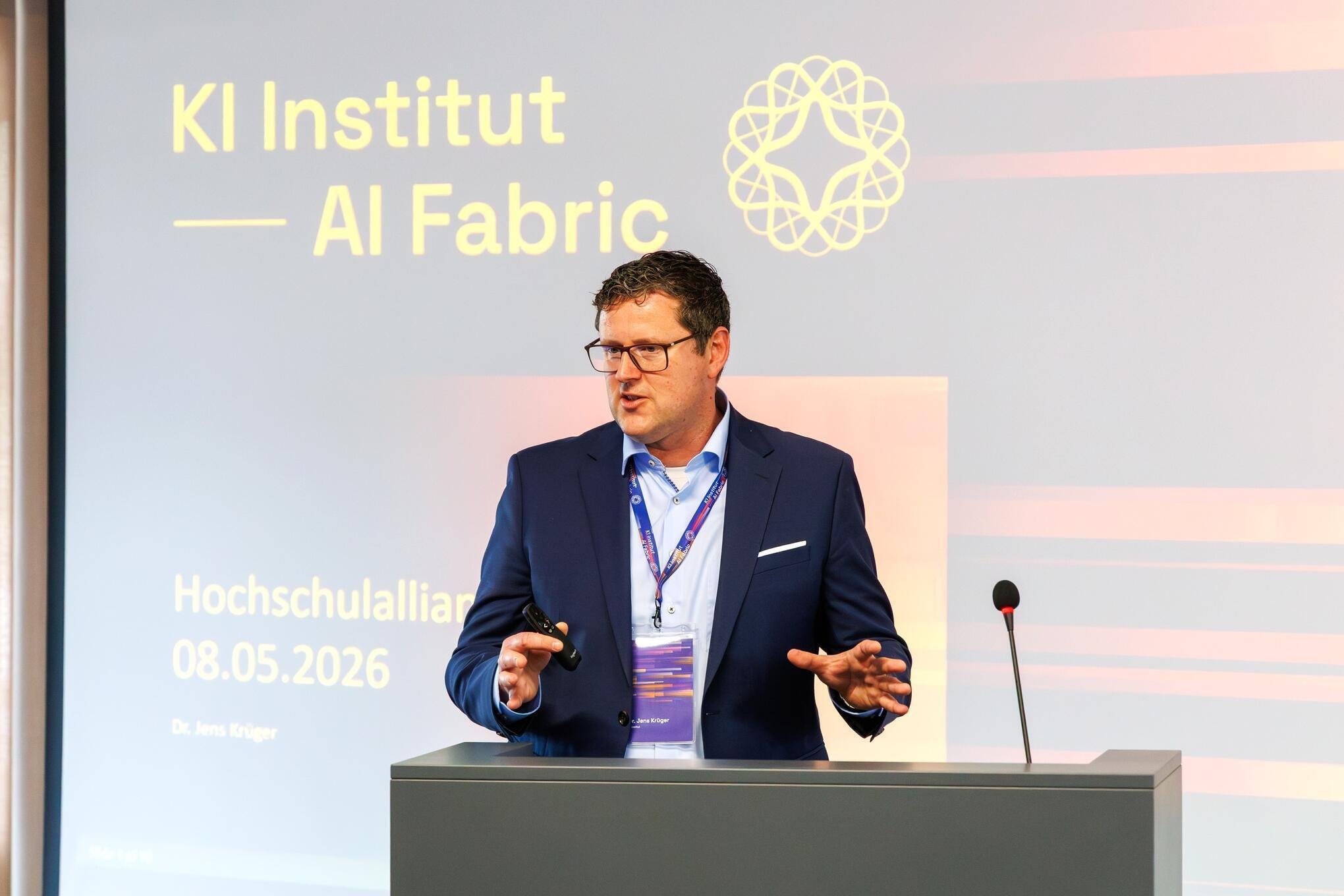
The appearance reconnects his current work with the research-and-industry setting of his early career. HPI, SAP’s Innovation Center and AI Fabric are different institutions, but each puts technical investigation within reach of organizations that want to use it. His professional connections include researchers, product leaders and the developers building NEWWORK.
He has publicly singled out NEWWORK developer Maria Prangishvili for praise, emphasizing her contribution and thanking the wider team. That gives the executive titles a little texture. Building software is a collective undertaking, and his public account of the work makes room for the people doing it.
His career has moved from the arrangement of data to the arrangement of work. The next chapter will be judged in the processes his company wants to improve: whether tasks advance, decisions reach the right person, and actions remain accountable. These are ordinary demands. Meeting them is what makes business software interesting.