A company can grow large enough to make its founder feel he has solved the problem. Then the problem changes. Girish Gaitonde’s business reached $80 million in revenue in 2000. Four years later, revenue was $17 million. The dot-com downturn had exposed the cost of depending heavily on technology customers. For an engineer accustomed to working through a system, this was a system with a particularly uncooperative variable: the market.
Gaitonde reduced the company to a size it could sustain and expanded its customer base beyond the technology industry, including financial services. Those decisions belong near the beginning of his story, even though they came a decade after he started the business. A founding date tells you when someone began. A contraction tells you something about what they had to learn to continue.
The business survived that passage. In January 2023, Xoriant announced its acquisition by ChrysCapital. Gaitonde later received Chicago Booth’s 2024 Entrepreneurial Award. The neat career outline runs from education to founding to recognition. The more interesting route doubles back through the uncomfortable years, when experience had to be revised rather than merely accumulated.
Before the balance sheet, the circuit
His formal education began in electrical engineering at IIT Bombay, where he graduated in 1983. He then earned a master’s degree in computer engineering at Pennsylvania State University. The progression took him from Mumbai to the United States and from electrical systems to the machinery of computing. Before founding his own company, he worked at Intel, AT&T and Arix, holding positions across engineering management, marketing and finance.
That range matters. A technology company needs people who understand what can be built. It also needs someone to consider who will buy it, how it will be delivered and whether the accounts can bear the arrangement. Gaitonde’s early career crossed those boundaries. The founder who emerged from it had already encountered several ways of looking at the same business.
He completed his MBA at Chicago Booth in 1989. Looking back, he described the gap in his preparation with a short, agreeable admission: “I could solve an equation.” Business required another education. A class with Steve Kaplan helped him connect financial theory with practical decisions. The following year, he left corporate life to found TekEdge. The interval between graduation and incorporation was brief; the education that followed would be considerably longer.
“I could solve an equation.”
Girish Gaitonde, reflecting on why he sought a business education
A business small enough to know its customer
TekEdge began in Silicon Valley in 1990 with three people. At that size, the distance between winning an assignment and doing the assignment is pleasantly short. There are fewer places for a problem to hide. There are also fewer people available when several problems arrive together. The original headcount makes the later international business easier to picture: it began as a small working group, rather than an organization chart.
One early assignment involved UNIX standards compliance. Gaitonde recalled a boutique customer testing different vendors’ versions of UNIX. Subsequent work reached systems and database companies. His lesson from those years was specific: build deep technical expertise and understand the customer. The first job had a defined task, a customer with a reason to need it and a team whose skills fitted the task.
He described a services company as a business that begins and develops with its clients. It is a plain principle for an industry whose vocabulary can get elaborate. A services company earns its place in someone else’s plans. The relationship has to remain useful when a product changes, a budget tightens or the customer’s own priorities move. Technical competence gets tested repeatedly, in circumstances the supplier does not entirely control.
In 2000, TekEdge became Xoriant as it expanded into outsourcing. Its services and geographical reach widened over time. The name changed; the accumulated customer work came along. Rebranding offers a new label, but the obligations underneath it remain wonderfully literal. Software must function. Teams must deliver. A customer still has a business to run on the other side of the contract.
TekEdge begins
Three-person team
The business takes
the Xoriant name
New ownership
CEO handover
By its twenty-fifth anniversary in 2015, the company had a presence in the United States, Europe and India. Gaitonde described technology orientation, customer relationships and employee relationships as the principles behind its progress. The list gives equal billing to the work, the buyer and the people doing it. None can carry a services business indefinitely without the other two.
Five years later, Xoriant marked its thirtieth anniversary. Gaitonde reflected on the change from the original three-member operation to a corporation working across three continents. Anniversaries are good at making time look orderly. The actual work sits between them: finding a next assignment, developing another capability and keeping a company useful through successive generations of software.
Balloons, buildings and the work between them
There is a photograph from October 2017 that supplies a welcome interruption to the financial chronology. Gaitonde inaugurated Xoriant’s Hinjawadi facility in Pune. The company’s collage shows a reception area dressed in balloons, colleagues gathering, and a lamp-lighting ceremony. He appears among the group in a light shirt and trousers. The occasion has the recognizable look of an office preparing to become an office.
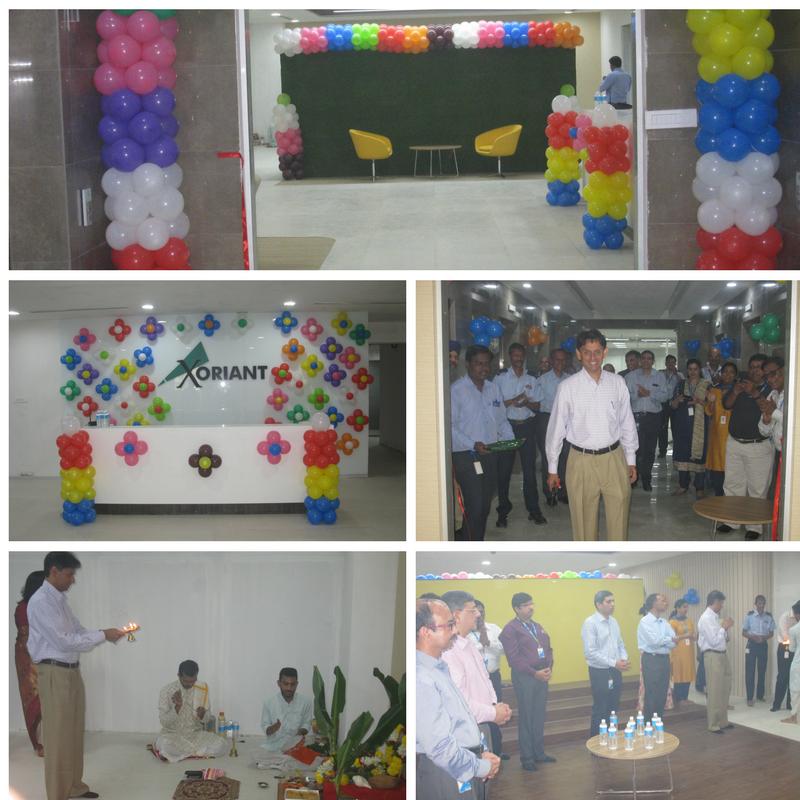
A new location becomes meaningful through the people who use it after the guests leave. The Pune photographs bring that ordinary scale into view. A company described in countries, customers and capabilities is also a collection of rooms where colleagues meet and work. An inauguration celebrates the space. Its usefulness is established on the less photogenic days that follow.
Gaitonde’s public comments returned to staff development. In 2022, he put the relationship succinctly: “To ensure customer value, you must bring value to your employees.” Xoriant described investments in infrastructure and skills programs alongside that argument. For a company selling engineering services, learning sits close to the product itself. The expertise a customer needs next year may differ from the expertise that won the contract.
That concern continued into the acquisition period. In a January 2023 interview, he discussed the constraint of employee attrition and the systems the company had put in place. Growth depends on the ability to deliver the work already sold. The order book and the available team have to be considered together, however attractive the demand may look from a distance.
The company changes hands
On January 5, 2023, Xoriant announced its acquisition by ChrysCapital. It described a global workforce of more than 5,000 and a business spanning product engineering, cloud, security and data services. Gaitonde thanked employees, associates and customers, and said he looked forward to working with Sanjay Jalona and the new owners. The announcement placed the transaction within a continuing company story.
That continuity took a practical form in the following weeks. In February, Xoriant appointed Nithin VJ as chief financial officer. Gaitonde welcomed his financial experience and strategic thinking. A founder with an MBA in finance could appreciate the relevance of that appointment. An expanding engineering business brings operational questions with it, and the financial function has work to do beyond recording the results.
Then, on March 16, Xoriant appointed Sukamal Banerjee as CEO. Gaitonde welcomed him and confirmed that he would continue as a board member. More than three decades after founding TekEdge, he passed the executive responsibility to another leader. The handover made a distinction that is easy to lose in founder profiles: creating a company and running its next phase are different responsibilities.
Gaitonde remains listed as Xoriant’s founder and a member of its board. Rohit Kedia is now listed as CEO. The organization has continued to change: its November 2025 acquisition of TestDevLab extended its European presence and quality engineering capabilities. Those developments belong to the company’s subsequent leadership and ownership. For the founder’s story, they show the institution continuing beyond his tenure in the operating role.
A classroom with his name on it
Another part of Gaitonde’s work returns to IIT Bombay. His support for its Electrical Engineering department helped create a 25,000-square-foot building with departmental offices and classrooms, and laboratories in systems, communications and power electronics. The institute’s records date the Girish Gaitonde Lecture Hall Complex to 2000. It is a physical connection between his own education and the students who came afterward.
The building’s name appears in the department’s admissions arrangements in 2026. That is a pleasingly functional afterlife for a donation. A facility becomes a place to report, attend a session or meet an interviewer. Its name enters the ordinary instructions of university life. The tribute keeps earning its floor space by being useful.
IIT Bombay recognized him with its Distinguished Alumnus Award in 2009. Chicago Booth’s Entrepreneurial Award followed in 2024. His work outside Xoriant has also included seed investment and board service for more than a dozen technology startups. These activities extend a career that has moved between technical work, business decisions and the institutions where people learn to make both.
In 2024, he spoke about exploring a money-management business and returning to work with the Polsky Center, where he had previously judged the New Venture Challenge. Those were interests he described for the future. Judging young companies offers a different vantage point from leading an established one. The proposals are new; the questions about customers, delivery and money have a familiar shape. His own first venture began a year after business school. Returning to that setting would bring several decades of subsequent experience into the room. His second education had left him with more to consider.