A clinical question is a small thing. It can fit in one line, arrive during a meeting, and sound almost conversational: How did this therapy perform for older patients with a particular condition? Then the machinery starts. Literature is reviewed. A study is designed. Data is prepared. Cohorts are argued over. Statistical code is written and checked. Medical reviewers inspect the assumptions. The question took seconds; the answer may take months. Nikhil Tiwari has decided that the calendar, rather than the science, contains the opportunity.
Tiwari is the co-founder and CEO of Frekil, a San Francisco company in Y Combinator's Spring 2025 batch. He describes the business as an intelligence layer for clinical real-world data. In practical terms, Frekil connects to sources such as electronic health records, claims, and registries, then helps a team carry a research question through study design, cohort construction, statistical planning, analysis, and reporting.
The ambition is speed, but Tiwari's more revealing word is inspectable. Life-sciences teams need to see where a claim came from, which assumptions survived review, and what changed between versions. A fluent answer without a visible trail is merely confidence wearing a lab coat. Frekil's wager is that useful AI in this field will have to show its work.
The first bottleneck was visible on a screen
Frekil's first public form was narrower. Tiwari and his co-founder, Shivesh Gupta, launched a platform for healthcare AI teams that needed medical images and expert annotations. X-rays, CT scans, MRIs, and pathology files are large, specialized objects. They are awkward to move, difficult to label precisely, and unforgiving of casual quality control. The founders offered data sourcing, a network of radiologists, and browser-based annotation tools intended to compress months of preparation into days.
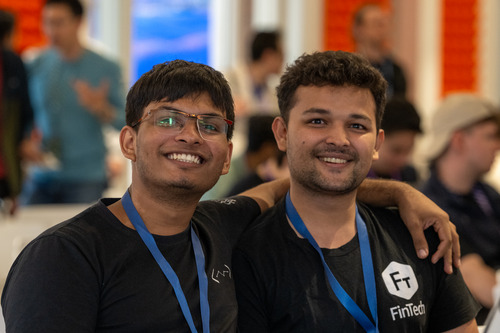
The problem was earned, not borrowed from a trend report. Tiwari and Gupta had been friends since IIT Bombay, where they studied and built together. Their work on healthcare-AI projects exposed them to the tedium surrounding multidimensional medical data. A promising model could wait while the people around it wrestled with file formats, expert availability, spreadsheet coordination, and review.
That origin explains both the company and its evolution. Annotation was a painful station on a longer route. The larger delay appeared across the whole journey from raw clinical data to a conclusion that a scientist, regulator, or payer could examine. So Frekil moved upstream. Its current product handles a wider sequence: clarify the question, review literature, define the cohort, map causal relationships, write a statistical analysis plan, extract data, execute code, and assemble the report.
Founders often speak of focus as if it means staring forever at the first diagram. Tiwari's version looks more like following a loose wire through the wall. The company kept the central complaint - important work was trapped in manual coordination - while widening the area in which it could remove friction.
We don't believe AI should replace scientists.Nikhil Tiwari
An engineer of handoffs
Tiwari arrived at this work through systems engineering. At IIT Bombay, he studied mechanical engineering with minors in computer science and artificial intelligence. He led technical initiatives in the Student Alumni Relations Cell and helped build platforms used by more than 10,000 students. The audience was different, but the work already involved many people depending on software they rarely wanted to think about.
His early career added other layers. He worked at Marsh McLennan, interned at Amazon, and later joined Stripe as a software engineer. His public biography emphasizes infrastructure, performance optimization, and low-level systems. He also spent a semester at the University of Geneva, where one listed project used convolutional neural networks to classify galaxy images connected to a CERN challenge. Another university project explored deep-learning approaches to image super-resolution.
There is a pleasing breadth to the sequence: mechanical engineering, blockchains, cloud infrastructure, medical images, galaxies, clinical evidence. Yet the through-line is fairly sober. Tiwari keeps turning up where complex inputs have to become reliable outputs. Frekil simply gives that instinct a higher-stakes workflow and far more acronyms.
The diagram matters because Tiwari does not frame AI as a single clever response. Real-world-evidence work crosses epidemiology, statistics, data engineering, medical review, regulatory thinking, and commercial needs. A chat window can make all that complexity disappear visually while leaving it intact operationally. Frekil instead breaks the work into governed stages. Each handoff becomes a place to preserve a decision, invite review, or return a question to the appropriate expert.
The architecture of restraint
The company's clearest design choice is a wall. Frekil says its AI generates code while the code executes separately, inside a sandbox connected to the customer's data environment. Clinical records do not pass through the model. The distinction has the elegance of a good kitchen rule: the person writing the recipe never rummages through the pantry.
That separation fits Tiwari's public argument about language models. He sees them as useful for organizing complexity, surfacing ambiguity, translating dense material, and producing code when expected behavior is explicit. The model can help a team move. It cannot quietly rewrite the study question, invent a citation, or promote an uncertain result into a polished certainty.
This is a less theatrical idea of automation. The professional remains in the picture. Frekil aims to remove the procession of documents, spreadsheets, repeated queries, and format changes around that professional. In a sector enchanted by the phrase “autonomous scientist,” Tiwari's governed co-pilot arrives wearing sensible shoes.
We believe LLMs are useful when they are grounded, constrained, and reviewed.Nikhil Tiwari
The emphasis on restraint may also be the commercial argument. A life-sciences team does not adopt software merely because the demo reaches an answer. The team adopts it when a biostatistician can inspect the code, a reviewer can trace the claim, and the person signing off can understand the history. Trust lives in the product's joints.
Medicine with logs
Tiwari has compared his desired future for medicine with continuous observability in software. When a bug touches a small fraction of users, engineers can investigate logs, isolate the failure, and ship a correction. Signals about how treatments perform in ordinary practice can take much longer to emerge. His question is whether every patient interaction could improve the collective understanding of which therapies work, for whom, and under what conditions.
The analogy is playful, though the claim beneath it is serious. Randomized controlled trials answer how a treatment performs under defined conditions. Real-world evidence studies what happens amid the untidiness of routine care. It comes from records, claims, registries, and other data already generated while care is delivered. Turning those records into evidence requires careful definitions and a defensible analysis. Volume alone has no magical properties.
Frekil wants to shorten the learning loop without flattening its rigor. A researcher asks a question in plain English. The platform helps propose a study, find the relevant cohorts, generate statistical code, run it where the data lives, and prepare a report with the route exposed. Tiwari has condensed the goal into an arresting contrast: five minutes rather than five months for a team testing a hypothesis quickly. The public product language is more cautious about production studies, but the direction is unmistakable.
The founder's job in this vision resembles a plumber for institutional knowledge. He is looking for every bend where context leaks out, every handoff where a week vanishes, every confident output that has misplaced its assumptions. Glamour is scarce in the pipework. So are people willing to spend their days mapping it.
A friendship becomes an operating system
Tiwari does not build alone. Gupta, Frekil's CTO, brought systems experience from Sony Japan and led IIT Bombay's web and coding club. Their friendship predates the company, the batch badge, and the San Francisco address. At university they studied, built, and encountered the same ugly data preparation that would produce Frekil's first pitch.
That history gives the company a useful division of labor without turning it into a sitcom. Tiwari's role spans the outward question - which problem deserves the company - while Gupta leads the technical organization. Both founders come from systems work. Their public language repeatedly returns to control, performance, and the mechanics beneath an interface.
When Tiwari announced the Y Combinator chapter in May 2025, he described a conversation with Paul Graham about artificial general intelligence, healthcare, and why clean annotated medical data might become a moat. Nicolas Dessaigne, Eric Levine, Andrew Miklas, and Diana Hu were among the people he thanked for believing in the team. At that moment, medical-image preparation was the headline. A year later, the company's vocabulary had shifted to evidence infrastructure, self-improving agents, and an intelligence layer for clinical data.
The interesting detail is not that a young startup changed its product. Young startups are professionally indecisive; the good ones make this look like attention. Frekil's change reveals the persistence of one concern. Tiwari keeps asking how scientific teams can receive a trustworthy answer before the next question has already arrived.
The answer must survive the room
Many AI products are designed for the moment of revelation: a blank box, a prompt, a completed paragraph. Frekil is designed for what happens after the paragraph enters a room full of experts. Who approved the cohort? Which definition changed? Did the statistical plan precede the result? Can the code run again? Does every assertion lead somewhere solid?
Tiwari's aspiration is therefore larger than faster paperwork and smaller than machine omniscience. He wants medicine to learn continuously from what happens in ordinary practice. He also wants the system to respect the people accountable for that learning. Speed earns attention. Reviewability earns use.
For founders, Frekil offers another lesson. The first bottleneck may be a doorway rather than a destination. Tiwari and Gupta began with the difficult work of preparing medical scans, listened to the wider complaint, and rebuilt around the full chain. They traded a crisp category for a harder, more consequential workflow. The company now has to prove it can turn its elegant diagram into daily practice.
Meanwhile, the question is still waiting on the table. It looks simple. Somewhere, a scientist is reviewing literature, a data engineer is translating codes, and a statistician is checking assumptions. Tiwari sees a software system connecting their work without pretending to replace any of them. If Frekil succeeds, the answer will arrive sooner. More importantly, it will know how it got there.