Enterprise software has a peculiar second life. First it is a product: polished demos, crisp promises, a contract signed. Then it becomes a project. People arrive with spreadsheets. Workshops multiply. Fields need mapping, permissions need negotiating, edge cases need testing, and the date marked “go-live” retreats into the middle distance. The software may be bought in weeks. Making it useful can take months.
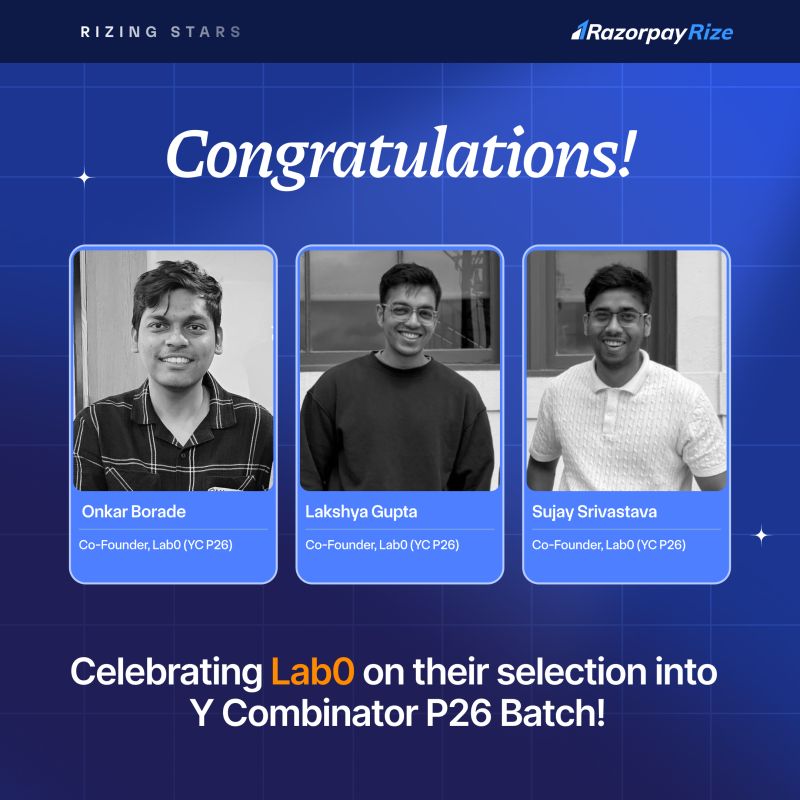
Onkar Borade has chosen this unglamorous interval as his company. Lab0, which he co-founded with Lakshya Gupta and Sujay Srivastava, builds AI forward-deployed engineers - “AI FDEs” in the company's brisk vocabulary - to run the discovery, planning, configuration, integration, and testing behind enterprise rollouts. The aim is not to produce another summary of a meeting. It is to make the change, inspect the result, and move a customer toward production.
It is an idea with the pleasing shape of a trapdoor. The vast enterprise software market is visible above ground. Underneath sits the services labor required to make those products function inside an actual company. Borade saw the imbalance from the inside at Oracle, where the implementation team was bigger than the development team. An org chart became a market map.
A résumé made of different machines
Borade arrived at Lab0 through a career that refuses to stay in one neat professional lane. He entered IIT Bombay in 2020 to study computer science and engineering, after earning All India Rank 4 in JEE Advanced. On campus, he added an entrepreneurship minor, served as a teaching assistant for computer science courses, coordinated competitions for Mood Indigo, and became the first General Secretary of Hostel 17.
The early jobs form a sampler of systems where tiny decisions acquire financial consequences. He interned in web development at crypto investment platform Mudrex. He worked as an artificial intelligence engineer at samespace, then as an algorithmic trader at Resoenix. In 2023 he joined Oracle Cloud Infrastructure's AI team. The assignments were relatively brief, but the subjects were not small: markets, machine learning, cloud software, and the coordination problems of institutions.
In 2024 he founded InvoicEase, an invoice-financing venture for Indian micro, small, and medium enterprises. Its premise concerned a different sort of waiting. A supplier has done the work and issued the bill, yet the cash remains lodged in the payment cycle. Invoice financing turns that delay into a product. Lab0 applies a similar impatience to enterprise software: the contract exists, the capability exists, but the value is stranded until implementation catches up.
“My biggest job as a founder is to answer one very simple question: What do you do?”Onkar Borade, reflecting after Y Combinator Demo Day
The sixty-second education
At Y Combinator Demo Day in 2026, Borade had 60 seconds to explain Lab0 to about 500 investors. Afterwards, he wrote that the deceptively simple question changes with the listener. Investors care about one answer. Customers need another. Employees require a third. His current version is direct: Lab0 automates the professional-services and implementation work behind enterprise software so companies can go live in days.
That sentence is the visible inch of a long operational list. A team first needs to understand how a customer works. It turns those conversations into requirements and a plan. It configures the platform, writes the custom connections, and tests the workflows. When something fails, the useful knowledge is often trapped in a consultant's memory or scattered across documents. The next deployment starts with much of the same archaeology.
Lab0's product connects those stages into one agent workflow. Work can happen in parallel and reuse decisions, artifacts, and failure patterns from earlier rollouts. The product is designed to operate across platforms such as ServiceNow, SAP, Salesforce, Workday, Microsoft Dynamics, Oracle, Jira, custom APIs, and smaller business software. In a ServiceNow example, a user describes a desired routing rule in plain English; the agent inspects the instance, proposes the configuration, makes the change, reads it back, and shows what happened.
The last verbs matter. Enterprise systems are not places for charming improvisation. A deployment tool has to leave receipts. Governance turns “the AI did it” from an excuse into an audit trail.
A necessary scale note: the three-month-to-two-week comparison is an early deployment result. It is a specific example, not a universal performance guarantee.
A dance tutor enters the enterprise
Before the world of assignment rules and approval flows, there was Dance Bomb. At South Park Commons India's Curiosity hackathon in 2025, Borade, Srivastava, and Abhinav Kumar Srivastava built an AI dance tutor. A learner could attempt a routine while the system offered immediate corrections and voice feedback with what the team cheerfully called Hinglish sass. The project received the event's Immersive Experience Award and an ElevenLabs honorable mention.
The prototype looks like a comic intermission in a serious enterprise career. It also rehearsed a durable product loop. Observe a person acting. Interpret the action. Offer a correction in context. Watch the next attempt. Lab0 works in a less musical environment, but its agents also inspect, propose, act, and validate. The distance from dance floor to enterprise system is considerable. The underlying appetite for feedback loops is surprisingly short.
Borade's public language tends to favor systems over spectacle. He describes Lab0 as rebuilding the services industry through a “productized approach.” Commenting on professional services, he borrowed Hemingway's “gradually, then suddenly” and argued that the winners would redesign the delivery model from scratch instead of attaching modest automations to the old one. The claim is strategic, but also architectural. A copilot can help a consultant type faster. An agent workflow attempts to reorganize who, or what, owns the entire job.
The economics hiding after the sale
Implementation has always been more than an inconvenience. For a vendor, slow deployments delay revenue recognition and crowd the calendar of solutions architects and customer-success teams. For the buyer, every idle month is another month when an expensive product produces little value. A large services layer can make software powerful and flexible; it can also make growth depend on hiring more people to repeat a sequence the organization has performed before.
Lab0's bet is that repetition can become memory. An agent that retains artifacts, mappings, test cases, and failure patterns can approach the next rollout with something closer to institutional experience. If the system improves, delivery begins to scale through software rather than headcount. This is where Borade's phrase “productized approach” earns its keep. It does not mean service without judgment. It means judgment that can be captured, checked, and reused.
The startup opportunity was sitting between two dates: contract signed and software useful.
There are reasons the work has resisted easy automation. Every enterprise contains old databases, political boundaries, local abbreviations, undocumented exceptions, and people who remember why a strange field cannot be touched. A convincing implementation agent must deal with permissions, security, ambiguity, and rollback. It must know when confidence is low. The task is not merely generating configuration; it is building trust around changes that can affect an entire operation.
The three founders bring different views of that problem. Borade saw enterprise implementation at Oracle and previously built in financial technology. Gupta, also an IIT Bombay computer science graduate, worked on agent infrastructure and integrations at Emergent. Srivastava studied quantum computing at IIT Madras and encountered custom rollout work while building AI for financial services. They had sat on different sides of enterprise deployment. Their shared company is the tool they wished those projects had provided.
What to steal from the story
Borade's path offers a useful method for spotting companies: follow the skilled labor around a successful product. Look for recurring translation, configuration, testing, reconciliation, and handoffs. Ask which decisions vanish when a project ends. Then ask whether software can preserve the valuable parts without pretending the messy parts do not exist.
His route also argues for a certain breadth before commitment. Trading exposed him to automated decisions under pressure. Invoice financing revealed the cost of business delays. Oracle offered a view of the services mass behind enterprise products. Campus leadership supplied practical coordination, while an AI dance tutor made feedback visible and funny. None of these experiences alone predicts Lab0. Together they make the company feel less like a pivot and more like a convergence.
Lab0 remains young: founded in 2026, a team of three, and an ambitious list of enterprise platforms. Its story will depend on deployments, not slogans. That suits the problem. Implementation is where promises meet permissions, processes, and production systems. Borade has planted his company precisely at that meeting point.
The old enterprise ritual ends with a go-live. Lab0 would prefer that moment to arrive with fewer workshops, fewer manual handoffs, and a better memory of what worked last time. In Borade's version of the future, software does not merely get bought. It participates in becoming useful.