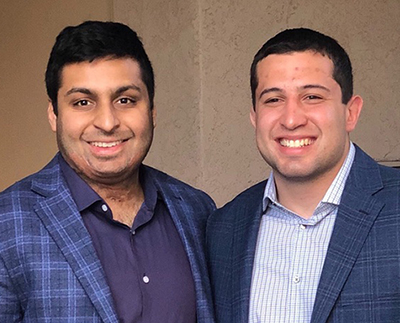
The first Ateios battery could stretch. It was thin, printable and rechargeable, the sort of laboratory object that makes a future feel close enough to hold between two fingers. Rajan Kumar had helped develop it while studying nanoengineering at the University of California San Diego. In 2017, he and fellow graduate student Carlos Munoz turned the work into a company. The invention looked like the story. Then the customers edited the plot.
Kumar and Munoz entered UC San Diego's first Institute for the Global Entrepreneur technology accelerator. The program put them in front of potential buyers and forced a useful collision between scientific possibility and purchasing reality. Their structural battery technology was clever, but Kumar concluded that demand might be a decade early. Beneath that timing problem, however, he heard something louder: battery makers were frustrated by how electrodes were manufactured.
That is an unglamorous place to build a company. Electrodes live inside cells. Consumers do not admire them through glass or queue overnight for a new cathode. Yet they hold the active materials where electrochemical reactions happen, and their production can dictate a battery's cost, performance and environmental burden. Kumar chose the invisible problem.
“I discovered this huge problem in how we manufacture batteries. And I was like, ‘Okay, I want to work on that.’”Rajan Kumar
A useful change of mind
Kumar had arrived at UC San Diego after earning a bachelor's degree in nanoscale science at SUNY Albany. He completed a master's degree and, in 2019, a PhD in nanoengineering. His dissertation studied polymer-particle composites for additive manufacturing. The subject sounds specialized because it is, but the practical question is wonderfully plain: how do you make tiny materials behave as a useful, manufacturable whole?
His doctoral work crossed printed electronics, composites and energy devices. Alongside professors Joseph Wang and Shirley Meng and other researchers, he worked on a paper-thin battery that could flex, stretch and recharge. Screen printing helped keep production inexpensive. The battery gave Ateios its opening idea and its name on a campus laboratory door. Kumar remembers that door fondly. He could bike between company work and doctoral work, a commute measured more in ambition than miles.
Customer discovery complicated the neat university spinout story. Published materials could be impressive and commercially useless if they cost ten times the incumbent. Kumar learned to ask a second question after “does it work?” The new question was “will anyone buy it?” For an engineer, this was less a retreat from science than an extra boundary condition.
Treat the first product as a probe. What customers reject may point more clearly to the company than what they praise.
Chocolate syrup and railway locomotives
Kumar has a gift for making an industrial process sound like an eccentric kitchen. Conventional electrode production begins with electrochemically active powders and a polymer binder. A solvent dissolves the polymer, producing a viscous slurry. Kumar compares its look and consistency to chocolate syrup. The mixture is spread with precision onto metal foil.
Then industry must undo the liquid part. Long ovens dry the coating, while equipment captures and handles the solvent. A complete production line can occupy the visual territory of several railway locomotives. It is expensive, energy intensive and slow. Ateios's alternative, called RaiCure, uses energy-curable polymers and an electron beam to cure the coated electrode without the conventional solvent-and-oven routine. The finished components are sold as RaiCore electrodes.
Conventional route
- Mix powders, binder and solvent
- Coat slurry onto metal foil
- Dry through long thermal ovens
- Recover and handle solvent
RaiCure route
- Mix active materials and curable binder
- Coat composite onto metal foil
- Cure rapidly with an electron beam
- Move onward without a drying oven
The chemistry came into Ateios through an exclusive license from Oak Ridge National Laboratory in 2021. Kumar joined the laboratory's Innovation Crossroads fellowship the next year, gaining access to scientific expertise and equipment while the company built additional materials, process, software and analytics work around the licensed foundation. He once described this layered intellectual property as a “picket fence.” A single patent can be walked around. A fence asks for more determination.
The cornfield calculation
A manufacturing startup eventually needs machinery, and machinery is unimpressed by storytelling. In 2018, Kumar and Munoz faced a choice. They could stay in California and raise enough capital to assemble their own pilot capability, or move toward the Battery Innovation Center in Southern Indiana, one of the rare shared facilities where a young company could test, build and compare batteries using serious production equipment.
They moved. Kumar jokes about exchanging San Diego's sandy beaches for Indiana's cornfields. The better trade was access for ownership. At the 40,000-square-foot center, Ateios could use lab space, dry rooms, production tools and testing capability without first recreating a factory. Mobile laboratories could be rolled into shared dry rooms, work completed, and rolled back out. Capital went toward learning and product development.
Kumar borrowed the mental model from semiconductors. Chip startups can design products and use shared facilities or outside fabrication partners. Battery startups have often been asked to raise tens of millions for a facility before proving that their idea performs and sells. His preferred order is test, compare, qualify, then scale. Factories are useful. Premature factories are unusually large monuments to optimism.
“We need testbeds that allow companies to test their solutions against the incumbents.”Rajan Kumar
Coach, player, coffee
The move from researcher to chief executive created another equipment problem: Kumar did not yet have all the tools for managing people. Engineering training had taught him how to investigate materials, not how to guide a team through uncertainty. He responded in character, by finding someone with practical experience.
Kumar asked UC San Diego soccer coach Jon Pascale to coffee. The conversation opened a different picture of leadership. “If you think of a CEO, the job of a CEO is to be a coach, not a player,” Kumar later said. “We're supposed to guide people.” It is a revealing analogy for a technical founder. Expertise can make it tempting to take every shot. A growing company needs a system in which other people can score.
His public comments return credit to the Ateios team with striking regularity. The CEO may receive attention, he says, but the team builds difficult batteries and delivers to customers. They learn, adapt the process and make the story worth telling. The sentiment also reveals his stated personality: optimistic, vigilant, willing to pivot, and unusually happy when standing near an unsolved production problem.
Kodak speed, Indiana patience
By 2023, Ateios had won a $2.4 million Department of Defense contract to improve battery materials and production for military applications. The assignment fit Kumar's broader concern with domestic capability. Batteries sit inside communications, vehicles, drones and field equipment. A supply chain built elsewhere can become a strategic constraint at precisely the wrong moment.
The company continued to separate electrode design from the need to own every meter of manufacturing. Eastman Kodak brought more than a century of precision coating experience and production assets. In September 2025, the companies reported solvent-free coating at 80 meters per minute, compared with a cited conventional industry speed of 30 meters per minute. Their work covered synthetic graphite and three widely used cathode families: LCO, LFP and NMC.
In October 2025, Ateios was named Battery Manufacturer of the Year at The Battery Show North America. In March 2026, it announced a $7.25 million Series A led by TitletownTech, with existing and new investors participating. The stated purpose is to move commercial pilots toward gigawatt-hour production and expand work with battery and materials partners, including Kodak and Vianode.
Three months later came an unusually legible manufacturing credential. Intertek certified Ateios's LCO, NMC, LFP and graphite composite portfolio as PFAS-free, with total organic fluorine required to remain below the certification threshold. For buyers, a third-party listing turns a marketing phrase into something procurement teams can check. For Ateios, it strengthens the argument that removing fluorinated binders can be a commercial specification, not only an environmental preference.
Making magic commonplace
Kumar still describes batteries with the affection of the graduate student who encountered them as “bottled magic.” They animate a phone, a car and nearly every untethered electronic object around us. But his career has moved steadily away from the theatrical reveal of a single unusual battery and toward the repetitive discipline required to make millions of ordinary ones better.
That is the personal thread through the pivots, relocations and partnerships. He follows scale. The stretchable battery proved a material idea. Customer interviews revealed the manufacturing problem. Indiana supplied shared infrastructure. Oak Ridge supplied a technical foundation. Kodak supplied coating muscle. Each connection moved Ateios one station closer to production without demanding that the company build the entire railway itself.
The coming test is commercial repetition. A fast line must remain consistent. A certified material must qualify in a customer's cell. Pilot rolls must become dependable supply. A Series A buys attempts, equipment and time, but not inevitability. Kumar's advantage is that he seems to enjoy precisely this stretch of the journey: close to the machines, listening for constraints, and quite content to discover that yesterday's plan needs editing.
“Manufacturing breakthroughs are what make transformative technologies ubiquitous,” he said when Ateios announced its new financing. Ubiquity is an unfashionable word for magic. It means the wonder has become cheap, reliable and easy to obtain. For a battery founder, that may be the better trick.