The laboratory is generous with beginnings. One coin-sized cell, assembled with exquisite care, can glow on a chart and make a room lean forward. A factory is less sentimental. It asks whether the powder behaved on Tuesday, whether the coating stayed even across a wide roll, whether the thousandth cell resembles the first, and whether the economics survive all that repetition. Yutaka Wakai has spent roughly thirty years in the company of those questions.
His public résumé runs through Panasonic, A123 Systems, Zeon, QuantumScape, 24M Technologies, Desktop Metal and Blue Current. His current LinkedIn affiliation is Seastone Partners LLC, a California company formed in 2025 for which he is the registered agent. The names trace several eras of advanced energy and manufacturing. The roles - chief engineer, principal engineer, research fellow, senior director of process engineering, vice president of advanced manufacturing - trace something steadier: a career built around getting difficult materials to move through real machines.
This is a particular kind of optimism. It does not announce itself with a concept sketch. It arrives with a manufacturing plan, an equipment list and a tolerance stack. At 24M, Wakai built a plan for volume production and selected the machinery to carry it out. At Desktop Metal, he developed media for mass-producing parts with metal 3D printers. At Blue Current in Hayward, California, the product changed again. The recurring problem did not.
A prototype proves that chemistry can work once. Manufacturing asks it to keep its promise.The operating idea behind a three-decade career
Silicon’s awkward abundance
Blue Current’s wager begins with silicon. As an anode material, silicon can store about ten times as many lithium ions per gram as graphite. That makes it tempting in the way a tiny apartment with ten times the closets would be tempting. The trouble is that silicon expands and contracts as a battery charges and discharges. In a solid-state cell, where intimate contact between particles is essential, all that movement can turn abundance into estrangement.
The company’s answer is an elastic composite electrolyte that puts polymers and ceramics to different work. Ceramic particles provide ionic conductivity. Polymer strands provide adhesion and compliance, helping the particles remain connected as silicon moves. The cell is fully dry - no flammable liquid or gel - and is designed to cycle at low operating pressure. Those choices are connected. They are also demanding. Chemistry, mechanical behavior and factory process have to agree.
Pressure deserves a moment. Many solid-state cells need substantial external force to preserve contact as materials swell and shrink. Pressure fixtures add mass, packaging and complication. Blue Current says prospective customers want no more than 1.0 to 1.5 megapascals for electric vehicles, with even less for devices. Its cells have been tested below one megapascal. A number that looks modest on a chart can therefore rearrange the practical design around the cell.
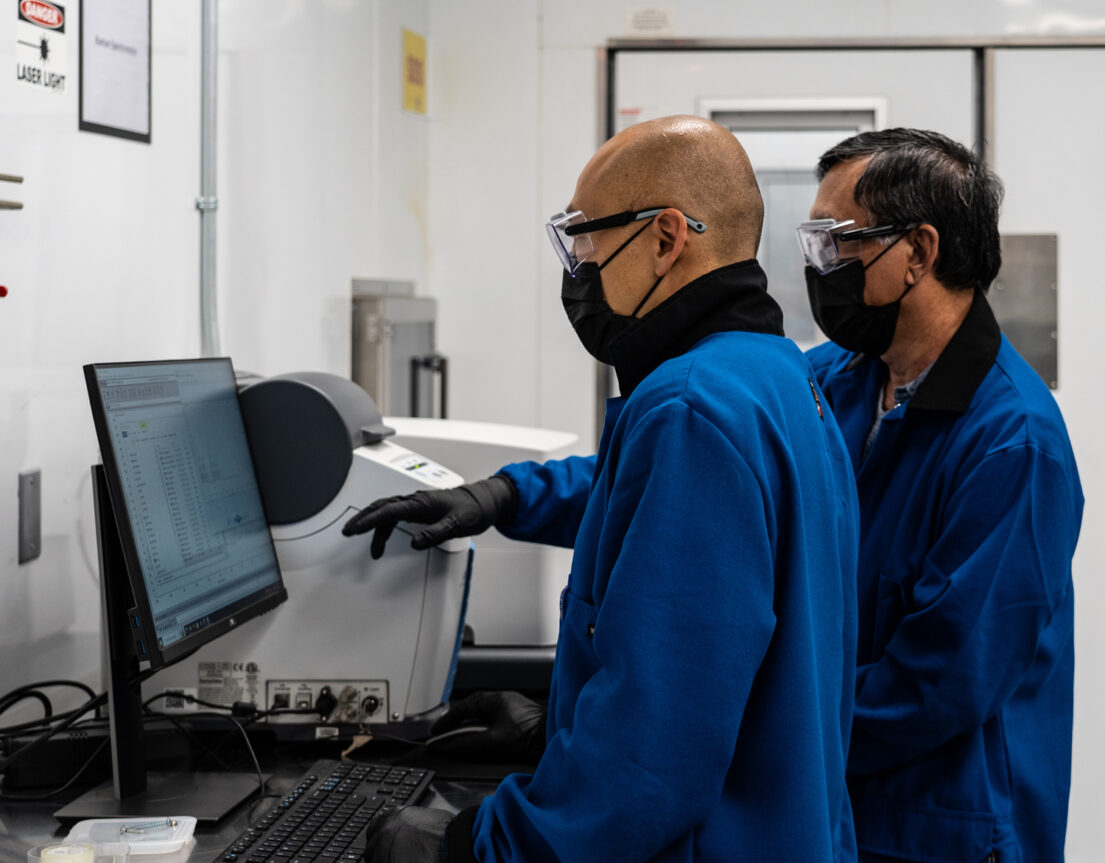
The factory is part of the invention
Wakai’s route into this work began with mechanical engineering at Maizuru College of Technology, followed by bachelor’s and master’s degrees in production-system engineering at Toyohashi University of Technology. The pairing is revealing without requiring mythology. One discipline attends to machines and forces. The other asks how those machines become a system. Battery scale-up needs both views at once.
Blue Current’s proposed production path is deliberately recognizable. The company says its dry chemistry can use mixing, coating, calendaring and stacking equipment already familiar to lithium-ion pouch-cell manufacturing. It also expects to avoid formation and aging, two costly, time-consuming stages used in conventional production. Compatibility is not a decorative detail. A technology that can ride existing industrial muscle has a shorter argument to make with the world.
Familiar equipment does not mean easy production. Dry powders bring their own habits: flow, agglomeration, static, dust and sensitivity to tiny changes in distribution. Coatings must remain uniform. Interfaces must survive. A machine capable of performing a step still needs recipes, controls and feedback loops. The distinction resembles owning a piano and being able to play it, except the piano is expensive, the score is proprietary and a discordant note may appear only after hundreds of cycles.
One of Wakai’s patents offers a glimpse of the preoccupations behind the job. Granted in 2024 and shared with a team of inventors, it describes systems and methods for infusion mixing a slurry-based electrode. Among its embodiments are ways to produce single- or double-sided finished electrodes directly from dry powder mixtures. A patent is not a personality test, but its verbs are telling: mix, compact, infuse, produce. They belong to the grammar of scale.
The glamorous unit of deep tech is the breakthrough. The useful unit is the controlled process.Mixing, coating, pressure, repetition
A career measured in handoffs
The detour through Desktop Metal fits more neatly than it first appears. Metal additive manufacturing also begins with engineered feedstock and ends with a demand for repeatable physical performance. The component may be different, but powder does not care which industry’s badge is on the building. It still has to mix, flow and consolidate predictably. Process knowledge travels when the underlying questions travel with it.
Battery production work spanning Panasonic, A123 Systems, Zeon, QuantumScape and 24M Technologies.
Manufacturing planning and machine selection for volume production.
Process engineering for mass-produced metal 3D-printing media.
Advanced manufacturing for a fully dry, silicon-rich solid-state platform in Hayward.
Current public affiliation; the company was formed in California in September 2025.
At Blue Current, the handoff is becoming tangible. The company reports that its Hayward pilot line became operational in 2026 and is producing two-amp-hour cells. Pilot production occupies an awkward, valuable middle ground. It is too large for the rituals of a research bench and too small to enjoy the economics of mass production. Its purpose is to discover which assumptions survive contact with cadence.
The company has momentum to spend on that discovery. Its 2025 Series D financing, anchored by Amazon, brought in $81 million to accelerate commercialization for mobility and stationary-storage batteries. Money does not resolve an interface or tune a coating line. It buys the time, equipment and people required to learn what will.
The technical scorecard is ambitious. Blue Current reports multilayer cells with no thermal runaway, venting or ejection of internal materials during independent nail, crush and overcharge tests. It reports ten times the silicon content of current lithium-ion cells, more than a thousand cycles in earlier technical disclosures, and an eventual path to high energy density with lower material and processing costs. These are company results and targets, not permission to skip the hard middle. The pilot line exists because the middle must be crossed.
The quiet leverage of an operator
Wakai is not the loudest character in Blue Current’s public story. The company’s chemistry, founders and financing produce more obvious headlines. His value is easier to see in the dependencies. High silicon content matters only if electrodes can be made consistently. Low-pressure operation matters only if multilayer cells keep cycling. A dry process matters only if powders can be handled at useful speed and yield. Advanced manufacturing sits beneath every promise, holding up the nouns.
Even the factory vocabulary hides human judgment. Selecting a machine means deciding which variation can be tolerated and which must be designed out. Writing a process means translating the practiced motion of an expert into instructions another person can follow. A pilot line is therefore a school as much as a facility. Materials teach the equipment; equipment teaches the team; the team revises the materials. The lessons are recorded in settings, inspection routines and the small interventions that prevent a bad batch from becoming an expensive one.
Wakai’s bilingual fluency in Japanese and English is a modest biographical detail with a practical echo. His career connects Japanese engineering education and Panasonic experience with a sequence of American battery and manufacturing ventures. Modern battery production is an international conversation among material suppliers, equipment makers, researchers, automakers and capital. The production operator often stands at the crowded center, translating not only language but priorities: a scientist’s ideal formulation, a supplier’s available powder, a machine builder’s limits and a customer’s specification.
That makes his career useful beyond batteries. Deep-tech companies often organize their story as a relay: scientists invent, engineers develop, operations scale. Reality is less courteous. Choices made in chemistry create equipment problems; choices made in equipment constrain chemistry. The baton is wet clay. Everyone leaves fingerprints.
The sharper model is concurrent. Ask early what a production line will tolerate. Prefer materials that can be sourced and handled. Treat pressure, packaging and formation time as design variables, not unfortunate details for another department. Blue Current’s silicon-first language describes its chemistry. Wakai’s career suggests a companion idea: production-first curiosity.
There is wit in the fact that a battery, an object prized for storing energy, requires so much organizational energy before it can exist at scale. Thirty years in, Wakai remains close to the conversion point. Not electricity into motion, but possibility into procedure. The pilot line in Hayward is now making cells. The next result will not be a single dazzling object. It will be the same good object, again and again, until repetition begins to look like progress.