In a battery, the separator has an unglamorous assignment: keep two electrodes from touching while letting charged particles pass. It is a little like asking a nightclub door to be both wall and bouncer. In 2015, Peter Frischmann and Brett Helms, working from research at Berkeley Lab, made a polymer membrane with pores small enough to control who got through. The science was promising. Then they talked to the people who would have to buy it.
- Sepion sells polymer coatings and coated separators for battery makers, not consumer batteries.
- Early customers resisted a switch to lithium-sulfur manufacturing; Sepion moved toward lithium-metal and existing production lines.
- Its Alameda pilot plant, 620 reported coating trials and 2026 commercial-line qualification show how much work hides inside a thin film.
The founders first imagined the membrane in lithium-sulfur batteries. An NSF customer discovery program brought an inconvenient answer: lithium-ion manufacturers were unlikely to rebuild their factories for that chemistry. Their invention had met a market that preferred its machinery. Sepion turned toward lithium-metal batteries, where the same sort of selective membrane might help tame the unruly way lithium plates during charging.
That was one change of mind. The more consequential one came later. By 2022, the team had decided that becoming a full battery company would be too capital hungry. A component supplier could reach many cell makers without financing every electrode, pouch and production line itself. The part that had seemed too small to headline a company became the company.
What the little film does
A conventional separator is a porous plastic sheet, often coated with ceramic particles. It blocks electrical contact between the electrodes and lets lithium ions move through electrolyte. Sepion coats a polymer layer onto that sheet. Its pores can favor lithium's passage while hindering larger, troublesome species crossing from the cathode. In lithium-metal cells, its materials also aim to make lithium deposit more evenly at the anode rather than forming needle-like structures that can shorten a cell's life or create a short circuit.
metal ions
separator
lithium
Lithium ions need a path. Unwanted crossover and direct electrode contact do not. The polymer layer is Sepion's attempt to separate those outcomes.
Its pitch is also industrial. The coating can be applied to separator film on roll-to-roll equipment and inserted into conventional lithium-ion cell manufacturing. That matters because a marvelous battery material with a new factory attached to it is a much harder sale. Sepion's nearest comparison is the incumbent ceramic-coated separator; solid-state battery systems offer another route to high-energy cells, but ask for more sweeping process changes. Sepion instead tries to improve the familiar stack.
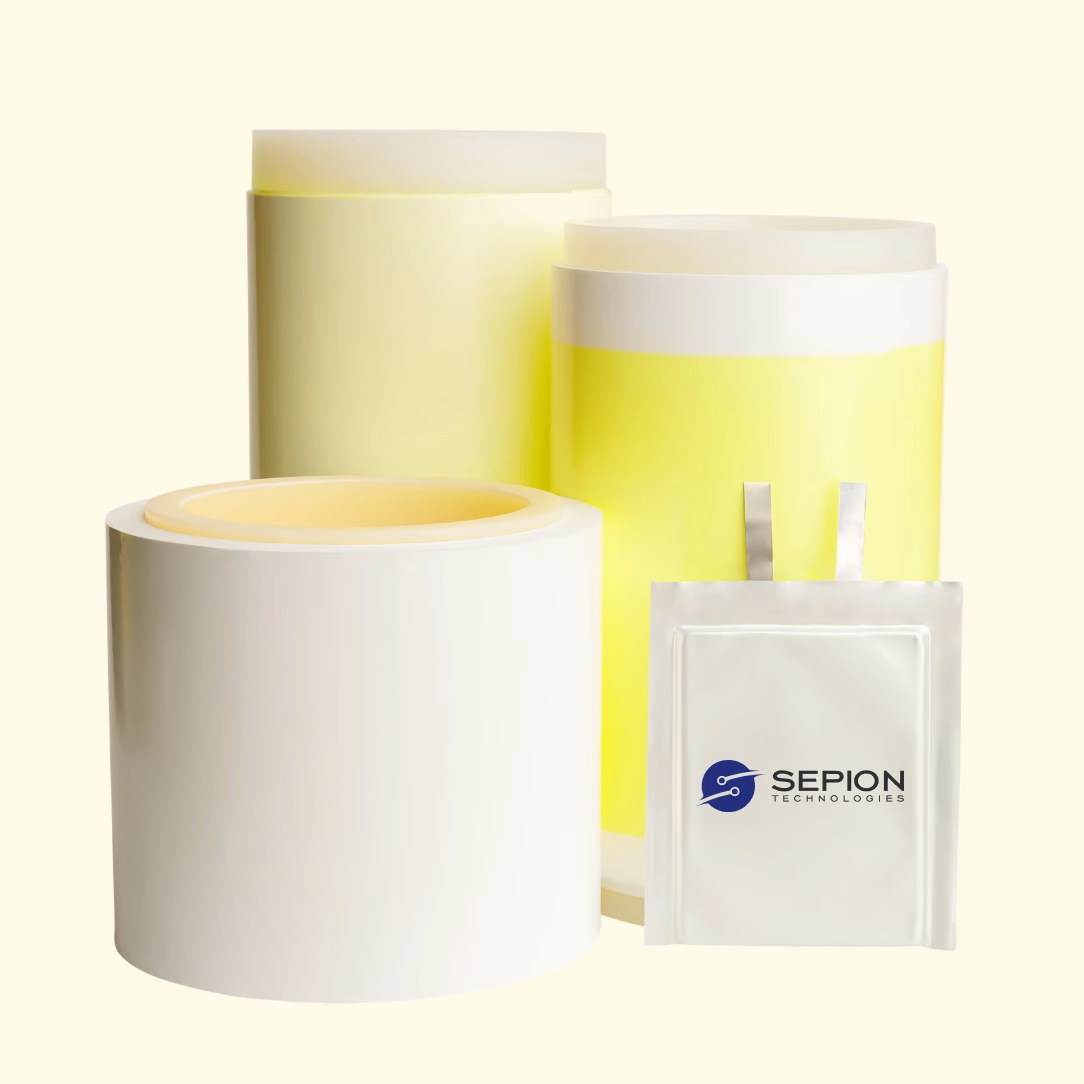
The product family now has two names. Sepion Power is aimed at charging speed and energy density; a March 2026 company release describes a coating under 200 nanometers thick and claims potential vehicle-level weight reduction of up to eight kilograms. Sepion Shield is tuned for durability, safety and cycle life. Those are company-reported performance aims, not a promise that any particular car will charge faster. Cell design, chemistry and customer validation decide the result.
Power
For battery designs chasing charge rate, energy density and a thinner system.
Shield
For designs where lifespan, thermal stability and cost over time lead the specification.
The factory was a clock
In the laboratory, a good separator can be made one sheet at a time. Battery customers buy consistency by the roll. Sepion's California Energy Commission report reads like a tour of the distance between those two ideas: 378 qualified polymer ink formulations, 620 coating trials, and a 150-millimeter roll-to-roll machine that needed new web controls and a precision slot-die module. Tension, curling, repeating defects and uneven coverage were not minor annoyances. They were the reasons a beautiful membrane might never become a product.
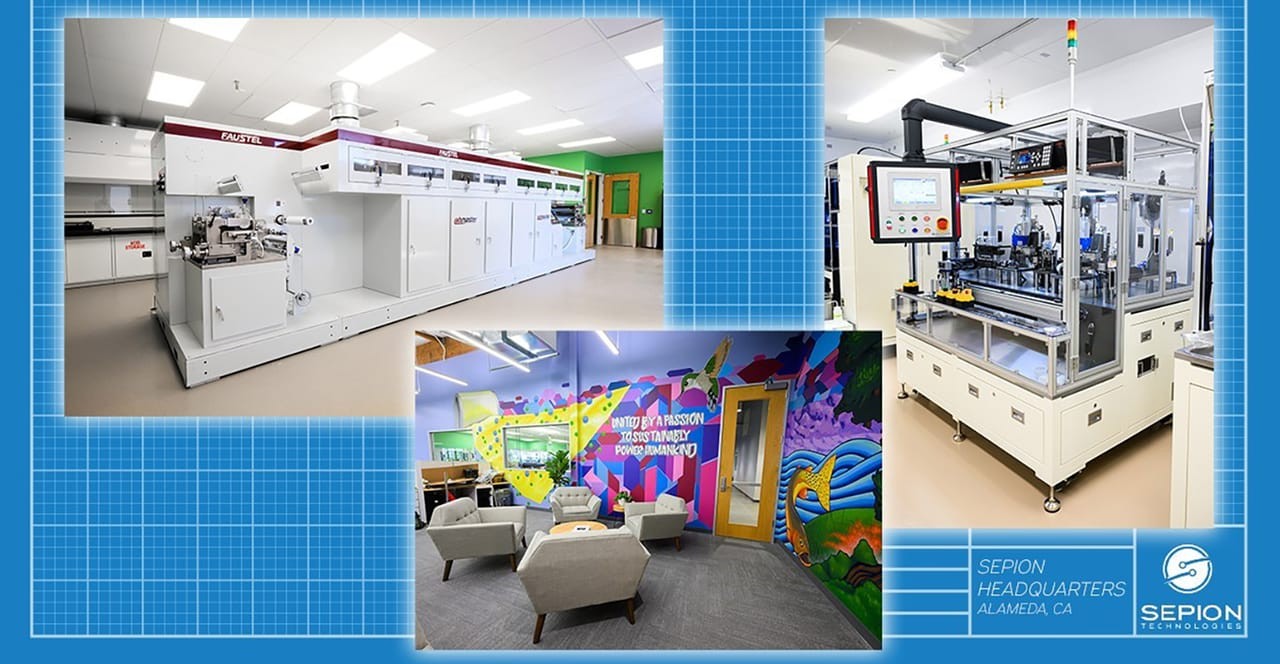
The project set a manufacturing cost target below $1.50 per square meter for the coated separator; the published report calls it a target, not a verified selling price. The report also says that, before Sepion had enough internal capability, a prototype traveled to a partner facility, back for testing, then onward to a customer. The trip could consume four to six months. That makes the 25,000-square-foot Alameda pilot facility, opened in 2023, easier to understand. Its coating lines and cell prototyping capability were not merely a display of industrial ambition. They shortened the distance between a customer question and a sample the customer could test.

Peter Frischmann / CEO and co-founder
He and Berkeley Lab scientist Brett Helms founded Sepion in 2015. Their customer interviews first changed the battery chemistry; manufacturing economics later changed the business model.
The bill, and the buyer
Sepion's growth has required money from several directions: a $16 million Series A in 2021, a $9 million ARPA-E SCALEUP award in 2022 and a $17.5 million grant announced in 2024 for a planned West Sacramento manufacturing facility. In March 2026, it announced a $10 million Series B led by Fine Structure Ventures, with W. L. Gore & Associates and Syensqo Ventures among the strategic participants. The company said the proceeds would support U.S. polymer production, quality operations and commercial purchase orders. The West Sacramento project remains a plan; grant money and projected output should not be confused with a completed factory.
“Separators are one of the most critical and most under-innovated components in the battery.”Peter Frischmann, March 2026
The buyers are separator manufacturers and battery cell makers serving electric vehicles, stationary storage and consumer electronics. Sepion says multiple global battery manufacturers are qualifying its material, but has not named them. Its agreement with Shenzhen Senior Technology Material shows how one channel could work: Sepion brings polymer coating material and design; Senior brings separator substrate and coating capacity. The 2024 memorandum included a large forecast for 2026-28 sales, explicitly subject to demand and execution. A forecast is not a delivered order.
The commercial status is narrower, and more interesting, than a triumphant launch slogan. Sepion says its coated separators are being produced on commercial lines for late-stage customer qualification. That places the company beyond a bench demonstration while leaving the decisive test to customers: can a new layer be produced repeatedly, at the required price, with enough safety and lifetime data to earn a place in a battery design?
A lesson hidden in plain sight
Sepion's story offers a sequence other materials startups can use. Ask buyers about the factory before celebrating the molecule. Design early experiments so the lab process resembles a manufacturable one. Test the ugly practical variables - web tension, ink stability, cycle life, sample lead time - while there is still room to change the product. And decide whether the customer needs a new device or a better ingredient for the one it already makes.
- Find the existing line. Sepion chose a separator coating that could fit established roll-to-roll processes.
- Make samples quickly. The pilot facility attacked a months-long delay between request and customer test.
- Let qualification set the claim. Commercial-line production is a milestone; deployment at scale still depends on battery makers.
This approach has limits. A cell maker must still prove the coating in its own chemistry, format, safety regimen and economics. A drop-in material that fails yield, cost or long-term reliability is no drop-in at all. Sepion's expansion into water treatment and industrial separations, under its Frontier program, remains exploratory beside the battery work. The useful lesson is less romantic than invention: the invisible part wins only when someone can make it, buy it and use it without breaking everything around it.