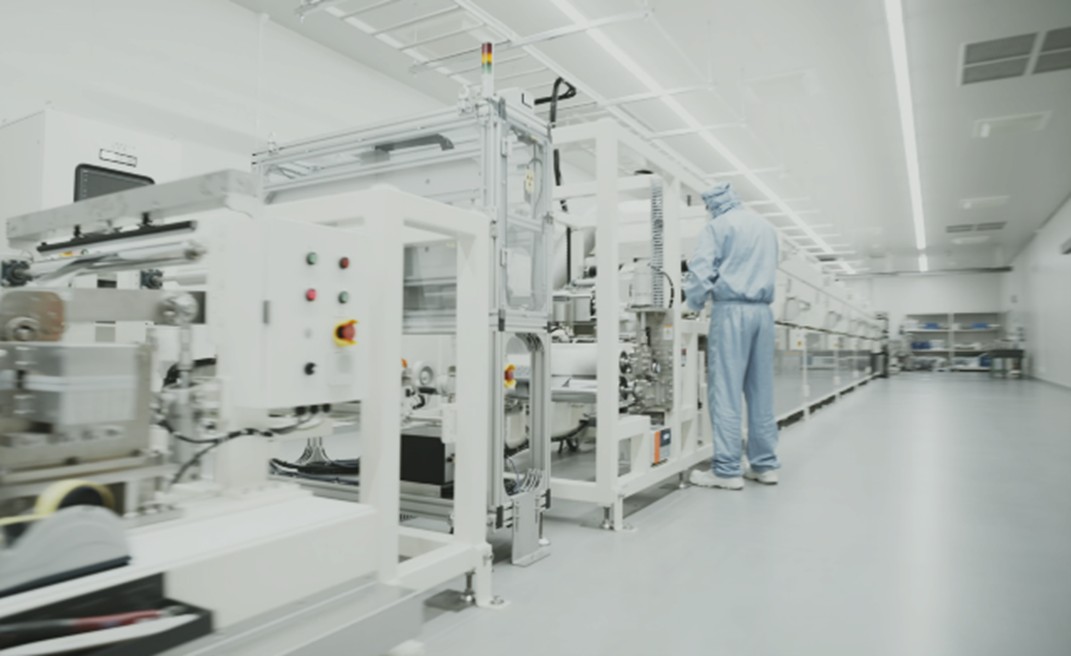
The interesting object in TeraWatt Technology’s story is not a battery cell. It is a production line. In a clean room in Japan, a worker stands beside a long procession of white machines. The photograph has none of the theater of a laboratory reveal. That is the point. A cell that dazzles once is a science result; a cell that emerges to specification day after day is a business.
- TeraWatt develops high energy density lithium-ion cells for electric mobility, drones and stationary storage.
- It began as a 2020 spinoff of SERES’s battery division and now runs development and production work in Japan.
- Its first mass production facility began preliminary operation in September 2024; customer engineering validation is the bridge to commercial sales.
- JERA, Kyuden International and other investors have backed a larger manufacturing and deployment effort.
The company’s maxim is “Make it Work at Scale.” This sounds modest until one considers how many battery stories end before the scale part. Chemistry can perform beautifully in a controlled setting, then meet coating tolerances, yield losses, quality checks and a buyer who expects the next shipment to behave exactly like the last. TeraWatt’s public case rests on making those two worlds speak to each other.
A spinoff with a factory problem
TeraWatt was born when SERES, an automotive technology company, separated its battery technology division on January 1, 2020. Ken Ogata, a battery researcher with a PhD from Cambridge, became co-founder and CEO. SERES kept a minority stake. The original announcement described solid-state battery work; TeraWatt’s current public description is broader and more grounded: next-generation lithium-ion cells that are lighter, smaller, more powerful and safer, built for production.
Ogata’s route to this position helps explain the emphasis. After research at Cambridge, he moved to a major battery manufacturer in 2014. In a later interview with the Japan Bank for International Cooperation, he described the widening gulf between research and production when new battery designs require new processes as well as new materials. His remedy was organizational as much as chemical: put R&D engineers and manufacturing engineers in a single team.
“The next battleground will be mass production.”Ken Ogata, in JBIC Today
That sentence is a good test for the company. TeraWatt is selling an industrial promise. Customers do not buy energy density in isolation. An electric vehicle maker needs range, power, safety, price and dependable supply. A drone operator cares about useful payload and flight time. A grid storage developer will ask about reliability, economics and delivery. The same cell technology may address several markets, but each market will qualify it on its own terms.
The expensive middle chapter
There is a long stretch between a pilot cell and a purchase order. In 2022, Temasek led TeraWatt’s Series B, and Daikin invested while collaborating on applications for lithium-ion battery materials. A 2023 Pre-C round was directed toward a larger development facility, an expanded pilot lineup and more customer sample work. These were steps toward proving that commercial-size cells could be made consistently, rather than merely designed persuasively.
By September 2024, TeraWatt had begun preliminary operation at its first mass production facility in Japan. It said it had already been making and validating commercial-size cells at two existing sites for domestic and overseas customers. The new facility joined development and manufacturing in one route to production. The company set commercial sales from 2026 onward as its target, after customer engineering validation. A target is not a shipment; the distinction matters in battery manufacturing.
The facility received ISO 9001:2015 certification in April 2025. It is a quality-management credential, not a certificate of battery superiority. But it speaks to the unromantic part of the proposition: controlled processes, documented improvement and the discipline a customer will look for before building a product around a young supplier. TeraWatt’s factory can be expanded in phases; the company has described gigawatt-hour potential with further equipment investment, not current output at that level.
Why the power companies arrived
A battery business can begin with vehicle range and end up in the electric grid. TeraWatt’s early stated applications included EVs, delivery drones and electric aircraft. Its newer alliances make stationary storage much more prominent. Kyuden International invested and agreed to explore battery storage businesses, first in Japan and potentially farther afield. JERA said it invested approximately $10 million in March 2026, then signed a memorandum with TeraWatt’s Japanese subsidiary to explore manufacturing and storage collaboration.
JERA’s approximate March 2026 investment. TeraWatt has not published a total for its Series C final close, so this figure belongs to one investor, not the whole round.
Those relationships offer more than money. JERA described possible work on domestic battery supply, cleaner electricity for manufacturing and links across the storage value chain. Kyuden brings power-system experience and routes into Japanese and international energy projects. None of that guarantees an offtake contract. It does give a cell maker potential partners on the other side of the factory gate, where cells must find systems, projects and buyers.
The April 2026 Series C final close added JERA, Kyuden International, Japan Green Investment Corp. for Carbon Neutrality and ITOCHU Technology Ventures to a round that had already included Khosla Ventures, Temasek, JBIC and others. TeraWatt said the proceeds would expand capacity at its initial facility in phases. Public round totals were not announced. The useful figure is therefore less a valuation than a sequence: pilot work, production site, quality system, strategic buyers and investors.
The part worth copying
Most readers will never build a battery factory. They can still borrow TeraWatt’s approach to a stubborn translation problem. The company treated the handoff from research to manufacturing as a design problem of its own. It put the people responsible for inventing the cell near the people responsible for repeating it, collected process data across sites through an internal platform called TeraSpace, and staged customer validation before promising ordinary commercial supply.
This approach has a cost: facilities, specialists, equipment and time. It also has limits. A good factory cannot rescue a cell that buyers do not want, and an alliance to explore storage opportunities is not the same as a signed supply contract. The idea works best where performance must survive repetition, qualification and price pressure. In those markets, the most consequential innovation may be the one a visitor barely notices: the same product coming off the line tomorrow.