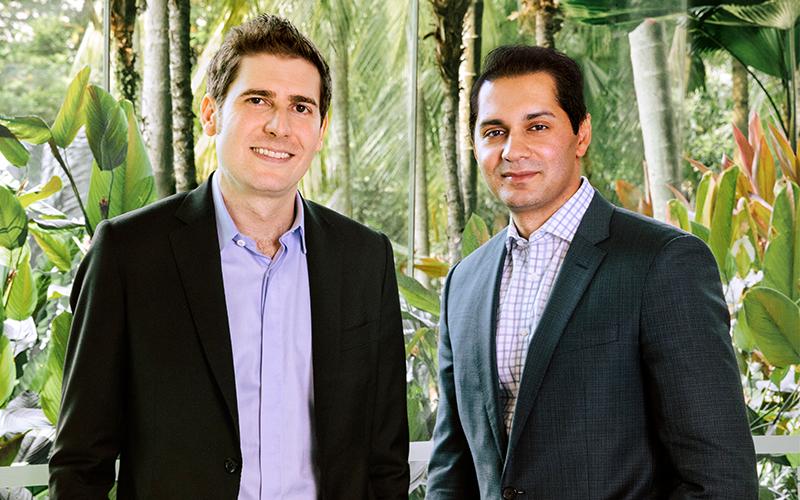
Raj Ganguly calls himself a skeptic. His co-founder Eduardo Saverin, he says, is the optimist. This is a useful division of labor in a business that pays people to imagine improbable futures and then asks them to put a price on the odds. Someone ought to ask the awkward question before the money leaves the room.
Ganguly’s path began outside Kolkata. At five, he moved with his parents and sister to the United States, where his father had taken a job as a nuclear reactor operator in New York. He later assembled a 286 clone computer with friends. At college, he quickly decided his fellow programmers were better than he was. He finished his degree anyway.
The computer stayed in the story. So did the willingness to reassess his own place beside it. Today, as co-founder and co-CEO of B Capital, he helps decide which technology businesses deserve capital, connections, and the considerable attention required to build across countries. His career offers a question worth following: what happens when someone who likes building things becomes responsible for helping other builders?
An insider who remembers the entrance fee
The credentials are familiar to anyone who has read a venture investor’s biography: the University of Pennsylvania, Harvard Business School, McKinsey, Bain Capital. Ganguly earned an MBA and undergraduate degrees spanning Penn’s Wharton School and School of Engineering and Applied Science. He graduated from the Management & Technology Program with summa cum laude honors, and was a Benjamin Franklin Scholar and Joseph Wharton Scholar.
His working life also included Diageo and the early internet-payments company Miradiant, later acquired by J.P. Morgan. At Bain Capital he invested in technology-driven businesses across the United States and Asia and co-led its global technology initiative. This was an education in companies from several angles: products, operations, advice, ownership, and geography.
Ganguly has supplied an important annotation to that polished résumé: scholarships enabled both Penn and Harvard. In a 2020 essay about overlooked entrepreneurs, he described himself as an Indian-American immigrant from humble beginnings. He acknowledged having acquired the recognizable qualifications and jobs while arguing that promising founders often arrive by other routes. The distinction matters. He knows the usefulness of the established entrance ticket, and the danger of treating it as a test of imagination.
Look for the delivery van
His argument about overlooked talent has a practical example with wheels. In that same essay, Ganguly described starting with a problem: digitally connected consumers in Southeast Asia would want to buy online and receive goods at their doors. Rather than looking only for another giant shopping platform, B Capital looked at the machinery that would make shopping possible.
That search led to Singapore’s Ninja Van and founder Lai Chang Wen. B Capital invested in 2016. The appeal was logistics: the less glamorous work between a purchase and a parcel arriving. A storefront can make a promise in a second. Delivery requires an organization to keep it.
By September 2024, Ganguly was describing Singapore as a home for B Capital from its first day and reporting that the firm had backed more than 40 companies across the region, from seed through growth. He also described an annual September gathering there to strengthen connections. For an investor committed to finding businesses across borders, returning to the same place has its uses. Local knowledge takes repeat visits; a map alone makes a poor colleague.
The introductions have to lead somewhere
At a September 2019 conversation in Singapore, Ganguly laid out three areas where B Capital wanted to help: customer introductions, senior hiring, and strategic capital. These are ordinary-sounding nouns with expensive consequences. A promising product needs someone willing to buy it. A growing business needs people who can run functions the founders once managed themselves.
He argued that one or two stronger executive hires could change a company’s direction. He also wanted large enterprises to become useful investors and partners. The point was to connect capital with commercial relationships, rather than leave the founder holding a cheque and a list of congratulatory messages.
The Boston Consulting Group partnership gives that idea an institutional form. In a later conversation with BCG’s Vikas Taneja, Ganguly emphasized access to customers, networks, industry knowledge, and critical thinking. The offer carries an obvious test: does a connection become something a founder can use? A prestigious name may improve a presentation. A customer meeting, a sound hiring decision, or help navigating a new market can improve the business.
A global firm needs local ears
B Capital’s structure reflects the ambition. Its platform team and partnership with BCG support companies with market entry, talent, strategy, and connections. Its investment reach extends from early stages through later growth. Ganguly is based in Los Angeles, while the work asks him to think across markets.
In January 2025 he set out a broader case for global venture investing. He proposed judging businesses on global problem-solving, adaptability across borders, and their contribution to entrepreneurial ecosystems. His argument allowed for local constraints, including regulated industries, while resisting the assumption that retreating into a single market was the natural response to uncertainty.
The appealing part of this philosophy is also its difficulty. A problem can be shared across countries while the way customers buy, regulators act, and organizations work remains stubbornly particular. Ganguly’s prescription was to embed investors locally and retain a global view. It asks a firm to do two demanding things at once: recognize a pattern, then listen carefully enough to discover where the pattern stops working.
The skeptic still wants a working business
Ganguly’s appetite for technology has room for less fashionable financial questions. In March 2022, as startup valuations faced a correction, he welcomed renewed attention to profitability. He said some Southeast Asian companies had seen valuations run ahead of themselves. Optimism about a region did not require approval of every price attached to it.
That distinction remained visible at Davos in January 2026. He discussed further AI and AI-services deals in India, alongside the need for the startup ecosystem to produce more IPOs and acquisitions as it matured. In the same round of conversations, governance was in focus. He said investors, as well as startups, had learned lessons.
These remarks put obligations around the opportunity. A growing ecosystem needs routes for investors to realize returns, and companies need governance capable of sustaining confidence. It is possible to believe strongly in founders while asking demanding questions about the institutions around them. For Ganguly, the questions belong in the investment conversation. Otherwise, confidence becomes a very well-dressed substitute for diligence.
“A return to profitability is a good thing for everyone.”Raj Ganguly · March 2022
AI arrives at the investment committee’s door
By February 2026, Ganguly and B Capital general partner Yan-David Erlich were applying that approach to AI. Their joint essay argued that the difficulty of deployment deserved as much attention as the speed of technical progress. Enterprise adoption involves data, procurement, compliance, retraining, and trust. A successful demonstration leaves much of that work untouched.
They highlighted applications that could show measurable business value and infrastructure that would make agents usable: organizational memory, coordination, observability, and security. Their case focused on the systems surrounding a model, including the information that allows software to understand a particular business and the controls that make its actions accountable.
This is recognizable territory for an investor whose earlier pitch involved helping products reach customers. A tool’s capabilities and an organization’s willingness to depend on it are separate commercial hurdles. The interesting question becomes how the distance between them gets covered, who does the work, and which businesses can earn money by making that process reliable.
Even the Bee has questions
At the Milken Institute’s May 2026 conference, Ganguly described an experiment inside his own firm. B Capital had built an AI team and an agent called the Bee, working with a system called the Hive. He said AI had helped clean up internal data and reduced diligence from three or four weeks to a few days. Those were his reported results, rather than a promise about every investment process.
The people, he said, were another obstacle. His account included the agent identifying its own human users as a constraint on adoption. There is a pleasing indignity in financing the future and then being informed by the office software that you are slowing it down.
Ganguly also described a shift toward innovation capital, with venture investors operating alongside growth equity, private equity, strategic investors, and institutional partners. In July, B Capital appointed Andrew Jackson chief AI officer. The experiment had acquired a dedicated executive. The question of who helps whom now ran through Ganguly’s own organization.
Ganguly’s May 2026 account of AI-assisted diligence at B Capital: from 3-4 weeks to a few days.
A REPORTED INTERNAL RESULT · NOT A FORECASTBuilding the room, as well as choosing the guests
Ganguly’s public accounts of B Capital’s gatherings show another part of the job: assembling people who would not necessarily share a room otherwise. His description of the firm’s 2023 annual meeting ranged from Columbia robotics professor Hod Lipson to entrepreneur Sarah Jessica Parker, alongside investors, founders, and market leaders. He delivered the State of the Firm address with Saverin.
The variety fits the business he has chosen to build. An investment firm needs judgments about technology, but it also needs relationships sturdy enough to carry information, disagreement, and introductions. A room full of people who already agree would be a comfortable place to spend an afternoon. Its investment value is less obvious.
Ganguly’s skepticism gives this story its human scale. He is asking founders to attempt difficult things, asking established businesses to try unfamiliar products, and now asking his own colleagues to change how they work. Each request needs conviction. Each also deserves a few awkward questions. The partnership with an optimist leaves plenty of work for both of them.