Rahul Dhanda sent the email with less than a week left before graduation. He was finishing his MBA at MIT Sloan and wanted to meet Robert Langer. He did not expect much. Langer replied within minutes. They arranged a meeting. Years later, the relationship would help produce Syntis Bio, the company Dhanda co-founded with Langer and Giovanni Traverso in 2022.
It is an appealing origin story because the action is so small. No pitch competition. No carefully staged introduction. One student asking someone he admired for a conversation. The eventual company makes the email memorable, but the more interesting part is the interval: a relationship maintained while Dhanda accumulated the experience to become a founder.
When he announced Syntis to his professional community in 2022, he went back to that final week at Sloan. Langer had become a continuing presence in his career and had introduced him to Traverso. A company has a founding date. A working relationship can have a much longer calendar.
The family business had a forecourt
Dhanda grew up in New Jersey with two brothers and parents who had immigrated from India. His father worked as an engineer at Bell Labs. His parents also owned a gas station. At six, Rahul began helping there: his father would collect him after work and relieve his mother, who went home to his brothers. Father and son pumped gas. On weekends, he learned about fixing cars.
The family combined salaried employment with the daily demands of running its own business. His older brother would also go on to start companies. Entrepreneurship was already part of the household long before Rahul acquired the vocabulary of product management and corporate development.
At Wesleyan, where he graduated in 1995, Dhanda majored in history and also took premedical classes. His education crossed subjects that a tidy career biography might put on separate shelves. He has spoken about the appreciation Wesleyan gave him for the humanities and their place in science, particularly the wider social consequences of new technology.
That combination would remain visible. His subsequent work involved research, business development and company leadership; his first book asked how commercial organizations should behave. A history degree sits quite comfortably in that company. People, institutions and consequences were going to occupy a considerable amount of his working life.
A book before the corner office
In 2002, Wiley published Guiding Icarus: Merging Bioethics with Corporate Interests. Wesleyan’s magazine included the book in its list of newly published alumni work. Dhanda was writing about the relationship between ethical judgment and business years before Syntis existed.
The book’s central concern was practical: companies help determine how new technologies enter the world, while the people studying their ethical implications often work elsewhere. Dhanda wanted those conversations brought together. Responsible conduct, in his account, belonged inside an organization’s commercial thinking.
The title provides a fairly pointed companion for an ambitious executive. Icarus is an awkward mascot for anyone selling an unqualified promise of ascent. A book called Guiding Icarus leaves room for ambition and for somebody to ask about the wings.
Its contents moved across several areas of biotechnology and included a conclusion, glossary and suggested reading. This was an attempt to make a conversation usable across professional boundaries. The author was already operating between disciplines, translating questions that could otherwise remain trapped inside their respective departments.
Dhanda’s record also includes service on the American Association for the Advancement of Science’s Committee on Scientific Freedom and Responsibility. That pairing of freedom with responsibility is a useful description of the questions that have followed him from publishing into company building.
A book about bringing ethical judgment into the business conversation.
Learning the machinery
His operating career developed through specific jobs. From May 2001 to June 2004, he worked in business development at Interleukin Genetics. After earning his MBA, he joined Boston Scientific in June 2005 and worked in marketing. In 2008, he moved to T2 Biosystems.
At T2, he became vice president of marketing in 2010 and senior vice president of corporate development in February 2016. The progression put him on both sides of a familiar company problem: deciding what to offer and arranging the relationships that allow an organization to grow.
He spent roughly a decade at T2 as it developed from a venture-backed startup into a publicly traded commercial business. His responsibilities covered strategy, marketing, product management and corporate deals. Those partnering activities brought more than $40 million to the company. At Boston Scientific, he had led a team responsible for a portfolio generating more than $100 million in annual revenue.
Those figures describe different things. One measures partnering activity; the other measures annual product revenue under a team’s responsibility. Together, they show the range of commercial work on his résumé. The founder label arrived after substantial time spent inside the machinery.
- 1995Wesleyan graduate
- 2002Published author
- 2008Joined T2
- 2022Co-founded Syntis
Dhanda later co-founded Sherlock Biosciences and served as its president, CEO and a director. His career had moved from helping negotiate transactions and manage products to carrying responsibility for an organization. He subsequently became a co-founder and chairman of BLASTID as well. Building companies had become a recurring occupation.
Who gets to take part?
The question of corporate responsibility acquired an organizational form in 2020. Sherlock established the 221b Foundation, with Dhanda and Mark Jefferson, then an assistant dean at Harvard Law School, among its initial board members. The foundation linked access to company intellectual property with support for racial and gender diversity in science, technology, engineering and mathematics.
Its first partner was Scratch, the programming language and online community originally developed at MIT. Scratch’s role was to direct funding toward work benefiting Black, Latinx and Native American communities, along with young women and girls. Corporate assets, a nonprofit structure and educational opportunity were being connected in the same arrangement.
That is a more specific proposition than putting a statement about inclusion on a website. It identifies an asset, a route for proceeds and a partner. The arrangement makes the question of participation part of how the organization allocates resources.
By 2021, the foundation named Scratch, HMS MEDscience and the Akilah Institute among programs supported through its model. The list gave the initiative a set of institutional relationships. For a business leader who had written about bringing ethics into corporate decisions, it represented another way of working on that problem.
The email comes back into view
After leaving Sherlock, Dhanda contacted Langer again for advice about his next move. The conversation led to a meeting with Traverso. This time the relationship produced a founding team.
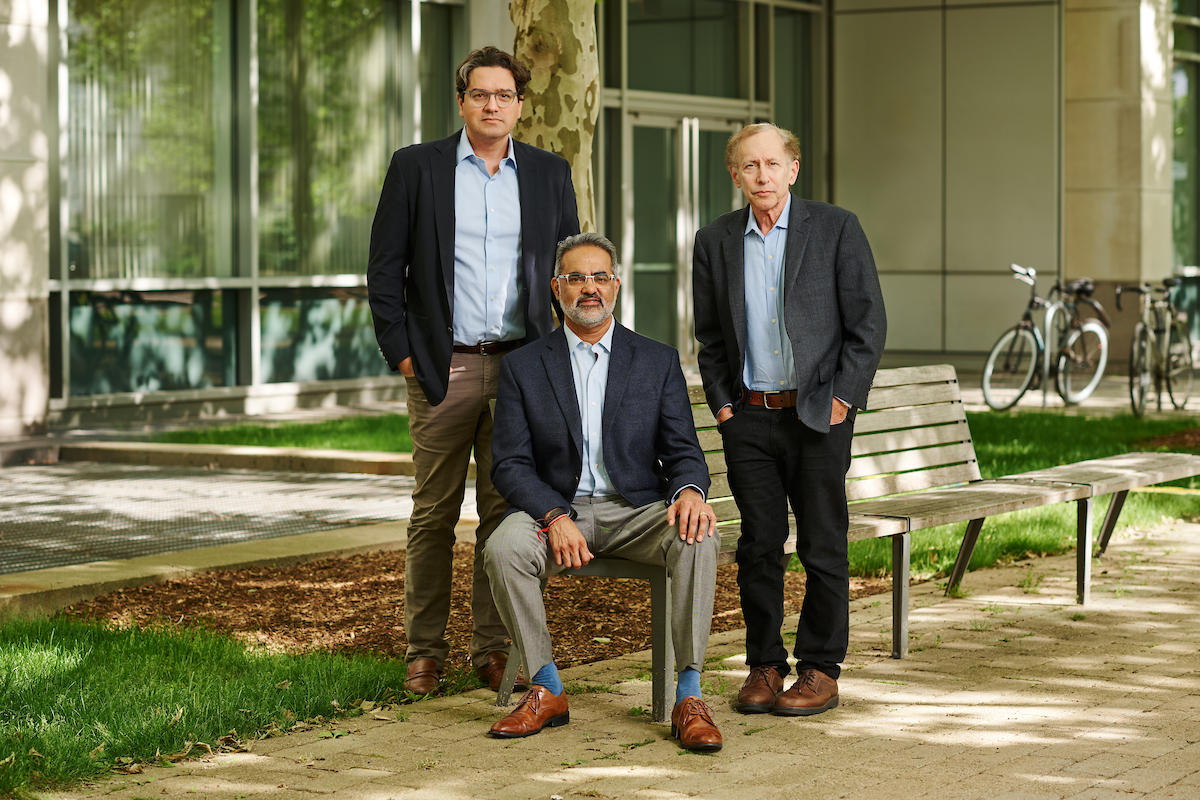
Syntis was founded in 2022 and publicly launched in June 2024. By its public debut, it had raised $15.5 million. The two dates are useful together: the announcement came after the founders had already spent time assembling the business. The public starting line was some distance into the race.
Dhanda’s responsibilities extend beyond his own company. In November 2023, he joined the board of Constructive Bio as a non-executive director. The appointment connected a Boston executive with a company in Cambridge, England. Its announcement emphasized his experience building platform businesses and bringing scientific work toward commercial use.
His conversations about entrepreneurship also reach beyond boardrooms. In 2023, he appeared on Lab Rats to Unicorns in an episode recorded before an audience in Dorchester. The discussion covered startup creation, organizational culture and the difficulties created by silos. Later that year, he spoke with Joshua Fox for the Mintz On Air podcast about founding and running businesses.
Give the team the credit
In July 2025, Syntis announced a $33 million Series A led by Cerberus Ventures. New investors included Mansueto Investments, Woori Venture Partners and Apollo Labs, alongside existing backers. Chenny Zhang and Michael Nannizzi joined the board. More capital brought more relationships into the company.
Dhanda’s own announcement dwelt on the difficulty of raising money in that market and thanked people who had worked on the company, including former team members. He acknowledged a contribution from luck, then assigned the rest of the credit quite clearly.
“Everything but the luck was built by this team.”
Rahul Dhanda · on Syntis’s Series A
The sentence is revealing in its allocation of ownership. In a post carrying his name, announcing a financing for a company he leads, he gave the work to the team. His account placed execution and evidence alongside the capital, and people alongside the milestone.
In June 2026, Syntis appointed Matt Dallas as chief financial officer. Dallas brought more than 25 years of financial experience, including work on public and private financing, operations and partnerships. Dhanda’s comments emphasized building the company’s financial and business infrastructure for its next stage.
That is where the long preparation returns to the present. The executive who worked across marketing and corporate development is now adding those capabilities around him. His company’s next chapter depends partly on experienced people being able to carry their own responsibilities.
The cold email still deserves its place in the story. It opened a conversation that lasted. But look at everything between the message and the company: the operating roles, the book, the transactions, the colleagues and the organizations built along the way. Dhanda sent a short note. He then spent years acquiring something worth bringing to the next meeting.