John Harthorne remembers the apple juice. There was a boombox, too, and a room with far too much space for the handful of people occupying it. He had crossed over from MIT’s business school to meet engineers. Judged as a party, the mixer was in trouble. Judged as a collection of people attempting useful things, it would rearrange his sense of what a career could be.
He began asking people what they were working on. The answers included ways to bring energy to places beyond the electricity grid. Then the question came back to him. His own plan involved consulting. In his retelling, the gap between their ambitions and his expectations of himself became uncomfortable. He had underestimated the ambitions a working life could hold.
That recollection supplies a useful entrance to Harthorne’s career. He saw something he wanted to join, and recognized that assembling people could be his contribution. Plenty of business stories begin with a product. His begins with discovering what other people were trying to do, in a room whose social arrangements left considerable scope for improvement.
“I didn’t know I was allowed to be amazing.”
John Harthorne, recalling MIT
The bonus arrived at the wrong moment
The practicalities were less romantic. Harthorne finished his MIT Sloan MBA in 2007 with $150,000 in student loans, by his account. Bain & Company offered a salary and a route toward paying them down. He planned to stay through his first full year-end bonus and then start a company. December 2008 was an unfortunate date to put in that particular calendar.
The financial crisis gave the decision a wider meaning. Harthorne and fellow Bain consultant Akhil Nigam began developing MassChallenge during the downturn. They founded the organization in 2009, with the first competition launching the following year. Instead of choosing one startup idea to build, they would put resources within reach of many people who already had ideas.
That choice required its own act of entrepreneurship. An organization that gives away support still needs money, space, and a reason for other people to participate. The founders had to persuade an entire supporting cast to show up. Harthorne’s contribution would be measured partly in the ventures other people managed to start. It is a curious business to enter if you enjoy having every achievement carry your own name.
A million dollars, and a door left open
On April 19, 2010, Massachusetts Governor Deval Patrick and Boston Mayor Thomas Menino joined Harthorne, Nigam, and fellow founder David Constantine for the public launch. MassChallenge had secured a $1 million prize pool. Entrepreneurs could enter with any idea, from anywhere. The announcement paired a local address with an invitation that had no national boundary.
The launch brought public and private backing together. Massachusetts had pledged $500,000 through aligned organizations. Supporters included Microsoft, the Deshpande Foundation, The Fallon Company, and the Blackstone Charitable Foundation. It was coalition building with a deadline: the accelerator phase would run from July through October. The concept had to become a working place where teams could spend their days.
The original proposition was unusually easy to explain. Selected startups received access to office space, mentors, workshops, and networks during a four-month program. At the end, they competed for cash awards. MassChallenge operated as a nonprofit and took no equity. A founder could accept help without adding the accelerator to the ownership table.
The distinction matters because ownership follows a company for years. Advice can be offered in an afternoon; a stake is a continuing claim. MassChallenge’s structure made room for a different relationship between the institution and its participants. The institution could organize the contest and cheer for the contestants. The founders kept the consequences of whatever they built.
Someone still has to find the furniture
There is a less photogenic side to a startup community: someone has to arrange the office. When MassChallenge opened a new home in 2014, Harthorne thanked a list that ran from the City of Boston and Jamestown LP to furniture, construction, networking, and design contributors. The acknowledgments made a useful inventory of everything that has to exist before people can casually describe a place as an innovation hub.
The supporting relationships reached beyond the room. In 2012, MassVentures renewed its Fast Track partnership with MassChallenge after providing early funding to alumni Libboo and Vsnap the previous year. It planned to review as many as five more participating companies. The point was to help young businesses keep moving after the competition, rather than spend all their time finding the next source of money.
These details explain more about Harthorne’s work than a photograph of a crowded awards stage can. A program needs people who will return calls, judge applications, introduce customers, and keep commitments. Making the introduction is only the beginning. For the founder on the receiving end, the useful question is whether anything happens afterward. MassChallenge’s partnerships gave that question somewhere practical to go.
Boston was the beginning of the map
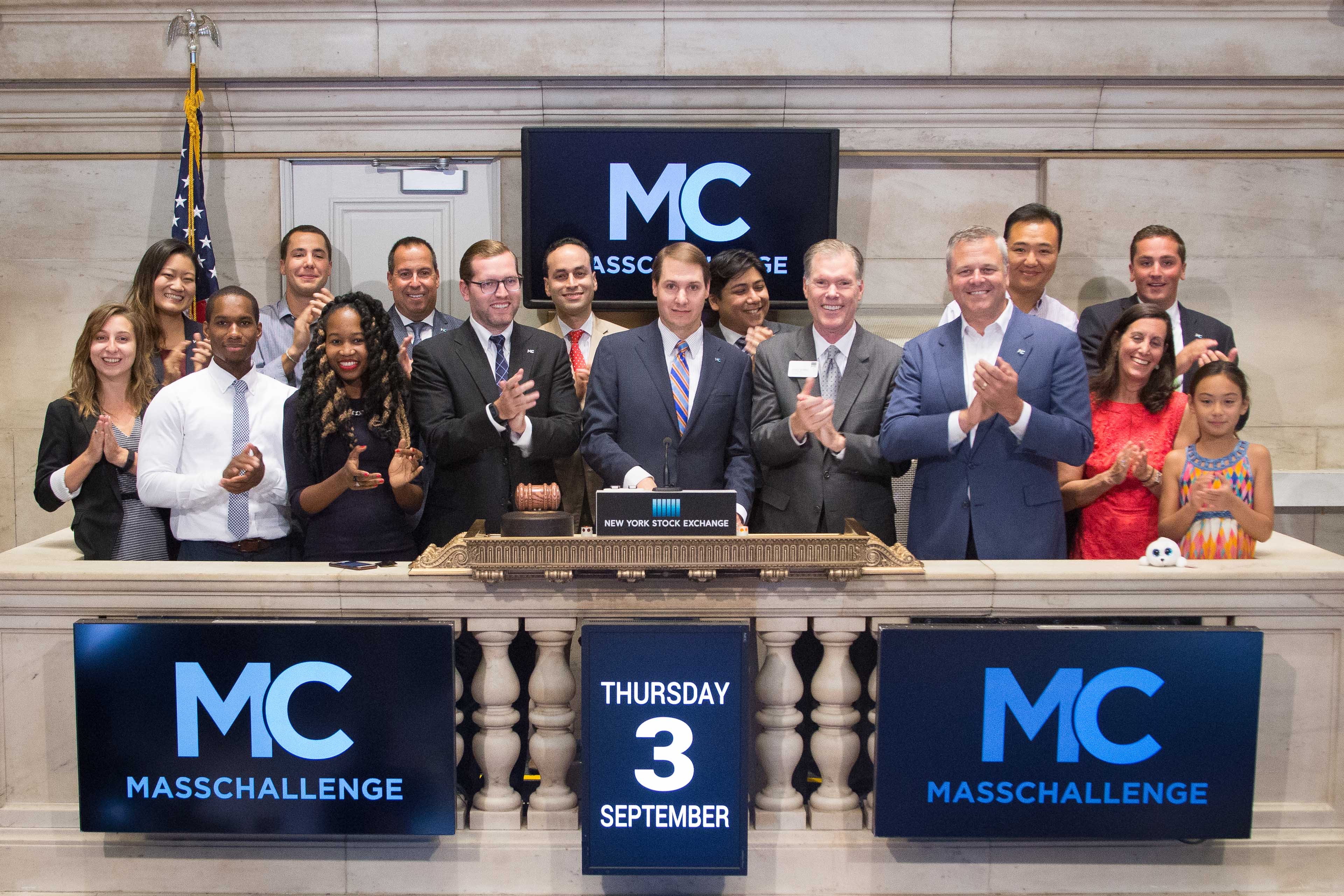
The organization’s ambitions extended well beyond Massachusetts. At the 2015 Boston awards ceremony, Harthorne introduced a message from Jerusalem Mayor Nir Barkat and detailed plans for an accelerator there in 2016. He also announced progress toward a program in Mexico. Boston and London had together drawn more than 2,250 startup applications that year.
The Boston cohort contained 128 startups; 44 percent had at least one female founder. Those figures describe a particular class, rather than a promise about every year. They also make the work tangible. Each place in the cohort represented a team passing through a selection process, then arriving with its own needs, expectations, and capacity to surprise the people running the program.
Harthorne became a public representative for that expanding network. In 2016, he arrived at a Harvard Innovation Labs conversation in business attire and promptly apologized for being “too overdressed.” He had come from another meeting. The small wardrobe complaint captures the movement between audiences: student founders in one room, institutional supporters in another, with the same organization to explain to both.
- 2007MIT Sloan MBA
MIT $100K grand prize - 2009 / 10MassChallenge founded
First competition launches - 2019 / 20Leaves CEO role
Launches Two Lanterns
The literature student in the pitch room
There is an earlier clue to how he learned to do that explaining. Harthorne graduated from Bowdoin in 1995. Asked which college class had helped him in business, he chose postwar German literature. He credited it with teaching him about storytelling, perseverance, and hope. A literature classroom is a perfectly reasonable place to learn that a protagonist will encounter difficulties before the final page.
His academic record later acquired more conventional entrepreneurial markers: the 2007 MIT $100K grand prize and MIT’s Patrick J. McGovern Award. Suffolk awarded him an honorary Doctor of Commerce in 2014. In 2019, he returned to the MIT competition’s thirtieth-anniversary event as a speaker. The former contestant had become someone invited to address the next set of contestants.
The public persona has room for a joke. In a Bowdoin alumni profile, his list of necessities included beer and Red Sox baseball, with family added in a comic afterthought. He is a Massachusetts baseball fan who can talk about a global startup renaissance. The scale of the ambition does not require him to abandon the ordinary pleasures of home.
A second lantern, a different bargain
Harthorne left MassChallenge’s chief executive role in 2019 and launched Two Lanterns in 2020. His partner, Michal Gilon-Yanai, is also an MIT Sloan graduate and had helped establish entrepreneurship programs in the United States and Israel. Their fund put a geographic focus around a network Harthorne had spent years developing.
The name reaches back to the lantern signals at Boston’s Old North Church. Harthorne also gives it a personal meaning: a founder travels a lonely road, and an investor can bring another light along. It is a warmer image than the usual language of deal flow. It still sits inside a fund that must choose companies and earn returns.
In a 2020 interview, he described a preference for capital-efficient companies and founders who care about revenue and business results. The present firm emphasizes pre-seed and seed investments in AI and software in the United States and Israel. Its portfolio includes Loora, an AI language-learning company, and dataplor, which supplies business-location data. The invitation now comes with a more specific set of criteria.
In a later conversation with Fidelity’s Kristen Craft, he put the team at roughly 65 to 70 percent of his evaluation. He spoke about ambition, resilience, professionalism, and integrity, alongside experience. Market size mattered; evidence from customers mattered. But the people carried most of the weight. An early investment gives both sides years to discover whether their first impressions were any good.
The useful person at the edge of the room
The change from accelerator chief to investor carries an obvious difference in incentives. Equity-free support can welcome founders without seeking a financial stake. Venture investing selects a smaller group and accepts the obligations of ownership. Harthorne has worked on both sides of that distinction. His career makes a case for helping entrepreneurs through more than one kind of institution.
There are quieter examples of his willingness to participate. The creators of the interview series How I Got Here described approaching him before they had any guests. Shared ties to Bain and MIT gave them a reason to write; he agreed to talk. Their account of the exchange is a reminder that an established person’s ordinary yes can be an unestablished person’s first piece of evidence that an idea might work.
By July 2025, he was discussing the journey from MassChallenge to Two Lanterns on the Stand Up to Stand Out podcast. The job title had changed; the recurring subject was still how people get ventures started. Look back at the mixer and the continuity is easy to see. Harthorne entered a poorly attended room, asked a question, and found work worth doing. He has spent much of his career trying to make that encounter easier for somebody else.
Keep the conversation going
- Two Lanterns · firm & portfolio
- John Harthorne · LinkedIn
- John Harthorne · X
- MassChallenge · the organization today
- Watch · How a Party at MIT Built the Groundwork for MassChallenge
- Listen · Accelerating Innovation (2025)
- Listen · Harvard Innovation Labs (2016)
- Read · Angel Invest Boston interview (2020)
- Read · The college class he credits
- Read · The 2010 launch announcement