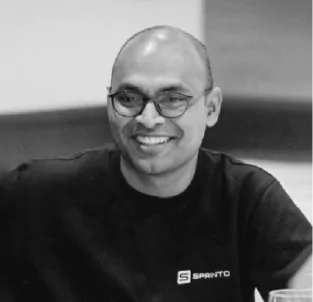
The Compliance Builder
The Twitter handle says it all: @notraghu. A founder who names himself after what he isn't. There's a particular kind of self-awareness in that - and it runs straight through how Raghuveer Kancherla builds companies.
He is, by his own description, "a programmer by choice, engineer by education, and performance junkie by passion." That last part - the performance junkie bit - shows up everywhere. In his early obsession with sports, in the bootstrapped discipline of RecruiterBox, and in the architecture of Sprinto: a platform built on the premise that compliance should run continuously in the background, not detonate every audit season.
Raghuveer graduated from IIT Madras in 2005 with a B.Tech in Mechanical Engineering. The pivot to software wasn't instantaneous. He spent a year as an associate at ZS Associates, then two years consulting at Genpact, before something clicked. The engineering brain turned to software, and he co-founded RecruiterBox around 2008-2009 with Girish Redekar and Raj Sheth.
"A growing market trumps having a better product."
- Raghuveer KancherlaRecruiterBox was an applicant tracking system - not glamorous, not venture-hyped, but real. They bootstrapped it. No VC money, no flashy seed rounds. Just customers paying for something that worked. Over seven-plus years, they grew it to 2,500+ customers and 50+ employees, with 70% of the client base in the US. Then Turn/River Capital, a San Francisco-based PE firm, bought them out in an all-cash deal.
Most founders would have taken a year off. Raghuveer, with Redekar again as co-founder, started Sprinto in 2020.
SOC 2 compliance used to mean six months of spreadsheets, manual evidence collection, and a stretched engineering team. Sprinto made it a continuous automated process.
THE SPRINTO PREMISEThe insight behind Sprinto is almost obvious in retrospect - which is how the best B2B ideas tend to work. Every SaaS company selling to enterprises eventually hits the same wall: the security questionnaire, the SOC 2 audit, the ISO 27001 certification request. For most startups, it's a distraction from building. It pulls engineers into evidence-collection theatre for months.
Sprinto automated the whole thing. The platform integrates with a company's existing cloud infrastructure - AWS, GCP, Azure - and continuously checks controls, collects evidence, and maps it to frameworks like SOC 2, ISO 27001, HIPAA, GDPR, and PCI-DSS. The audit, when it comes, is mostly already done.
By 2022, they'd grown the team from six people to 160+. By 2024, 300+. ARR tripled between 2022 and 2023. Accel led a $20M Series B in April 2024, with Elevation Capital and Blume Ventures participating. The company has grown 20x since its Series A.
Sprinto Funding Journey
Markets Over Products
Raghuveer's most-quoted line - "a growing market trumps having a better product" - isn't just a founder aphorism. It explains both companies. RecruiterBox entered applicant tracking when the market was expanding alongside the SaaS hiring wave. Sprinto entered compliance automation as the SEC, SOC 2, and enterprise procurement requirements were tightening globally. In both cases, he picked a wave over a niche.
He recommends Rob Fitzpatrick's "The Mom Test" for founders who want to validate ideas without getting politely lied to. He admires Ray Dalio's investment philosophy and applies principles-first thinking to company building - building systems and roles before personalities.
"Managing people is more about managing roles than managing personalities," he has said. It's a very engineer way to think about human dynamics: model the function, not the person. Define what the role needs at this stage of the startup, align expectations there, and the people part sorts itself out.
"Managing people is more about managing roles than managing personalities."
- Raghuveer KancherlaAI at the Speed of AI
Raghuveer's most recent thinking has turned to AI governance - which makes sense when your company's product is, at its core, about keeping systems in check. In a March 2026 Analytics Insight podcast, he laid out the challenge clearly: "The scale of adoption is outpacing the scale of oversight."
His argument is precise. When AI systems start making decisions, traditional compliance frameworks - built for human-paced processes - can't keep up. The answer isn't slower AI deployment. The answer is AI-powered compliance: machines governing machines at machine speed.
"When machines start making decisions, you need machines that can keep up with these machines so that the guardrails are also moving at the same pace as the technology." This isn't hypothetical for Sprinto. Their stack already includes Anthropic Claude, OpenAI, and n8n. They're not waiting for the AI governance market to form - they're building into it.
Raghuveer on Building
"A growing market trumps having a better product."
"When machines start making decisions, you need machines that can keep up with these machines."
"Everything we do is our small way of making the world a better place."
"The scale of adoption is outpacing the scale of oversight."
"I loved playing outdoors and spent most of my time learning new sports. I hated losing."
"Managing people is more about managing roles than managing personalities."
What He's Built
The Fine Print
His IIT Madras degree is in Mechanical Engineering. About as far from cloud compliance as you can get - and possibly the reason he approaches software like a systems engineer.
Twitter handle: @notraghu. Two underscores on Instagram: @rag__hu. The naming convention suggests either deep philosophy or a very crowded namespace.
Has been writing on Medium since 2012 - a continuous thread from Django code quality posts to startup philosophy. Thirteen years of thinking in public.
RecruiterBox hit 2,500+ customers and profitability without a single dollar of venture capital. In 2024, that kind of story is rarer than a unicorn.
Sprinto's customer base spans 75 countries - built by a team headquartered in Bengaluru, India, selling primarily to US and global SaaS companies.
He recommends "The Mom Test" by Rob Fitzpatrick for idea validation - a book about how to stop hearing what you want to hear from potential customers.