When Raghu Yarlagadda arrived in the United States in 2006, his digital life made the journey rather more elegantly than his money. His Google and Gmail accounts were available once he connected to the internet. Moving his funds was another matter. The inconvenience stayed with him. Years later, it would become a useful way to explain why an engineer who had worked on video transmission and Chromebooks wanted to rebuild the machinery of financial markets.
It is a small, human complaint beneath a large business. We have grown accustomed to a photograph crossing an ocean before we finish our sentence. Money, which has enjoyed centuries of professional attention, can still behave like a guest waiting for a formal introduction.
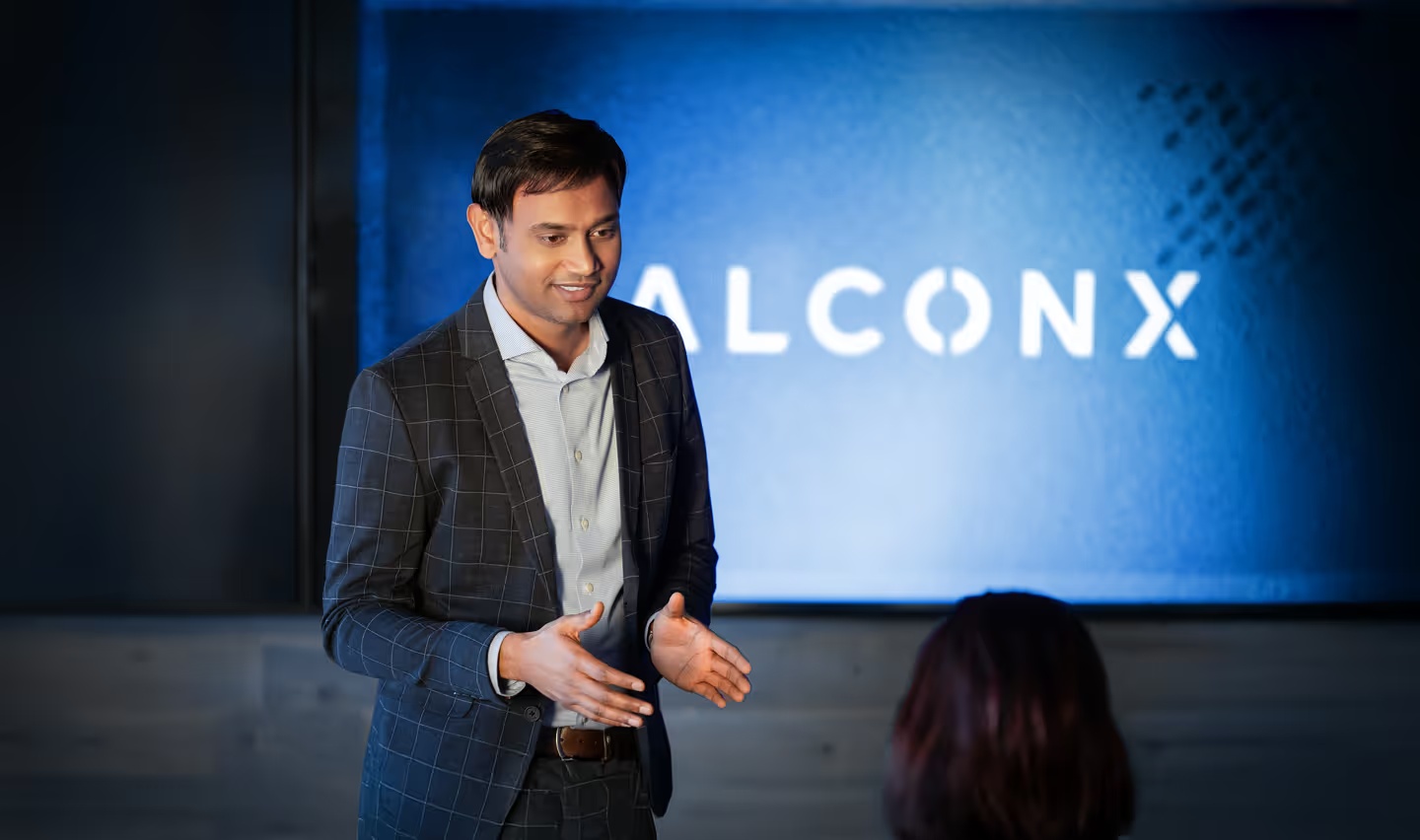
Yarlagadda co-founded FalconX with Prabhakar Reddy in 2018. He remains its CEO. The business serves institutions that need to trade, borrow and manage digital assets. His recurring question is why finance should accept opening hours and operational friction that an internet company’s customers would find absurd.
A business education, with reservations
Yarlagadda is originally from Vijayawada, India. He studied engineering at Vellore Institute of Technology, spent time in Australia as an exchange student, and went on to the University of Texas at Dallas. His master’s degree in electrical engineering, completed in 2007, concentrated on signal processing and machine learning. The education matters because his subsequent career repeatedly returns to the same practical problem: getting complex systems to deliver something useful.
At Motorola Mobility, he worked on a team developing high-definition video transmission over internet protocol. He later became a general manager at MIC Electronics. Video, hardware and commercial responsibility preceded the crypto vocabulary. His résumé acquired its financial ambitions by degrees, rather than beginning with a trading desk.
Harvard Business School supplied an MBA, completed in 2014, and material for a joke. He has described being advised that engineers needed business school to be taken seriously, then gently mocked himself for accepting the advice. The qualification evidently survived the teasing.
His more serious account of Harvard concerns the people around him and the size of his ambitions. A classmate was a Vietnamese pop star. Different backgrounds produced common questions about leadership. He had been thinking about a company for the Indian market; business school encouraged him to consider a global one. An expensive education had, among other things, enlarged his map.
From the laptop to the ledger
He joined Google in 2014 as a lead product manager on the Chrome OS team. His work contributed to scaling Chromebooks into a business generating more than $3 billion in revenue for Google and its partners. That last distinction deserves its place: a product ecosystem has many contributors, and the figure describes their business rather than his personal sales ledger.
The Chromebook experience gave him a view of technology reaching ordinary users through a substantial commercial network. At FalconX, the immediate customer would be a professional institution. Both careers, however, involved systems that must work beyond the demonstration. A pleasing presentation has a short shelf life when the product fails on Tuesday.
After leaving Google in January 2017, he became product lead at eightfold.ai. FalconX followed in 2018. The transition brought his machine-learning background into financial services, alongside Reddy, who shared the task of turning an emerging market into a business institutions could actually use.
UT Dallas
Google Chrome OS
eightfold.ai
FalconX
The unglamorous appeal of one account
FalconX’s original proposition was concrete: connect institutional customers to cryptocurrency liquidity through a single account. Rather than maintain separate relationships and balances across a collection of venues, a customer could execute through the brokerage and settle with one counterparty. The attraction lay in the work removed from the customer’s day.
That is a revealing choice of business. Crypto has never suffered from a shortage of things to buy or opinions about buying them. A brokerage earns its place by handling execution, financing and operational complexity. Those tasks may attract less applause than a rising token price, but an institution still has to perform them when prices fall.
Yarlagadda’s engineering instincts are particularly visible in his approach to data. In 2021, he described capturing mouse interactions across FalconX’s price feeds, collecting enough information to overwhelm the database more than once. It is an unusually candid detail for a founder to volunteer. The glamorous future of finance briefly meets the familiar inconvenience of a database that needs attention.
“We captured every single mouse interaction”
Raghu Yarlagadda, 2021
He also advocated sharing data with willing industry participants and using public blockchain datasets. The underlying argument was commercial: a younger company needs a deliberate way to acquire useful information if it hopes to compete with incumbents. His enthusiasm for machine learning came with an appetite for the rather less photogenic business of gathering its raw material.
An $8 billion valuation meets a difficult year
In June 2022, FalconX announced a $150 million Series D at an $8 billion valuation, led by GIC and B Capital. The valuation had more than doubled from $3.75 billion the previous August. The timing made the announcement conspicuous: cryptocurrency markets were falling, and other businesses were cutting back.
Those figures record a financing round and its negotiated valuation. They say something about investor confidence at that moment. A founder’s story becomes more interesting when the next chapter asks what confidence will withstand.
Later that year, FTX collapsed. In December, FalconX disclosed that 18% of its unencumbered cash equivalents were locked on the exchange. The company said it had sufficient capital to continue operating even if none of those funds were recovered. The disclosure matters in a profile built around reliability: FalconX had exposure to the failure, and its claim was that its balance sheet could absorb it.
Company valuation at the June 2022 funding round.
Unencumbered cash equivalents locked on FTX, disclosed in December 2022.
Historical figures. The first measures a funding valuation; the second describes a specific balance-sheet exposure.
For Yarlagadda, this is the less comfortable side of selling financial infrastructure. An institution buys access, but it also assumes relationships and risks. The test arrives when a counterparty fails, and explanations become more valuable than slogans. The episode belongs beside the fundraising announcement, however inelegantly the two fit on a celebratory slide.
A second job in Vijayawada
There is another institution in Yarlagadda’s professional life, considerably nearer his beginnings. He co-founded Sarada Educational Institutions, a group of intermediate colleges in Vijayawada, and serves as its chief technology officer. The work extends his engineering career into education.
Sarada describes his responsibilities as setting its technical direction, developing and managing the technology team, and contributing to strategy. These are operational duties. The title puts him in the business of deciding how technology should support a learning community, rather than simply lending a well-known name to a prospectus.
His public record also includes board or advisory roles at Dramatize, Fyndo and JoyUp. In 2025, UT Dallas recognized him with a Distinguished Alumni Award. His former university’s account places the education work alongside FalconX, a useful reminder that a person’s most highly valued company need not contain his entire working life.
The geographical connection has its own quiet appeal. Vijayawada remains part of a career that has passed through Dallas, Harvard and Silicon Valley. Ambition can travel a considerable distance without requiring every earlier address to disappear from the story.
The market he wants to build next
By October 2025, Yarlagadda was discussing a FalconX business that had handled about $1 trillion in trading volume over the preceding year. The customer groups included hedge funds, market makers, corporate treasuries, exchange-traded funds and businesses offering crypto access to retail users. The machinery now served several different reasons for entering the same market.
His argument for tokenization has remained closely connected to settlement: assets represented on shared digital systems can support financial activity outside conventional banking hours. In his telling, stablecoins provided an early practical application. The wider ambition encompasses more of the assets and credit relationships that institutions already understand.
In July 2026, FalconX acquired blockchain networking and trading technology company bloXroute. The announcement described an expansion across oil, gold, silver, compute and tokenized equities. This gives a concrete shape to his longstanding ambition: infrastructure developed for digital assets reaching into other financial markets.
August brought an announced $1 billion secured lending facility with Ethena, structured through a special purpose vehicle. Capital from assets backing USDe would support overcollateralized institutional loans. FalconX would originate and service the loans and manage collateral, with qualified custodians holding it. The vocabulary is less romantic than the early promises of crypto. It is also more specific.
Yarlagadda’s career makes most sense at that level of specificity. Video had to travel. A laptop platform had to reach users. A trade has to execute, and its money has to settle. His ambition keeps returning to the distance between an impressive technical possibility and an experience someone can depend on.
He has already experienced how easily an account can cross an ocean, and how stubbornly money can resist the same journey. FalconX is his continuing attempt to improve the itinerary. Finance may yet learn to travel with less luggage.
Continue the conversation
Visit his FalconX biography, follow LinkedIn or X, and explore Sarada’s team.
▶ Watch: Tokenization & the Future of Financial Markets · SALTFurther reading: The 2022 conversation about his beginnings · The 2025 Rebank interview · FalconX announcements.