Anton Katz learned to write code before he had a computer. At ten, given a programming book by his grandfather, he worked through programs on paper. The machine would have to catch up. Years later, when he and Ethan Feldman began investigating a cryptocurrency investment business, the same inconvenience appeared on a rather larger scale: they could imagine what they wanted to do, but the equipment was missing.
They had spent years building systems for professional traders. Crypto offered an unfamiliar arrangement of exchanges, connections and operational loose ends. Before running the investment business, someone would need to construct the machinery it required. Katz and Feldman decided that someone should be them. The fund idea gave way to Talos, founded in 2018.
That detour is the useful place to begin with Katz. His career has taken him from competitive shooting to MIT, Microsoft and quantitative finance. The recurring interest is how a difficult system works, and what happens when someone expects it to work reliably. In his current occupation, a clever idea must survive contact with a trading desk.
A medal before the markets
Katz was born in Ukraine and moved to Israel with his family at ten. Computers shared his attention with sport. As a member of the Israeli national shooting team, he won a junior world championship gold medal in 1998. His coach, Guy Starik, identifies the event as the three-position rifle competition. This was a competitive life before the software career had properly begun.
Shooting supplied a different kind of technical education. Katz has described its mental demands alongside those of programming. Each rewards sustained attention; neither is improved much by an impressive speech. The comparison is his own, and helps explain why the transition from sport to computer science seems less abrupt when he tells it.
Military service in the Israel Defense Forces followed. Looking back, he has talked about learning to work with people from different backgrounds and to keep going when plans meet circumstances they did not anticipate. Afterward came a choice between continuing his sporting ambitions and studying. He applied to MIT, his one college choice, and got in.
There is a pleasing lack of admissions strategy in that decision. He has joked about whether the acceptance was a mistake. His education was real enough: he studied computer science at MIT, attending from 2003 to 2007. He speaks English, Russian and Hebrew, a compact reminder of the different places through which his life had already passed.
Learning where the software hurts
His technology career began at Microsoft. In its Windows Live division, Katz encountered the scale of a product whose changes could reach millions of users. He has recalled the attention paid to security and privacy. A program written on paper can remain an elegant private exercise. A service used by millions has an audience with opinions, passwords and very little patience.
Broadway Technology brought him closer to financial markets. Over six years there, he worked on trading technology for banks, asset managers and vendors, eventually becoming director of software. It also brought him into the orbit of Feldman, his future co-founder. Their partnership grew from work on systems that institutions already depended upon.
The next move changed Katz's vantage point. At AQR Capital Management he became head of trading technology, moving from a supplier of institutional tools to a user of them. That distinction matters. A vendor sees a product and its implementation; an investment manager lives with the consequences across the working day. Katz had now occupied both sides of the conversation.
In October 2020, introducing Talos publicly, he described the jobs he and Feldman had left as unusually attractive positions for capital-markets technologists. Leaving was a decision with something to lose. Their experience also gave them a specific standard against which to judge crypto's existing tools. They knew what professional trading infrastructure was supposed to do.
The fund that became a software company
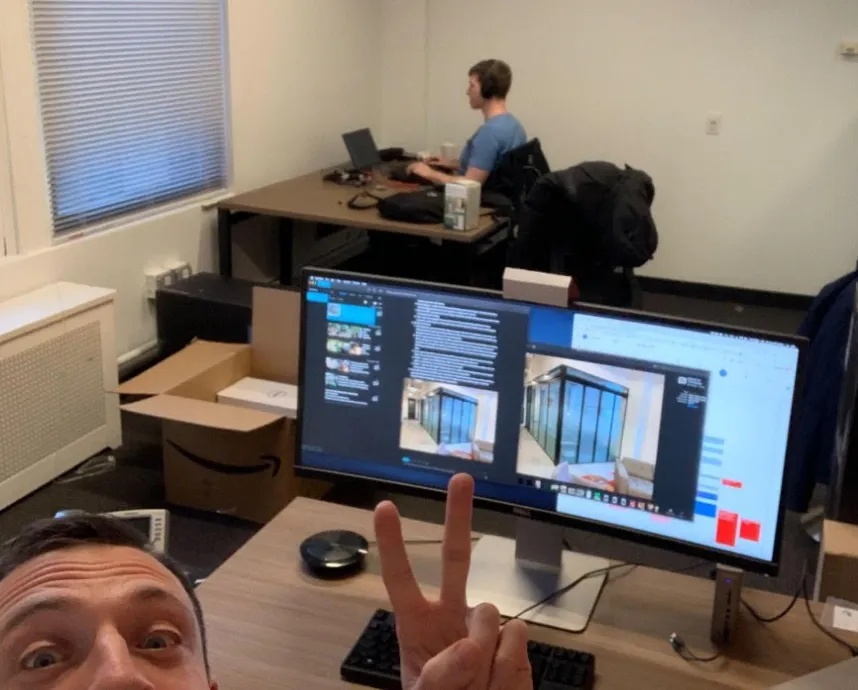
The early office photograph is wonderfully unceremonious: desks, monitors, boxes, window blinds, and a face entering the frame from below. It belongs to a company history that began with the founders investigating their own crypto hedge fund. Instead of finding a ready institutional toolkit, they found retail-oriented infrastructure and fragmented liquidity.
A fund would have made Katz and Feldman participants in that market. Building Talos made them suppliers to other participants. Their expertise could be applied repeatedly, across firms with different strategies, rather than confined to one investment operation. The choice put the trading system itself at the center of the business.
The company's timeline places its first hires in January 2019 and its first trade in August that year. The founders had to turn a diagnosis into something another institution would trust. A working connection was only part of the job. An order needed somewhere to go, a sensible way to get there, and a usable record afterward.
A trade has an afterlife
Katz's subsequent product decisions follow the order beyond the trading screen. In a 2024 client fireside chat, he described demand for technology that served portfolio managers, risk managers, researchers and operations teams alongside traders. Execution was becoming one workspace within a broader investment operation. The customer was growing more complicated, and the product was following.
For a reader outside finance, the distinction is straightforward. Buying an asset is a moment. Deciding how much to own, measuring the exposure, checking the transaction and ensuring settlement are continuing responsibilities. A good trading interface cannot, by itself, discharge them. Institutions need the pieces to agree with one another.
This is also where Katz's background becomes commercially relevant. He has worked among the people who ask those questions. In a January 2025 conversation with TABB Group's Bruce Morris, he emphasized the capital-markets experience within the technology team and its role in anticipating customers' needs. His own route through Broadway and AQR gives that approach a recognizable origin.
When the customer brings its own customers
Another change was less visible to an ordinary investor: Talos began supplying businesses that wanted to offer digital-asset trading to their own users. In his August 2025 conversation with John Furrier, Katz described white-label infrastructure for retail brokers, neobanks and other platforms as roughly half the business at that point. Talos could be present without its name appearing on the customer's screen.
The same interview explained his interest in data. Trading systems generate and consume market information; portfolios also need benchmarks, valuations and analytics. Buying Coin Metrics brought established data capabilities into the company rather than asking its engineers to invent every component afresh. The acquisition announcement in July 2025 paired Coin Metrics' market data, blockchain analytics and indexes with Talos's trading and portfolio systems.
“The evolution toward tokenized collateral is a natural progression for institutional capital markets.”
Anton Katz · March 2026
BlackRock's existing desk
The institutional ambition became tangible in October 2025, when Talos announced its integration with BlackRock's Aladdin platform. BlackRock traders could route cryptoasset orders directly into Talos's order and execution management system. Trading information could then flow between the systems, fitting the new capability into an existing investment workflow.
The announcement reported more than $1 billion in trading volume during the first week of implementation. That is a measure of activity through the integration, with a clear time period. For Katz, the interesting achievement is also organizational: an established trading team could use specialist digital-asset technology from within tools it already used. Adoption can involve a surprisingly large amount of arranging the furniture.
The next asset does not need a new desk
In January 2026, Talos announced a $45 million extension to its Series B, bringing that round to $150 million at an approximately $1.5 billion post-money valuation. New investors included Robinhood Markets, Sony Innovation Fund, IMC, QCP and Karatage. Part of the investment was settled in stablecoins, a small practical demonstration of the payment infrastructure under discussion.
The stated product plans reached beyond crypto into traditional assets as they become digital. In March, a partnership with Nasdaq gave that ambition a more specific form: connecting Talos with Nasdaq's Calypso and Trade Surveillance platforms to develop tokenized collateral management. The work concerns execution, risk, collateral and compliance across conventional and blockchain-based markets.
Katz's language here is operational. Tokenized collateral still has to be valued, monitored and moved within a firm's controls. A new representation of an asset does not relieve anyone of responsibility for it. His opportunity lies in helping institutions handle that representation without making each new market a separate technology project.
One trillion, and the machinery underneath
On August 18, 2026, Katz marked Talos crossing $1 trillion in cumulative notional trading volume since inception. In his account, the milestone represented clients trusting the platform with consequential activity. The number belongs to the company he co-founded; the more personal achievement is sustaining a business around a problem he and Feldman initially encountered as prospective customers.
Cumulative notional trading volume through Talos since inception.
His longer ambition is a financial system in which more assets use digital infrastructure and institutions can operate across old and new systems together. That remains an ambition, with real integration work attached. It suits a founder whose first programming tool was paper: he has experience imagining a useful machine before the machine is ready.