A chat window can be a surprisingly presumptuous little thing. It appears in the corner of a website, offers help, and waits while you try to remember what you came for. In October 2022, Raghavender Rao Jitta published a small piece of code for a different arrangement: hide Gist’s messenger, then open it when someone clicks a button. The visitor gets to make the first move.
It is an ordinary implementation example, the sort of thing a website owner might copy, adapt, and forget. Yet it makes a useful entrance into Jitta’s work. The founder and CEO of Gist has spent years dealing with the space between an available tool and a person who knows how to use it. Sometimes that space needs a guide. Sometimes it needs a better greeting. Sometimes the answer is simply a button.
Other examples in his public code collection deal with where the messenger sits on mobile, how a website form identifies a visitor, and how a returning visitor receives a personalized greeting. These are small adjustments with a person at the other end. A crowded screen, a submitted form, a remembered name: the implementation work concerns moments a customer can recognize without knowing how the code works.
Before the inbox, a study plan
Jitta is based in Hyderabad. He attended KL University from 2009 to 2013, studying engineering, and describes starting his first business at 21. Before Gist, he was co-founder and CEO of CrunchPrep, a GRE preparation business. Its founder listing places him alongside Sachin Kaundinya.
Education also appears outside his companies. Jitta listed a presidency at Make A Difference from February 2012 to March 2014, describing work around English-language learning and career awareness for children in shelter homes. It places teaching and access to opportunity within his early professional life.
Their co-authored guide to scoring 330 or more on the GRE contains 101 tips, strategies, and techniques. Its opening addresses the reader’s ambition directly: the university place, the funding, the wish to make parents proud. The guide then makes a rather less glamorous proposition. A large task becomes manageable through individual steps. It reaches for a pizza analogy, which has the advantage of being considerably easier to understand than an admissions committee.
The advice is practical, but the audience is personal. An exam score has a number attached; a student’s reason for wanting it has a life attached. The writing spends time on both. You can see the authors trying to make a demanding process feel approachable before introducing the work it requires.
Jitta’s educational writing also includes advice on composing a statement of purpose for graduate applications. Here the problem moves from choosing an answer to explaining yourself. An applicant needs to put motives, experience, and plans into words that another person can follow. Clear communication is already doing substantial work.
CrunchPrep’s lessons needed a voice, too. In 2017, the business used PostPlay for narration to help students understand video lessons. Jitta explained that the team could not produce that narration on its own and welcomed the small amount of work required at their end. The episode gives the early venture a concrete working detail: getting the explanation right sometimes meant asking someone else to deliver it.
A company learns a shorter word
Gist began with another name: ConvertFox. The name described the business of turning visitors and subscribers into customers through communication. As the product’s intentions grew, a word focused on conversion began to feel narrow. Marketing, sales, and support were all supposed to belong under the same roof.
When Justin McGill joined, he proposed changing the name before the new marketing effort gathered momentum. Jitta agreed and made the rebrand McGill’s first assignment. That decision is worth lingering over. A founder had accepted a colleague’s suggestion to reconsider something already attached to the company’s identity.
McGill’s eventual choice, Gist, offered a compact word for the essential part of a matter. The company settled on GetGist.com. For Jitta, agreeing to the change meant allowing the business to be described more broadly than its original name permitted.
The episode also keeps the cast of the story properly populated. McGill did the naming work; Jitta gave it room. A company can carry a founder’s direction while benefiting from another person’s vocabulary. The resulting four-letter name is brief enough. The decision behind it contains a little more.
Equity sold by ConvertFox Global, Inc. to nine investors, reported in a filing signed by Jitta as president and director.
There was formal company-building alongside the naming. In October 2018, ConvertFox Global reported $1.073 million in equity sold to nine investors. Jitta signed as president and director. That number belongs to the company’s financing history. It gives the early business a dated, concrete milestone alongside the decisions about what customers would call it.
Three teams, the same customer
The premise of Gist is straightforward to state: put marketing, sales, and support communication in one platform. Following through on it is less straightforward. A person can be a prospective buyer in one conversation and a paying customer in the next. Their questions do not conveniently arrive labelled for the department that should answer them.
Gist’s tools include live chat, email marketing, a knowledge base, and automation. Their usefulness depends partly on whether the people operating them can see enough context to respond sensibly. Repeating your circumstances to a second person is an excellent way to discover how long an afternoon can be.
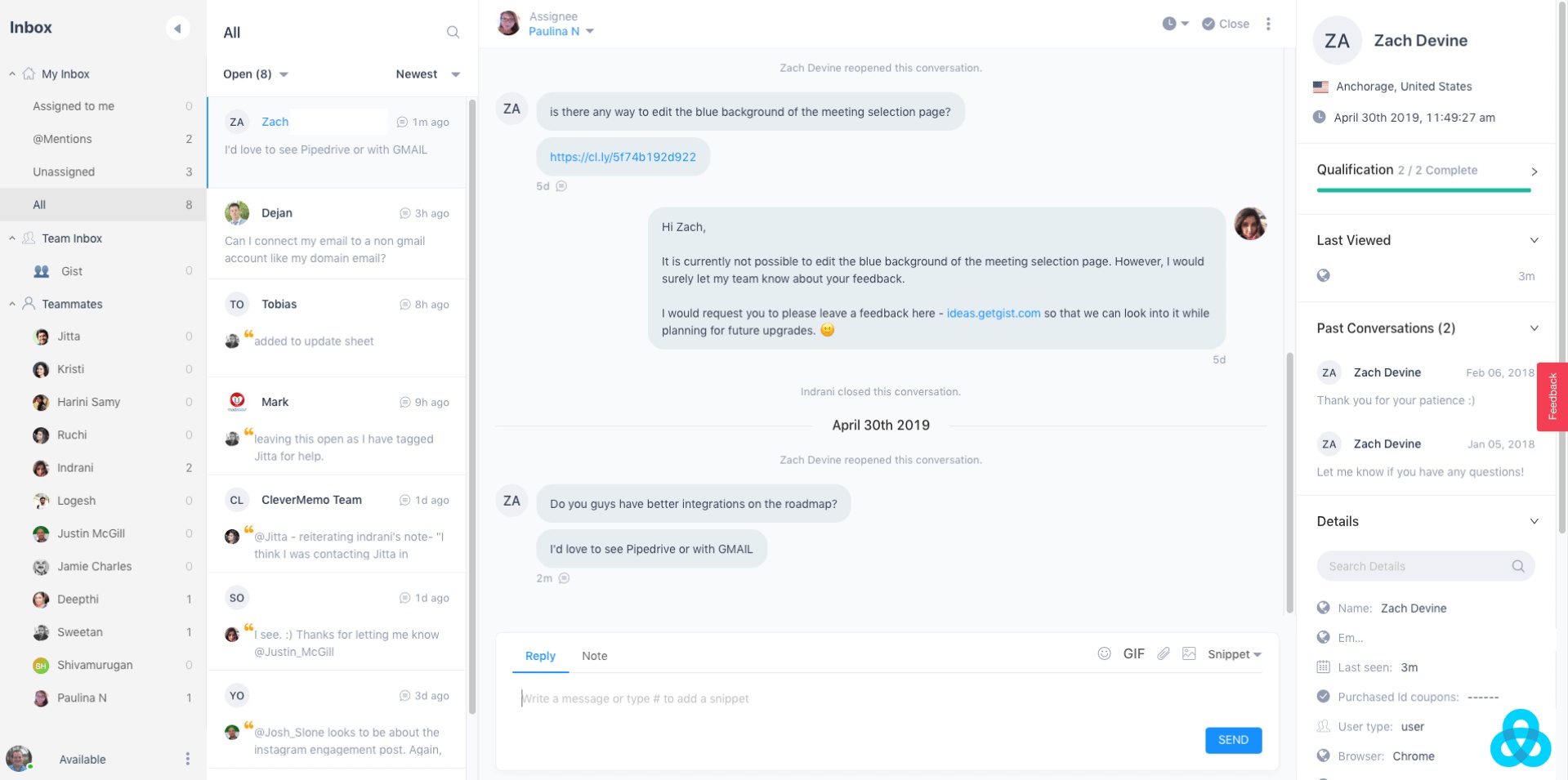
The 2019 interface update made this ambition tangible. Teammates could see a contact’s three most recent conversations while chatting, and reply drafts would remain when someone clicked away. The release also introduced visual workflows. These are specific answers to familiar working problems: remembering what happened, preserving unfinished work, and seeing how a sequence fits together.
That is a more revealing description of a software business than an inventory of buttons. The changes concern continuity. A customer has a history; a teammate has an interrupted day. The interface has to accommodate both if the conversation is going to survive the handoff.
A conceptual diagram of Gist’s proposition, not a performance measurement.
Instructions are part of the product
In his writing about how software companies use Gist, Jitta begins with the oddity of software that is complicated to build but intended to simplify things. The article organizes adoption into four stages: set up conversations, create a knowledge base, start email communication, then introduce automation. There is a sequence to follow before there is a large collection of possibilities to admire.
A knowledge base occupies an interesting place in that sequence. It helps existing customers answer questions, while also letting prospective customers investigate how something works. Explanation belongs on both sides of a purchase. A person considering a tool can reasonably want to understand the thing they will spend their working hours using.
Jitta’s help-center guide to contact segmentation makes the idea concrete. A segment groups people according to their actions or properties, allowing messages to be targeted accordingly. The work is partly organizational: deciding who should receive a particular message and what makes it relevant to them. Sending it is only one part of the job.
Another guide, on workspace branding, gets down to settings: the workspace name, its timezone, and the places where a company’s identity appears. A timezone seems a modest detail until a scheduled message reaches somebody at a peculiar hour. Instructions of this kind bring a broad promise back to decisions a customer actually has to make.
His announcement of Gist’s Segment integration addresses a related problem: connecting the information already sitting in a business’s tools. Customer attributes and behaviour can be used to personalize communication. A useful response needs the right information close at hand, whether a human writes it or an automated process sends it.
An invitation to answer back
Gist’s published welcome email from Jitta begins with a question:
“How are your first impressions of Gist?”
Raghavender Rao Jitta · published welcome email
The message introduces him as the founder and invites questions. It then explains why customers sign up: to handle several communication tools together, improve customer communication, nurture leads, and maintain a common place for contact information. The greeting gives the newcomer a chance to describe the experience before the product finishes describing itself.
The invitation has a practical consequence for the tone of the relationship. An onboarding message can sound as though a company is presenting a finished explanation from a stage. A question makes space for a reply. It acknowledges that the person receiving the message has information the company would benefit from hearing.
Public exchanges around Gist show that the reply can contain criticism as well as approval. Product Hunt reviewers praised its breadth and founder involvement, while also identifying room to improve the bot builder. Jitta answered customers there. An extensive product creates plenty to discuss, and the people trying to use it have their own ideas about what should come next.
Close a tab. Keep a conversation.
Jitta’s public communication advice favours a single clear message in an email, a personal touch, and a real understanding of the customer. His productivity routine is similarly practical: early work with coffee and music, fewer distracting browser tabs, and calls kept for the afternoon. He also recommends learning from people only a step or two ahead.
Those choices make his work easier to read at a human scale. There is a student working through a guide, a business owner trying to configure a tool, and a customer deciding whether to ask a question. Each needs enough clarity to continue. Jitta’s career has crossed different markets, but those small moments give it a recognizable thread. The next step ought to be within reach.