The Orange Box That Bet the Smartphone Was Optional
A $199 orange gadget promised to replace your apps with an AI that clicks the buttons for you. The launch went viral, the reviews went brutal, and rabbit is still shipping.
In January 2024, a company most people had never heard of walked onto the biggest stage in consumer tech and did something rare: it made a small orange box the most talked-about object at CES. rabbit inc. had roughly two dozen employees, a device called the r1, and a claim big enough to bother a trillion-dollar industry - that the smartphone, or at least the way we use it, had become optional.
The pitch was refreshingly literal. Instead of a screen full of apps you tap through, the r1 would use an artificial intelligence that operated those apps for you. You talk, it acts. The company called this a Large Action Model, and it drew a deliberate line under the letter it changed: not language, action. A chatbot answers your question. rabbit wanted a device that would go do the thing.
People responded with their wallets before they responded with their reviews. The first batch of 10,000 units sold out in a day. By the time the dust settled after the CES announcement, rabbit reported around 130,000 units - a figure that reportedly translated into roughly $10 million in pre-orders on the strength of a concept and a keynote. For a $199 device from a startup nobody could pronounce yet, that is an unusual amount of trust to buy sight unseen.
01What rabbit actually made
The r1 is roughly half the size of a phone and weighs about 115 grams. It has a 2.88-inch touchscreen, an analog scroll wheel, a single push-to-talk button, and a small camera - the "rabbit eye" - that sits on a motor and physically rotates to face you or the world. There is no always-listening microphone. You hold the button like a walkie-talkie, speak, and let go. It runs rabbitOS, the company's own operating system built around the Large Action Model.
That hardware did not come from a phone factory's spare-parts bin. rabbit co-designed the r1 with Teenage Engineering, the Swedish studio known for cult synthesizers and a design language somewhere between a Tamagotchi and a piece of lab equipment. Teenage Engineering's Jesper Kouthoofd and rabbit's founder had worked together before, and the collaboration is the reason a device this strange still reads as covetable. The r1 is one of the clearest recent examples of design functioning as the entire marketing budget.
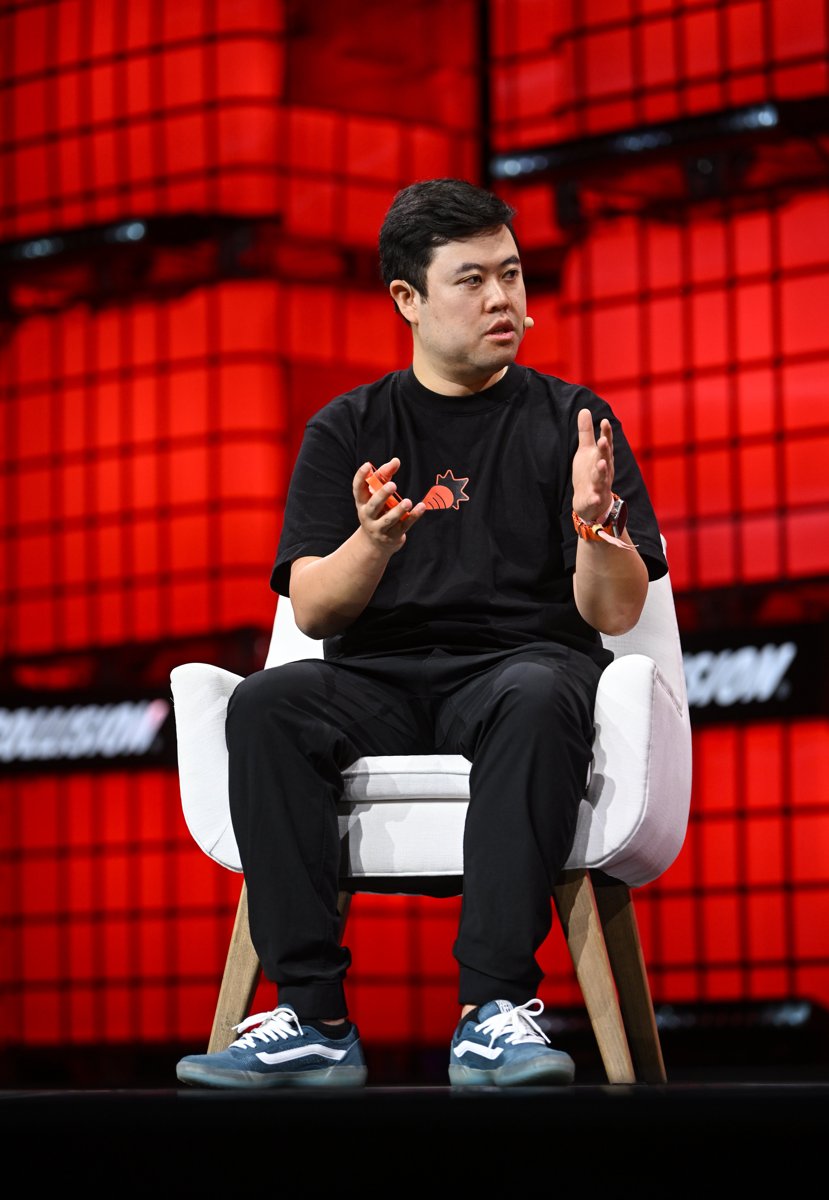
rabbit changed one letter in a familiar acronym - language to action - and turned it into an entire company.
The bet behind the r102Language model vs. action model
To understand why rabbit provoked such strong reactions, it helps to separate the idea from the object. Most AI you have used is a Large Language Model: you type or speak, it produces words. rabbit's Large Action Model is meant to sit one step further out. The company describes it as software that learns how people operate the buttons, forms and flows of real websites and apps, then reproduces those actions to complete a task - ordering food, booking a ride, running a search across services - without you touching the interface at all.
Large Language Model
You ask, it answers. The output is text or speech. You are still the one who opens the app and taps the buttons.
Large Action Model
You ask, it does. The output is a completed task. The model operates the interface on your behalf - that was rabbit's whole premise.
It is a genuinely harder problem, and that gap between ambition and delivery is where the story got complicated. When the r1 shipped to reviewers in the spring of 2024, the verdicts ranged from mixed to blunt. Critics found it slow and buggy, its promised actions thin on the ground, and its advantages over simply using a phone hard to locate. One recurring complaint stung more than the rest: much of what the r1 did could, in principle, have been an app. rabbit's counterargument - that the app grid is exactly the thing worth escaping - was philosophically coherent and, in that first version, unproven.
The rough patches, plainly
rabbit's early months included real bruises. A reverse-engineering project surfaced hardcoded credentials in mid-2024, prompting the company to rotate keys and part ways with an employee. There were questions about how user data was logged, which rabbit answered with a factory-reset option and tighter retention. And the founder's earlier venture - a since-abandoned NFT project from the company's previous life as Cyber Manufacture Co. - drew an unflattering investigation. None of this is hidden here because none of it is the interesting part. The interesting part is what happened next.
03The part everyone missed
Most companies pivot away from a rough launch. rabbit did roughly the opposite - it treated the viral debut as version zero and kept shipping the software it had promised. If you judge the r1 by its launch reviews, you get one story. If you judge it by its changelog, you get another.
Two features are worth understanding because they are the clearest expression of the original bet. LAM Playground, opened to all r1 users in October 2024, is a web-based agent that takes a plain-language request and works through the steps across real websites to complete it. Teach Mode, which followed in November, flips the direction: instead of waiting for rabbit to support a service, you demonstrate a task once through a web portal and the r1 turns your demonstration into a reusable agent. No code, no waiting on a roadmap. Show it how you do a thing, and it does that thing.
Show the r1 a task once, and it becomes an agent you never have to run yourself again.
Teach Mode, in one lineBy September 2025, rabbitOS 2 redesigned the interface around cards and gestures and added "creations," letting the device spin up small software tools on the fly rather than only calling pre-built ones. Updates in 2026 pushed further into agent territory - a proactive mode, a new agent the company calls hermes, and support for bringing your own model keys. The device that launched as a curiosity has, quietly, been turning into a platform.
04Where it fits, and who it's for
rabbit's real competitor was never another gadget. It was the phone in your pocket and the assistants already living inside it - Siri, Gemini, the voice modes of the big chatbots. The AI-hardware cohort it launched alongside, most visibly Humane's Ai Pin, offered a useful contrast: several of those bets have stumbled or shut down, while the r1 remained on sale into 2026 with active firmware. Surviving your own launch is, in this category, an achievement in itself.
Who buys one? Not, realistically, your parents replacing their iPhone. The r1's audience skews toward early adopters, developers, tinkerers and collectors - people who want to poke at what a post-app, agent-first device feels like, and who find $199 with no subscription a reasonable price for a front-row seat. The business model is refreshingly old-fashioned for the AI era: sell a device once, skip the monthly fee, and build the platform value on top over time.
05The founder and the pattern
rabbit's founder and CEO, Jesse Lyu, is not a first-timer. His previous company, Raven Tech, built a smart-home AI assistant and was acquired by Baidu in 2017. He then joined the board of Teenage Engineering before starting the company that became rabbit. Read in that order, the r1 stops looking like a random moonshot and starts looking like a thesis the founder has been circling for a decade: that the natural interface for a computer is you telling it what you want, and the machine doing the rest.
The company backing that thesis is small - roughly 26 people - and funded to the tune of about $46 million on record, with a $20 million Series A led by Khosla Ventures in October 2023 and a $10 million extension that December. Synergis Capital and Kakao Investment joined. That is enough runway to keep iterating and not enough to survive on hype alone, which may explain the relentless shipping.
06So, was it a good idea?
The honest answer is that rabbit was early, and being early looks a lot like being wrong until it doesn't. The first r1 overpromised, and the reviews were fair. But the category it staked out - AI that takes action rather than just producing text - is now on nearly every large lab's roadmap under the label "agents." rabbit wore the arrows for that idea in public, on a $199 orange box, in front of the entire industry.
You do not have to think the r1 was the future to find rabbit worth watching. The useful lesson here is quieter and more portable: a category can be right while the first product is early, and shipping through the embarrassment is its own kind of moat. rabbit changed one letter in an acronym, sold 130,000 boxes on a keynote, took the roast, and kept going. Whatever comes next in agent hardware, this company will have been standing where the target was.