Oatly had an audience problem. The oat-drink maker wanted to reach beyond people living a vegan lifestyle. That meant understanding consumers who might buy dairy alternatives for other reasons. Sandra Schlicht, its business insights manager for Germany, Austria and Switzerland, needed research that could keep up with the company. In quantilope’s published case study, Oatly completed its first project in under two weeks and established a benchmark for measuring funnel conversions.
- Survey design, fieldwork, analysis and reporting in one workflow.
- Oatly’s first project: under two weeks, the case study reports.
- Business starts at $2,300/month; scope shapes the budget.
The interesting part is the change in working arrangements. Oatly brought survey building, fieldwork and analysis into one platform. The people with the business question could stay close to the evidence. For quantilope, that is the product: a shorter distance between wondering something about consumers and doing something about it.
01Three doctorates walk into a survey
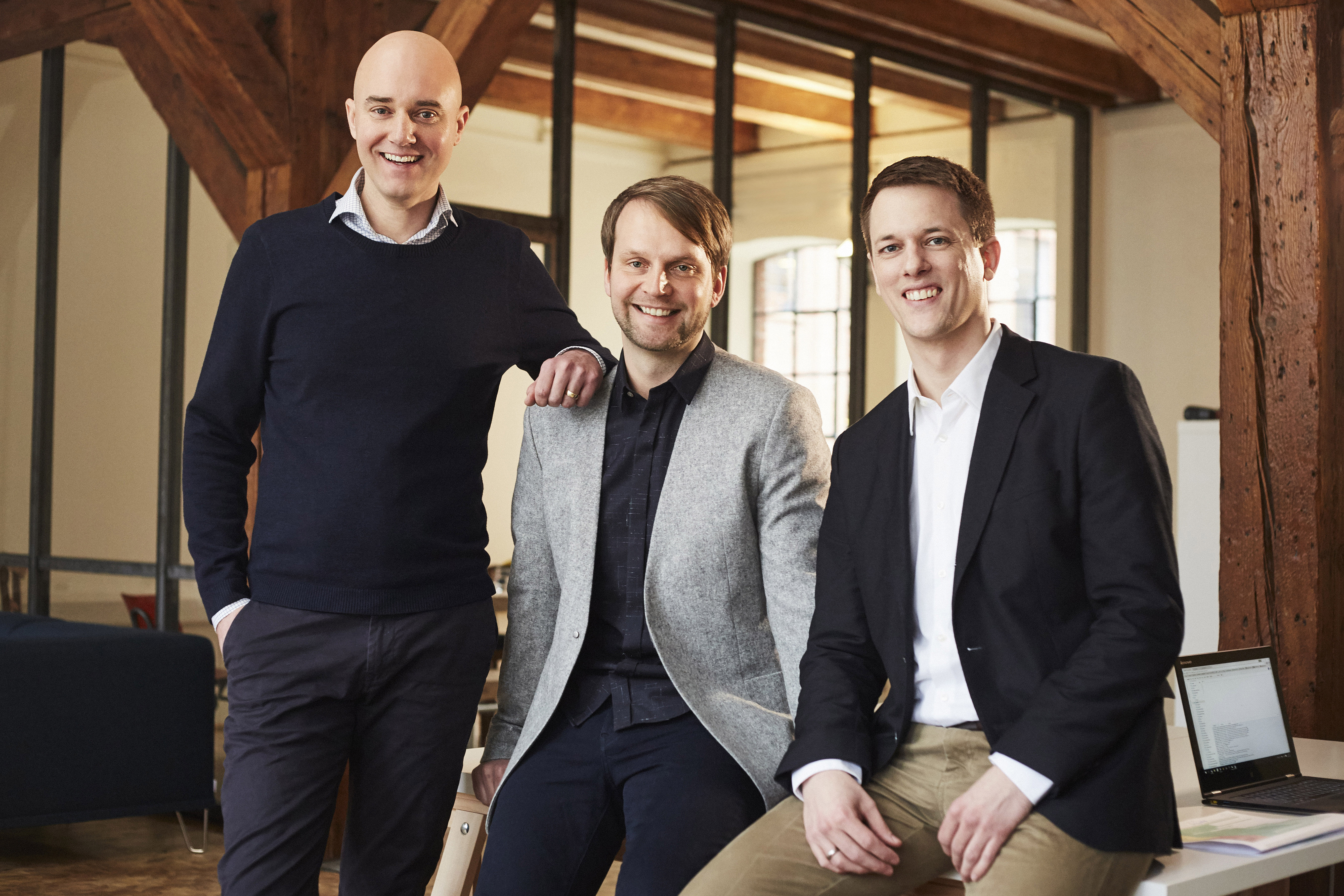
Founded in Hamburg in 2014, quantilope brought together Peter Aschmoneit, Thomas Fandrich and Lucas Bremer. Aschmoneit had worked in consumer-goods marketing at Unilever, Danone and Fuchs. Fandrich studied consumer behavior and marketing effectiveness. Bremer developed quantitative methods for analyzing consumer behavior, with research experience at Hamburg, Zurich and Columbia. Their backgrounds joined the marketer’s deadline to the academic’s insistence on method.
The resulting business sells research software with expert support. Its Consumer Intelligence Platform connects questionnaire design, respondent recruitment, analysis and reporting. CI Advanced handles individual research projects; CI Tracking monitors changes over time. inColor adds qualitative video feedback. Brand managers and insights teams can test packaging, compare advertising, explore pricing or investigate which product features deserve investment.
An $8 million Series A in 2018, led by Dawn Capital, funded development and international expansion. A $28 million Series B followed in July 2020, led by Digital+ Partners, with existing investors participating and Silicon Valley Bank providing debt financing. The announcement put cumulative funding at $40 million then. These are dated financing milestones, rather than a statement of today’s total.
02Make people choose
Ask consumers whether they value quality, convenience and a reasonable price, and agreement comes cheaply. MaxDiff makes them choose the most and least appealing items from sets. Conjoint analysis explores tradeoffs between bundles of attributes, including price. TURF looks for combinations that reach different people, helping a product portfolio avoid serving the same preferences repeatedly.
quantilope automates the setup and calculation around these established methods. Its distinction is packaging that statistical work into a connected workflow, with charts and reporting alongside it. Researchers can use its panel partners, another provider or their own respondents. Panel access is a recruitment option; the company’s advertised reach of 300 million-plus consumers is not a completed sample.
That puts it in the market between buying a managed research project and assembling software, sample and analysis yourself. Alternatives include automated insights platforms such as Zappi, broad survey systems such as Qualtrics, and research agencies. The purchasing question is practical: how much methodological depth and recurring research work does your team need to operate directly?
- 01Frame the decision
- 02Build the survey
- 03Collect responses
- 04Analyze + report
03A brand lives in a buying moment
Better Brand Health Tracking gives the platform a more specific point of view. Drawing on Professor Jenni Romaniuk’s work at the Ehrenberg-Bass Institute, it measures Category Entry Points and Mental Availability. The first describes situations that bring people into a category; the second concerns which brands come to mind in those situations.
Consider an illustrative breakfast: somebody needs a drink for coffee, something quick before work or an option for a guest avoiding dairy. Those are different routes into a purchase. Knowing a brand exists does not establish that it appears along each route. Tracking those associations gives marketers a concrete brief: build a connection to a buying occasion.
On October 6, 2026, quantilope announced Mental Availability Norms, adding benchmarks across six industries and four regions. The addition addresses an interpretation problem. A score needs context before a team can decide whether it deserves celebration, investigation or a different media plan.

04The button that had to go
quantilope launched its AI assistant, quinn, in 2023. By February 2026, the company described it as an end-to-end research partner able to draft studies, refine questions, analyze data and build dashboards. The software was moving from helping with isolated tasks toward supporting a sequence of research decisions.
A December 2025 product retrospective supplies the more revealing detail. Researchers needed to return to conversations across sessions, give feedback and revise reports. quantilope added saved chat histories and more extensive chart editing. It also retired quinn’s standalone dashboard-summary button in favor of conversational reporting. A single generated summary had become too narrow for the work.
Its newer Category Twins extend this direction into synthetic consumer communities grounded in a brand’s Mental Availability data. The company says 30 client teams across 10 countries helped develop the product. The output is directional feedback for early ideas. It depends on an active Mental Availability project, and a new study refreshes the underlying evidence. Synthetic conversation still inherits the boundaries of its data.
“quinn provides the velocity, and the human provides the direction.”
Jannik Meyners · Head of Data Science & AI · February 2026
05The subscription has to earn its keep
The current Business plan starts at $2,300 per month for three users. Pro and Enterprise require a quote; Enterprise lists access to conjoint and segmentation. Subscriptions use credits tailored to a research roadmap. A sensible buying conversation therefore starts with study frequency, methods, audiences and support needs. A headline subscription figure alone cannot settle the budget for a particular research program.
Business plan · 3 users
There is evidence of savings, with qualifications. A quantilope-commissioned Forrester Consulting study in June 2021 modeled 319% return over three years, using a composite organization based on four customer interviews. That is an investment framework with assumptions, rather than a return every buyer receives. The mechanism is understandable: moving suitable projects in-house can reduce external agency fees and repeated operational work.
The approach asks something of the customer, too. Someone must define the decision, choose appropriate respondents and interpret the result. A team needing occasional research without internal ownership may prefer a managed project. quinn’s own retrospective acknowledges that AI lacks the full business context researchers bring. Better automation leaves those responsibilities with people.
Oatly’s example offers a useful habit to copy: start with a decision that has to change, build a study around it and keep a benchmark for the next round. Faster research earns its place when an answer arrives while there is still time to act.