A solar layout can be wonderfully persuasive. Rows of panels sit neatly on a roof; a report estimates their output; a proposal gives the customer something to consider. Then another person has to decide where the wires go. PVComplete has built its business around the distance between those two moments. The attractive arrangement must become a drawing that engineers, suppliers and permitting officials can use.
- Browser tools handle early layouts; AutoCAD tools carry the project into detailed engineering.
- The range covers rooftops, carports and large ground-mounted solar projects.
- Customers can buy licenses, commission engineering work or request custom software.
- Enact acquired PVComplete in January 2026, with plans to connect design and operating data.
The drawing has another job
Consider the drawing as a document with several audiences. A sales team wants it to explain a proposal. An engineer needs equipment specifications and electrical connections. A purchasing team needs quantities. The installation team needs a plan it can build from. Each audience asks a little more of the same idea. Re-entering that idea at each stage is an expensive way to discover that everyone meant something slightly different.
PVComplete’s answer is a connected set of tools. PVSketch provides the quick browser layout; PVCAD brings solar-specific automation into AutoCAD. The company also offers Mega versions for ground-mounted projects that require larger layouts and more terrain analysis. Designs can move between the Sketch and CAD products. The interesting feature is that movement: a preliminary layout has somewhere useful to go.
The company was founded in 2015 by Daniel Sherwood, Claudia Eyzaguirre, Alexander Frumkin and Michael Zaydman. Its public description is refreshingly occupational: solar developers building tools for other developers. This places it in the software and engineering part of the solar market. Its output is a better-developed project, with the drawings and reports to support it.
Company-reported platform figures. Designed projects include design activity; they are not a count of commissioned solar plants.
Two interfaces, four tools
The distinction between Sketch and CAD is a distinction between jobs. PVSketch is aimed at business development, project management and early engineering. A user defines a site, marks obstructions, selects equipment and examines estimated production and savings. The software can produce proposals and reports. It works on phones, tablets and desktops, allowing a project to begin without making its author an AutoCAD specialist.
PVCAD serves the person who needs more detail. It automates rooftop, carport and ground-mount layouts, supports three-dimensional analysis, and helps create electrical drawings. Users can define strings of modules, place inverters and electrical equipment, calculate ampacity and voltage drops, and prepare a single-line diagram. They can also generate a bill of materials and export designs for further energy analysis in PVSyst.
PVSketch Mega shifts the browser workflow toward land assessment and early ground-mount development. It combines topography, equipment choices, production analysis and layout optimization. PVCAD Mega carries those projects into the engineering environment. The current guides recommend standard PVCAD for projects below 5 MW and Mega for larger ground mounts or projects needing topographic analysis. Terrain and the task matter alongside capacity.
The terrain gets a vote
A roof presents one set of questions. A tract of land presents another. PVCAD Mega lets designers define access roads, setbacks, obstructions and the point of interconnection. They can select fixed-tilt structures or single-axis trackers, set string lengths, and work within a capacity limit. Survey data or elevation services bring the ground into the model.
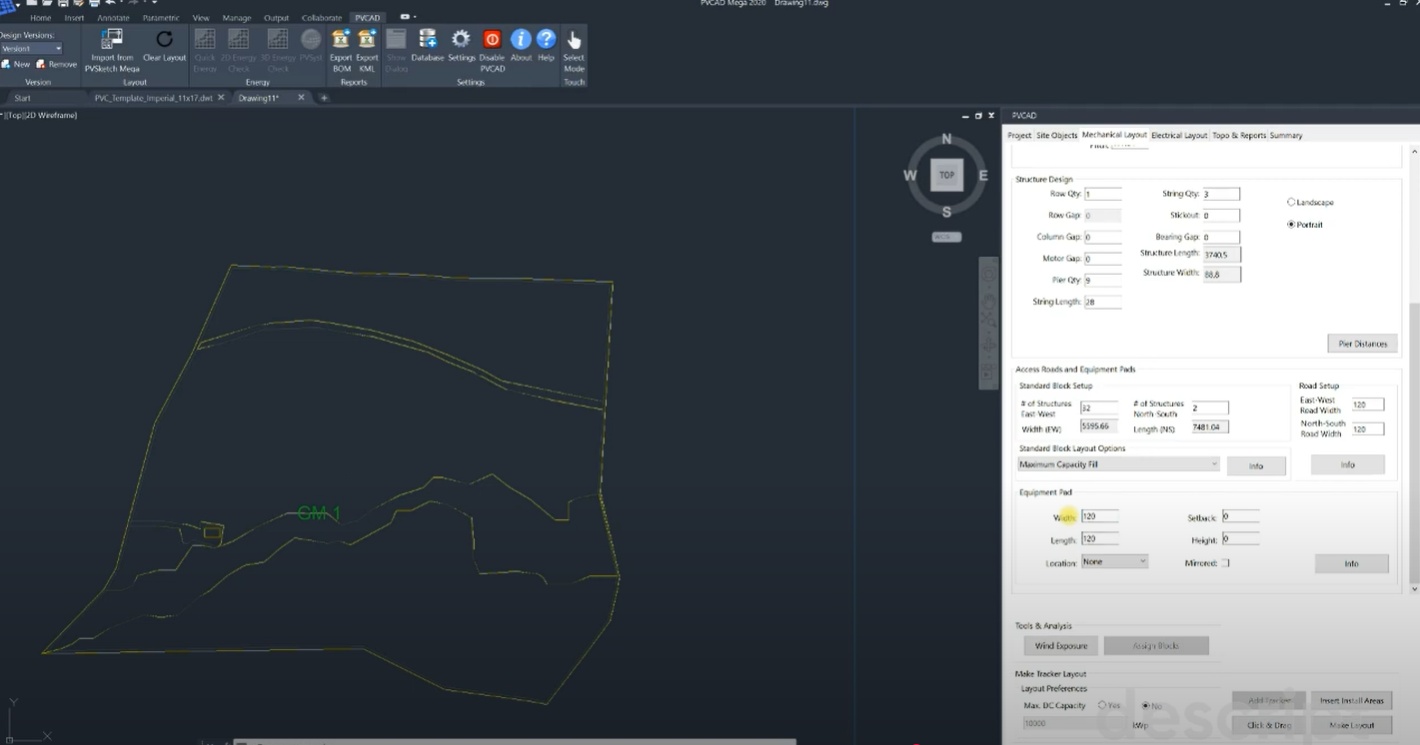
The details become quite physical. A designer can set slope tolerances, run a pier analysis and export a schedule of pier heights. Those supports are the point at which an elegant arrangement starts negotiating with the landscape. A design that ignores that negotiation can offer a pleasing capacity number while concealing difficult construction work.
PVComplete advertises very fast large-project layouts. Those claims are best understood as layout-generation claims, with the remaining engineering still to do. The useful lesson for a developer is practical: vary the equipment and layout assumptions while the project is young. Compare versions before an early choice becomes a costly commitment. Software makes that comparison easier; the quality of the comparison still depends on the inputs.
The customer who bought into the company
PVComplete’s European expansion has an unusually concrete beginning. EDP Renewables was using the software for utility-scale design. At Intersolar Europe in 2018, meetings with the project-development side of EDP led to introductions to its venture investment group. In March 2019, PVComplete announced a Series A led by EDP Ventures and backed by Syzygy West, among other investors.
“It’s unusual for an investor to start out as a customer”Claudia Eyzaguirre, writing about the Porto expansion in April 2019
The funding supported a subsidiary in Porto, Portugal. Eyzaguirre described help from EDP Ventures with admission to UPTEC, the University of Porto’s science and technology park, as well as introductions to recruiters, legal and accounting services, prospective customers and portfolio-company executives. Local connections gave the expansion practical machinery.
Other companies can copy the sequence, if they have the necessary customer relationship: demonstrate value inside a customer’s working operation, then explore what that relationship can support. An introduction is more useful when someone can explain why the product already matters. PVComplete also tied the move to European electrical specifications, support and training in local time zones. Selling internationally involved more than translating a landing page.
Pay for the tool, or pay for the drawing
The commercial model follows the division of work. There are monthly and annual software licenses, a free PVSketch option, enterprise arrangements and AutoCAD bundles. Published annual-plan starting rates put PVSketch Mega at $299 a month, the PVCAD bundle at $333, PVCAD Mega at $390 with an existing AutoCAD license, and the Mega bundle at $480 including AutoCAD. These are advertised starting prices checked in October 2026.
For customers who want to outsource work, the company offers proposals, electrical and mechanical plan sets, and structural and electrical stamping. Its service menu lists a residential plan set at $150 and a commercial or industrial plan set above 1 MW at $950, with separate edit fees. The page says these fees are added to the subscription payment. A plan-set listing should be read for its stated scope; it does not establish an all-inclusive stamped-project price.
Equipment manufacturers and engineering firms have another route: custom tools and integrations. PVComplete can build branded design software and automate equipment quantities, allowing a manufacturer’s customers to turn a layout into a purchasing list. This is a business-to-business company with several ways to charge for reducing repetitive work.
Its alternatives include OpenSolar’s design and sales tools and HelioScope’s commercial design and simulation software. PVComplete’s particular appeal is its browser-to-AutoCAD path, together with engineering services and custom development. That is a useful fit for teams whose later work already lives in CAD. A team choosing software should follow a real project through the exports it needs, rather than judge the opening screen alone.
A power plant talks back
The team has some pleasingly unexpected credentials. CTO Brian Hogan holds a doctorate in ethnomusicology from UCLA. Porto team lead Juan Ferreira has a physics doctorate and a background in climate-related research. Senior software engineer Carlos Frias previously taught mathematics. Solar design draws on several kinds of thinking: interfaces, physical models, electrical systems and the patient handling of repetitive detail.

Enact’s January 13, 2026 acquisition announcement gives the next chapter a specific ambition. It proposes combining PVComplete’s engineering tools with Enact’s proposals, asset monitoring and maintenance software. Operating-project information would feed back into the design phase. CEO Shane Lebow joined Enact; Hogan joined as CTO. The announcement promised continued support for existing users and further combined features.
That feedback loop remains an ambition to assess through delivered capabilities. Meanwhile, the existing workflow has concrete conditions: browser tools need connectivity; CAD products need the appropriate AutoCAD environment; equipment and site information must be usable. PVComplete’s FAQ even notes that corporate firewalls can block functions such as PVSyst export. Engineering judgment and professional approvals remain part of the work. A tidy drawing earns its keep when the next person can use it.