A transformer is an awkward place to look for drama. It does not have a screen. It does not acquire followers. Yet put one on a sufficiently long waiting list and an entire power project acquires a new personality: expensive, impatient and unable to switch on. Ayr Energy has built its proposition around this small indignity of the electric age. The machinery may be familiar. The delay has become intolerable.
- Ayr designs and supplies critical electrical equipment, with US oversight and manufacturing capacity in India.
- Its customers include renewable developers, utilities, data center builders and industrial buyers.
- It reported more than $500 million in contracts in April 2026. That is an order book, not revenue.
- The pitch combines shorter equipment lead times, custom engineering and support after delivery.
Consider what an equipment order asks of a developer. You must commit to a machine while your project is still taking shape. The longer the queue, the earlier the commitment. The earlier the commitment, the more opportunities there are for your requirements to change. Procurement becomes a forecast with a purchase order attached. Ayr’s wager is that making this process more forgiving is valuable enough to support a new equipment company.
Associated with more than 20 GW of new US power capacity.
Contracts and project capacity do not equal revenue or completed installations.
A factory slot is a product, too
Ayr’s published delivery range for power transformers is 40 to 72 weeks. Its experience page compares that with a 120-week industry average for 2024, attributed there to Wood Mackenzie. These are advertised ranges and a historical benchmark, rather than a promise that every buyer receives the same saving. Still, the comparison explains the attraction. A year matters when the rest of your project is waiting for a large piece of electrical equipment.
The operational idea is to connect available manufacturing capacity with customers who cannot get equipment soon enough. Ayr lists manufacturing locations in India, while its US team oversees engineering and project delivery. It calls itself an original equipment manufacturer. Public descriptions of the business also emphasize manufacturing partners. The useful distinction for a buyer is responsibility: who controls the design, production schedule, testing and eventual shipment?
Another part of the offer concerns changes. Ayr’s investor 3one4 Capital describes modular transformer designs that allow customers to adjust an order later in the process without restarting the design cycle. That flexibility has a practical purpose. A developer ordering early should have a better chance of receiving equipment suited to the project it eventually builds. It is a design choice responding to a purchasing problem.
The grid is a chain of purchases
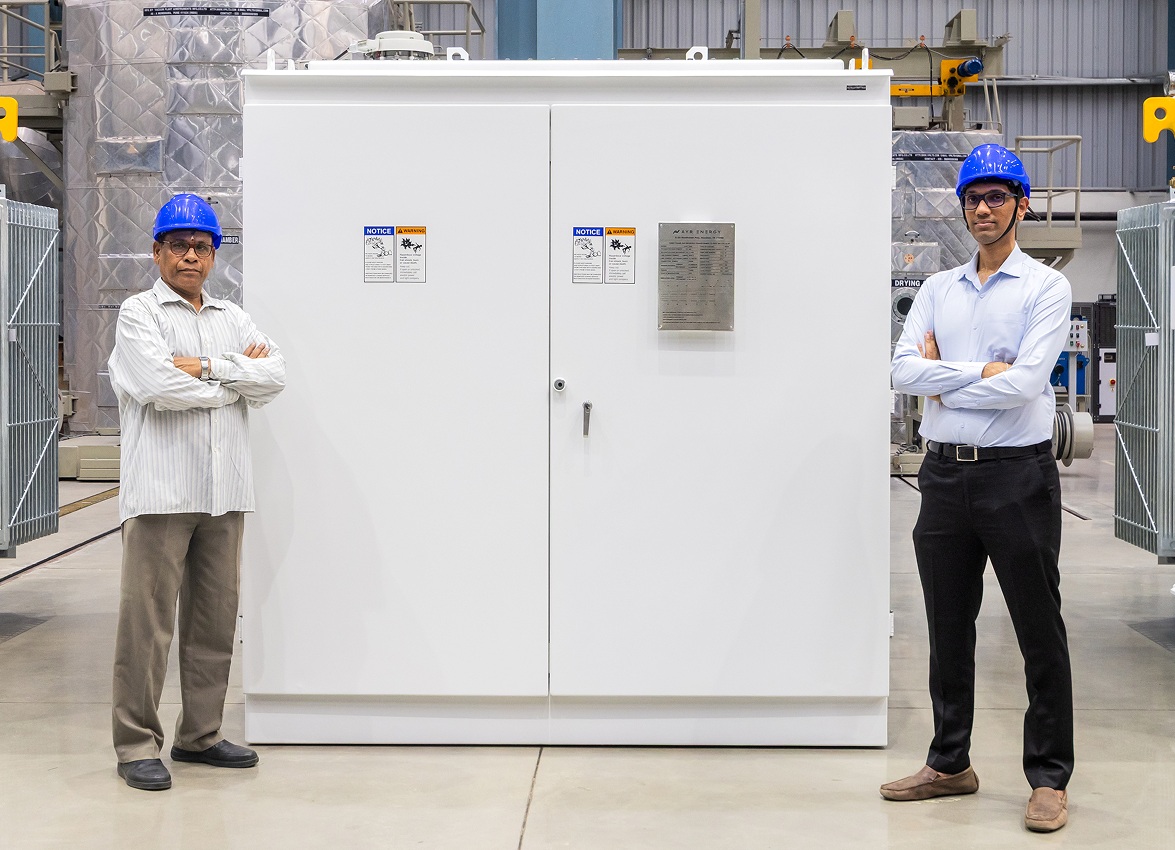
Ayr’s catalog follows electricity through several jobs. Generator step-up transformers raise voltage for transmission. Substation transformers bring it down for distribution. Auto transformers connect networks operating at different voltage levels. On its dedicated power-transformer page, Ayr lists equipment up to 500 MVA and 500 kV. Those are catalog limits, not the specifications of every unit leaving a factory.
Further downstream, distribution equipment comes in pad-mounted, dry-type and substation forms. The dedicated distribution page advertises medium-voltage transformer lead times beginning at 16 weeks. Different environments call for different constructions; an indoor commercial installation and a utility distribution site do not present identical engineering questions. This is why an equipment supplier has to sell more than a delivery date.
- 01GenerationStep-up transformer
- 02TransmissionProtection & switching
- 03DistributionStep-down transformer
- 04End useLocal distribution & control
Special-purpose transformers address more particular demands. Inverter-duty units serve power-electronics applications, including renewable energy and storage. Grounding transformers provide a neutral point for electrical protection. Furnace transformers accommodate demanding industrial loads. The labels sound obscure until a buyer has a furnace, an inverter or a grounding requirement. Then the difference between a standard machine and the correct machine becomes rather less academic.
The catalog also covers medium-voltage switchgear and high-voltage circuit breakers. Switchgear controls and protects distribution systems; breakers interrupt faults. Ayr advertises 12 to 20 weeks for complete switchgear systems. Its dedicated breaker page lists 72.5 to 363 kV equipment, while some cross-links still describe breakers as being developed. A sensible purchase begins with confirming the particular product’s availability and approved specifications.
The people buying back their calendars
Ayr names utilities, data centers, renewable energy, industry and oil and gas among its markets. The clearest customer evidence comes from procurement testimony. At its September 2025 launch, Linea Energy CEO Cassidy DeLine praised safe-harbor work completed in weeks, describing it as less than a quarter of competitors’ time. That is a customer’s account of a specific process, rather than a controlled comparison of every transformer delivery.
“We’ve trusted Ayr with a significant portion of our equipment procurement, and that confidence has been well-placed.”
Joe Song · Segue Sustainable Infrastructure
In Ayr’s April 2026 announcement
That endorsement captures the buyer’s problem neatly. A developer needs equipment procurement to behave predictably across its portfolio. Ayr’s business model is built around equipment contracts, with engineering, commissioning and continuing service wrapped around the physical purchase. Annual maintenance agreements and spare-parts support extend the relationship into operations. The commercial conversation concerns the whole period of ownership, including the day something needs attention.
The founders’ backgrounds help explain this emphasis. Anirudh Reddy, the CEO, lists experience at Ather Energy and Eaton. Rahul Arora lists McKinsey and Schlumberger. Yash Takallapalli lists Sportscafe and McKinsey. All three list undergraduate degrees from IIT Madras. Their company’s public language prizes responsiveness and direct access to engineers. For customers, that culture claim has a useful test: can the supplier’s engineers actually resolve the next specification question?
 Anirudh ReddyCo-founder / CEO
 Rahul AroraCo-founder
 Yash TakallapalliCo-founder
Twenty-five million dollars, and a very old machine
General Catalyst announced its investment in September 2025, when Ayr emerged from stealth with more than $250 million in reported contracts associated with over 10 GW of new power. By April 2026, Ayr reported more than $500 million in contracts and over 20 GW of associated US capacity. Its announcement also said units had been commissioned across the country. The order book and the installation record are related, but they measure different stages of work.
Investor 3one4 Capital reported $25 million in cumulative funding across two rounds. Energy Impact Partners led the April financing, with General Catalyst and 3one4 participating. This is the capital raised to develop the company; it is separate from what a customer pays for a transformer. The stated uses include new product development and expansion into utility and data center markets.
The competitive setting includes established equipment makers such as Hitachi Energy, Siemens and GE-related transformer businesses. They bring installed equipment, customer relationships and manufacturing experience. Ayr’s case rests on delivery, flexibility and engineering partnership. Those advantages must be demonstrated project by project. A familiar electrical design can become a useful opening for a new supplier when the established purchasing process leaves customers waiting.
There is also a longer-term technology ambition. Ayr and its investors describe solid-state transformers as part of the roadmap, while conventional equipment serves customers today. The sequence is deliberate: deliver useful hardware, establish a working relationship, and mature newer technologies internally. It gives the company a near-term sales proposition without requiring buyers to wait for the next generation of transformer.
The delivery date is only the first test
A machine delivered early still has to pass testing, arrive intact and be commissioned. Ayr says its equipment is produced in ISO-certified facilities with material traceability and factory testing. Its transformer testing guide distinguishes routine electrical checks from more specialized tests. A buyer’s useful next step is to agree on the test plan, acceptance criteria and documentation before manufacture begins. Speed loses its charm when acceptance becomes an argument.
Service scope matters just as much. Ayr includes installation and commissioning in the standard scope for high-voltage transformers; medium-voltage support is optional, and breaker commissioning is available on request. Its service page describes maintenance partners operating from more than 15 US locations and advertises a 24-to-48-hour continental-US response. Response time measures attendance, not necessarily a completed repair. Parts, diagnostics and the fault itself still influence restoration.
The market is also contested in court. In August 2026, the US International Trade Commission announced a transformer investigation following Ayr’s complaint against Zetwerk entities, KRYFS and Unimacts. The complaint concerns alleged trade-secret and other unfair-trade violations. The commission explicitly said institution did not decide the merits. This is a procedural development, not a finding that the allegations are true.
For project buyers, the lesson is practical: compare suppliers on the path from specification to power-on. Ask what can change after ordering, which factory slot is committed, what tests are included and who handles commissioning. Earlier equipment cannot itself settle a permit or secure a grid connection. It helps most when equipment is the part holding the project back. Ayr’s opportunity lies in making that particular wait shorter - and then making the machine worth having waited for.