A fractional share is a wonderfully modest invention. It tells a person who cannot afford a whole share that the price on the screen need not be the price of admission. When Public launched in 2019, that was part of its appeal. So was the company around the purchase: other investors, conversations, a little less solitude. Wall Street had acquired a front door that looked like an app.
- Fractional shares opened the door; a multi-asset brokerage widened it.
- Public rejects equities order-flow payments, but shares options revenue through rebates.
- AI research took over some of the social feed’s original job.
- The next product is an instruction that can act inside a portfolio.
The share was only the beginning
Co-founders and co-CEOs Jannick Malling and Leif Abraham built a company whose stated mission is to give people opportunities to grow their wealth. Fractional investing addressed a visible obstacle: the ticket price. The social layer addressed a quieter one: feeling unqualified. Both made sense for someone approaching the market with more curiosity than capital.
But the customer who buys a first share can become a customer with several accounts, different time horizons, and a tax return that no longer fits the mood of a cheerful feed. Public followed that expanding problem. Its current menu includes stocks, ETFs, options, crypto, bonds and Treasuries, alongside cash and retirement accounts. The app increasingly asks for a larger role in someone’s financial life.
This puts Public between the familiar retail brokerage and the mobile trading app. Robinhood and Webull are alternatives for app-based traders; Fidelity and Schwab offer broader brokerage relationships. Public’s particular pitch combines asset choice with research and portfolio controls inside one interface. The useful question is whether that combination removes work for the investor who prefers to make decisions personally.
A free trade still has a business behind it
In February 2021, amid the GameStop upheaval, Public moved away from payment for order flow on equities. That practice pays a broker for routing customers’ orders. Public initially replaced that income with optional tips. The decision made an otherwise obscure piece of market plumbing part of the brand’s argument about trust.
The economics later became more elaborate. Securities lending, margin interest, cash-program revenue and product fees give the brokerage multiple ways to earn money. Its current fee schedule puts direct indexing at 0.19% annually and Generated Assets at 0.49%. For a constant $10,000 balance, those management fees work out to roughly $19 and $49 a year, before other applicable costs.
Options introduce an important qualification. Public receives options order-flow revenue and shares a portion with enrolled customers. Rebates depend on the contract, access method and trading volume. A lower trading bill can be useful; it does not improve the underlying investment thesis. The equities policy and options policy belong in separate sentences.
The feed loses its monopoly
Public introduced Alpha, an AI research assistant powered at launch by GPT-4, in May 2023. It offered conversational research across investments. A user could seek context while examining an asset, without first finding the right person to ask. For a company built partly around learning from others, that was a substantial change in where the conversation happened.
By December 2024, the founders said AI was providing many benefits previously supplied by social features. They reported Alpha usage by more than 90% of members, and a trade within three hours of 25% of Alpha conversations. Those are company figures. They show proximity between explanation and action, without establishing whether the resulting decisions were better.
“Move fast, don’t break things.”Public’s founders, December 2024
The same funding announcement reported billions in assets under management and a profitable core brokerage with more than ten significant revenue streams. It announced $135 million in financing: $105 million in equity, led by Accel, plus $30 million in debt. The core-brokerage claim should not be mistaken for audited profitability of the entire company.
The country Public left behind
Expansion also produced a reversal. Public launched in the UK in July 2023. In February 2024, it announced that it would withdraw, with accounts closing after April. A spokesperson pointed to accelerated US growth and newer products, including cash, bonds and options, as reasons to concentrate at home. Geographic ambition had met a competing use for the company’s attention.
There is a practical lesson here for another founder: examine what customers want to consolidate, then spend accordingly. Public’s choices suggest that serving more needs in one market could matter more than opening another. That logic depends on customers actually valuing the bundle. Someone content with a single inexpensive index fund may have little reason to seek a more elaborate interface.
From asking questions to giving instructions
The newer products move research toward construction. Generated Assets lets people describe screening criteria in ordinary language, inspect a resulting portfolio and invest in it. Direct indexing, starting at $1,000, offers customization and tax-loss harvesting. Its disclosures acknowledge that a small account may hold only part of a benchmark’s stocks. A personalized portfolio comes with tracking differences as well as preferences.
On March 31, 2026, Public announced AI Agents. Investors describe tasks, review the proposed logic, then activate workflows that monitor conditions and execute instructions. They can inspect actions, edit, pause or stop an Agent. Public says these workflows do not make independent decisions. The investor supplies the intent; software supplies the persistence.
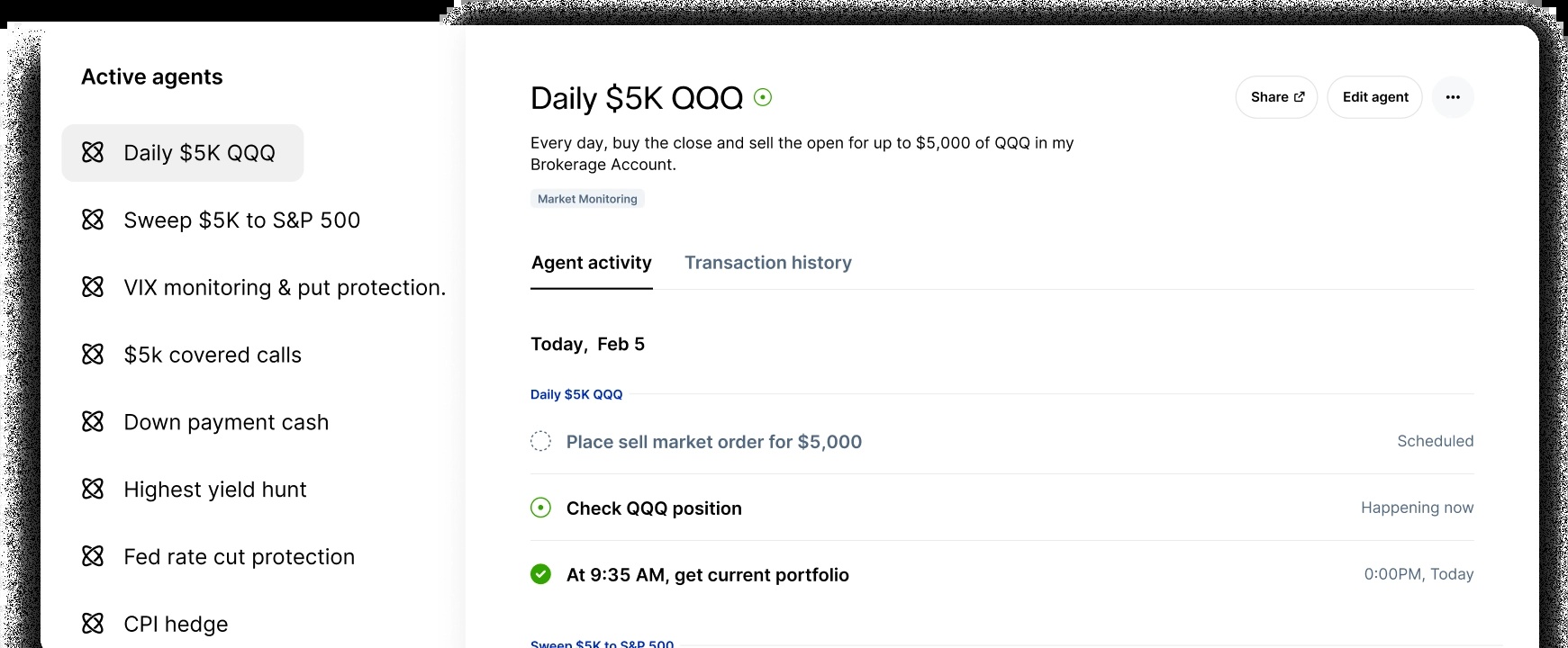
That arrangement has limits. Generated Assets’ historical backtests are hypothetical, tax benefits depend on the investor, and an automated instruction can preserve a mistaken assumption remarkably efficiently. Public’s disclosures put responsibility for suitability with the customer. The interface can reduce the work between an idea and an order. It cannot make the idea sensible.
Public’s evolution is therefore a story about the changing shape of assistance. First came permission to start small. Then came company, context and a wider set of assets. Now comes help carrying out a plan. The appealing part is continuity: an investor need not outgrow the software after the first purchase. The demanding part is that growing up still requires judgment.