The important object in Project Serum’s story was a key. You could not see it on a trading screen. It did not appear beside the bids and offers. But when FTX collapsed in November 2022, the authority to upgrade Serum’s trading program became a problem for everyone building on it. A market designed to connect independent applications had a dependency those applications could no longer accept.
- The idea: let different Solana apps trade through one shared order book.
- The catch: FTX retained authority to change the underlying program.
- The afterlife: developers copied the code into a separate project, OpenBook.
That sequence makes Serum worth understanding. It built something useful: infrastructure that let another team offer trading without first constructing an entire exchange. Its original mainnet program became defunct. The design, being open source, was available for others to carry forward. There is a practical distinction between those two outcomes.
The market behind the window
Start with the ordinary problem of opening a market. A pleasing interface cannot manufacture somebody willing to take the other side of a trade. Every new venue needs buyers, sellers and prices worth accepting. Spread those participants across disconnected applications and each application has a smaller crowd to work with.
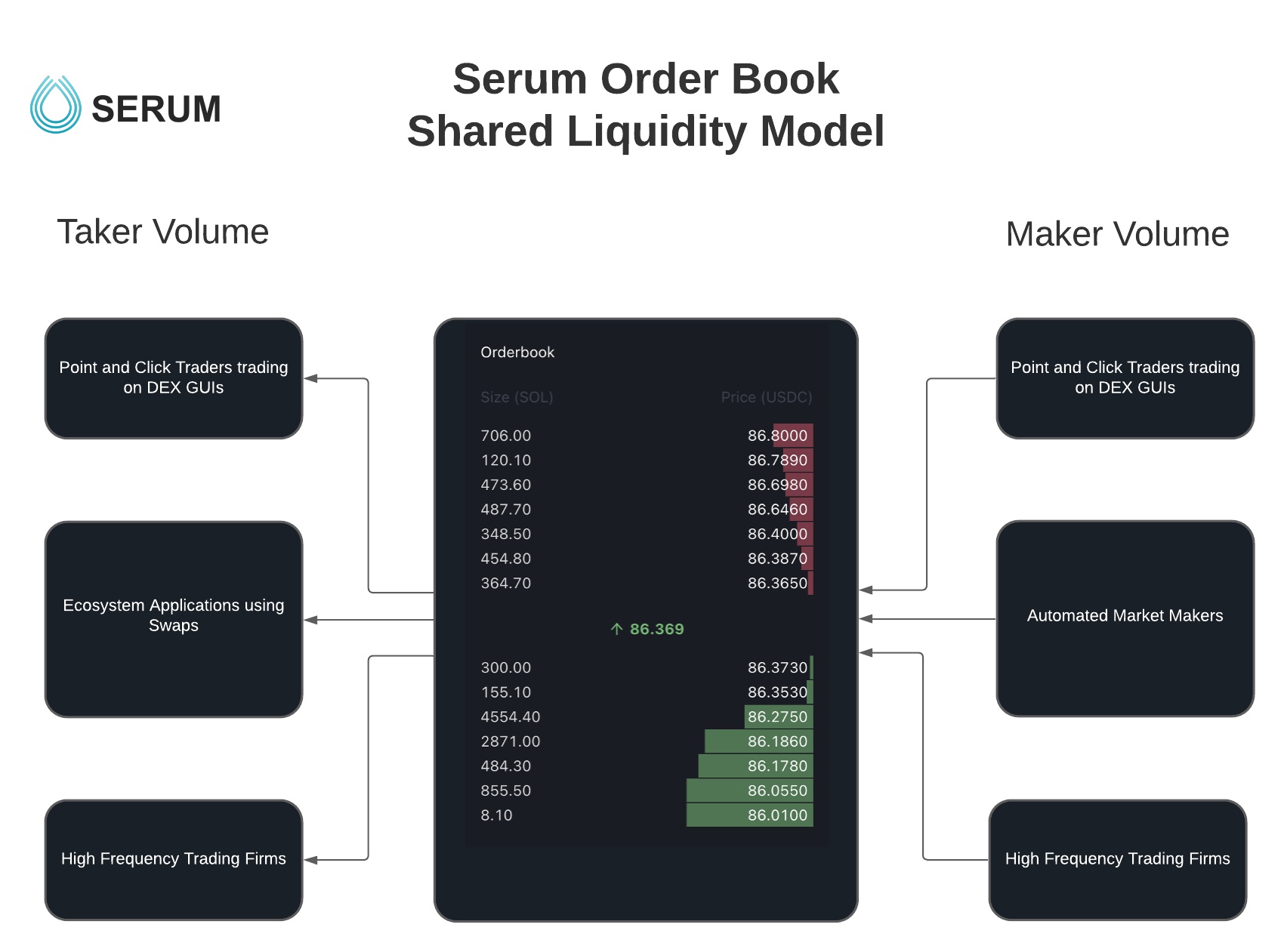
Serum’s answer was a shared central limit order book on Solana. A trader specified a price and quantity; the matching engine used price-time priority. Applications could present different screens while sending orders into the same market. The person buying through one interface could meet a seller using another, without either needing to choose the same website.
Announced in July 2020 and launched that August, Serum emerged from FTX and Alameda Research’s efforts, with Solana Foundation backing. Sam Bankman-Fried was its prominent founding sponsor. Solana’s speed and low network costs made frequent on-chain order updates more practical. The project’s expertise lay in combining exchange mechanics with blockchain programs and developer infrastructure.
For a small development team, that changed the starting point. Instead of recruiting every market participant itself, it could connect to existing trading infrastructure and spend its effort on the customer experience. The attraction was practical: fewer components to invent before a useful product could reach a trader.
The pool that joined the queue
This positioned Serum between consumer trading products and the blockchain beneath them. Traders and market makers used its markets. Developers used its matching infrastructure, TypeScript libraries and example interface. Bonfida and Mango appeared among its trading interfaces. Those integrations mattered because the product could serve people who never visited a Serum-branded screen.
Raydium supplied a particularly revealing example. Its automated market maker could place orders from liquidity pools onto Serum’s book. Pool liquidity then became accessible to other Serum interfaces, while Raydium could compare a pool swap with an order-book route. A pool and an order book could cooperate inside the same trading system.
Compared with the familiar pool-based approach of Uniswap or SushiSwap, Serum offered explicit limit prices and a common matching venue. Compared with a centralized exchange, it put the trading program on-chain and let outside teams build around it. Those choices addressed fragmented liquidity and developer duplication. They still required counterparties, working infrastructure and acceptable program controls.
The price on the ticket
The commercial invitation was straightforward. Serum’s hosting guide told interface operators they could collect 20 percent of the fees generated by orders through their GUI. Developers could customize an existing React interface, host it and participate in transaction economics. Distribution had an incentive attached to it.
A $1,000 executed taker order → $0.40
Fees appendix schedule, before network and account costs. Other archived schedules differ.The fees appendix listed a base taker fee of four basis points and discounts for SRM holdings. Its allocation sent 80 percent to SRM buy-and-burn. Historical documentation also contains other schedules, so a single number should not stand for every period. Nor were protocol fees the entire bill: users needed SOL for network transactions.
There were small operational surprises. Serum’s FAQ described roughly 0.02 SOL of recoverable account rent when first trading a market pair. Funds could require a separate settlement step before returning to a wallet. The promise of inexpensive trading did not remove the need to understand where a balance sat or which action moved it.
Expansion also needed capital. In January 2022, the Incentive Ecosystem Foundation raised $75 million through a token sale toward a $100 million target, with participants including Tiger Global and Commonwealth Asset Management. That was ecosystem financing, not a conventional equity round. Serum reported more than 70 ecosystem projects that quarter and promoted hackathons and an accelerator to attract builders.
The permission nobody could ignore
Then the sponsor relationship became the urgent issue. FTX held Serum’s upgrade authority. Following FTX’s collapse, integrations faced concern that compromised authority could be used to change the program. The critical failure was confidence in who could alter the infrastructure. An order book could still exist while the surrounding applications decided using it was unacceptable.
“Serum served a critical role in the Solana decentralized finance ecosystem.”Brian Long, Solana developer · December 2022
That explains the change of mind. Jupiter and Raydium moved away from Serum. Developers from Mango and other Solana projects helped create OpenBook from Serum’s code. By November 29, Serum’s own public account described the mainnet program as defunct. OpenBook was a separate deployment, with a separate community effort behind it.
What the builders carried away
The portable idea is clear: share the expensive market infrastructure while letting applications compete on experience. Give outside builders usable tools and an economic reason to participate. Make the code available so the useful machinery can survive the organization that first sponsored it.
Copying that approach requires more than a repository. Shared liquidity needs active participants. A fork needs new integrations and operators. Cheap execution needs a functioning chain and reliable access to it. Above all, a builder needs to inspect who can change a dependency. Serum’s history makes that last question unusually concrete: before sharing the market, understand who holds the key.
Open the archives
Explore the original tools and the community response.
Watch the original pitch
Historical videos, recorded before the November 2022 collapse.
▶ Serum: what it is and how it worked▶ Sam Bankman-Fried and Lennix Lai discuss Serum