A trade can fail over an amount too small to buy anything. In GTE’s reviewed code, a swap could leave a tiny remainder after rounding. The order book wanted the order filled completely; the previous trading venue supplied an amount that did not fit neatly. The transaction could revert. Somewhere between two perfectly respectable pieces of financial machinery, the customer’s trade had fallen through the floor.
This is a useful place to meet Liquid Labs, the company behind Global Token Exchange. Its subject is the journey a trade takes: where an asset begins, where liquidity gathers, how a price emerges, and how an order reaches completion. Crypto has plenty of destinations. The connections between them remain rather less civilized.
- GTE’s original design connected token launches, automated pools, and an onchain order book.
- Paradigm led a $15 million Series A announced in June 2025.
- The current public site offers a waitlist, previewing spot, perpetuals, and an API for agents.
01 / The customer was doing the stitching
Imagine creating a token, finding somewhere for it to trade, then persuading professional traders to quote prices. Those are different jobs. A launch mechanism gets an asset into circulation. A liquidity pool lets people exchange it. An order book collects buyers’ and sellers’ stated prices. A trader moving among them inherits the inconvenience of every boundary.
Liquid Labs approached that inconvenience as an architectural problem. Its earlier GTE documentation describes long-tail assets starting in automated market makers, then potentially graduating to an order book as liquidity and market-maker interest develop. The mechanism changes with the market’s maturity. Demanding a crowded order book from a newborn token would be an ambitious seating plan for an empty restaurant.
The documented suite also included a permissionless token launcher, a curated launchpad, and aggregation across trading venues. Together, those features proposed a route through an asset’s early life. For token creators, the appeal was continuity. For traders, it was fewer places to visit before getting an order filled.
An asset’s first social calendar. Earlier documented design; graduation depends on liquidity and market-maker interest.
02 / A familiar machine, a different foundation
A central limit order book sounds forbiddingly modern. Its principle is familiar: buyers name prices, sellers name prices, and compatible orders meet. GTE’s published engineering description explains price-time priority: the most competitive prices go first, followed by the order in which equally priced requests arrived.
The original foundation was MegaETH. In early 2025, co-founder Enzo Coglitore argued that GTE needed unusually high throughput and low latency. Putting the order book onchain was meant to preserve non-custodial trading and the ability to interact with other blockchain applications while approaching centralized-exchange responsiveness.
“When you’re a trader, every millisecond counts.”GTE, quoted by The Block, January 2025
That makes its competitive position clearer. Binance and Coinbase supply a familiar centralized trading experience. Hyperliquid and dYdX occupy the decentralized order-book market. Liquid Labs’s proposed advantage combined execution with the surrounding asset lifecycle. The company’s speed language describes an ambition; the meaningful customer test is a reliable fill at a useful price.
03 / An exchange needs two kinds of customers
Retail traders want access and execution. Liquidity providers need conditions in which supplying prices makes economic sense. GTE’s founders described both audiences in June 2025. An exchange must persuade them to arrive together. A beautifully responsive screen with nobody quoting on the other side remains an expensive way to admire numbers.
Auros offers a concrete glimpse of the work underneath. The trading firm describes supporting GTE with technical advisory and debugging, clearing integration and performance obstacles. Such relationships matter because liquidity provision depends on usable connections as well as capital. A market maker must be able to plug in, observe the market, and manage orders.
Liquid Labs’s expertise sits at that intersection of software and market structure. Coglitore previously invested at Alchemy Ventures; co-founder Matteo Lunghi was a Palantir technical lead. Their problem requires contracts, interfaces, and trading mechanics to agree on what just happened.
04 / The price of finding the awkward cases
Funding supplies development runway. GTE disclosed early venture and community rounds in January 2025, including $2.5 million raised through Echo. June brought the $15 million Paradigm-led Series A. These are capital figures, rather than receipts from customers.
USDC award pool for the July-August 2025 competitive review of GTE’s spot order book and router.
Security review makes the expenditure more tangible. Code4rena’s February 2026 report lists three high-severity and four medium-severity findings in that reviewed system. Zellic had also assessed earlier GTE contracts. These reviews describe particular versions of code; an audit is a bounded examination rather than a permanent certificate of safety.
The rounding problem in the opening belongs to the report’s lower-severity material. Its lesson is wonderfully unglamorous: test the joins. A liquidity pool’s output can be awkward for an order book’s lot size. Each component may look sensible alone, yet their combination disappoints the user. The report documents a failure condition, rather than evidence of a customer losing money in production.
05 / The next act has a different doorway
By August 2026, GTE appeared among the initial Open ATLAS collaborators, alongside Bullish, DefinedFi, and TrueNorth. LayerZero Labs’s headless exchange backend brings matching, clearing, settlement, and risk management into a framework that trading applications can use. That broadens the story beyond its original MegaETH-only positioning.
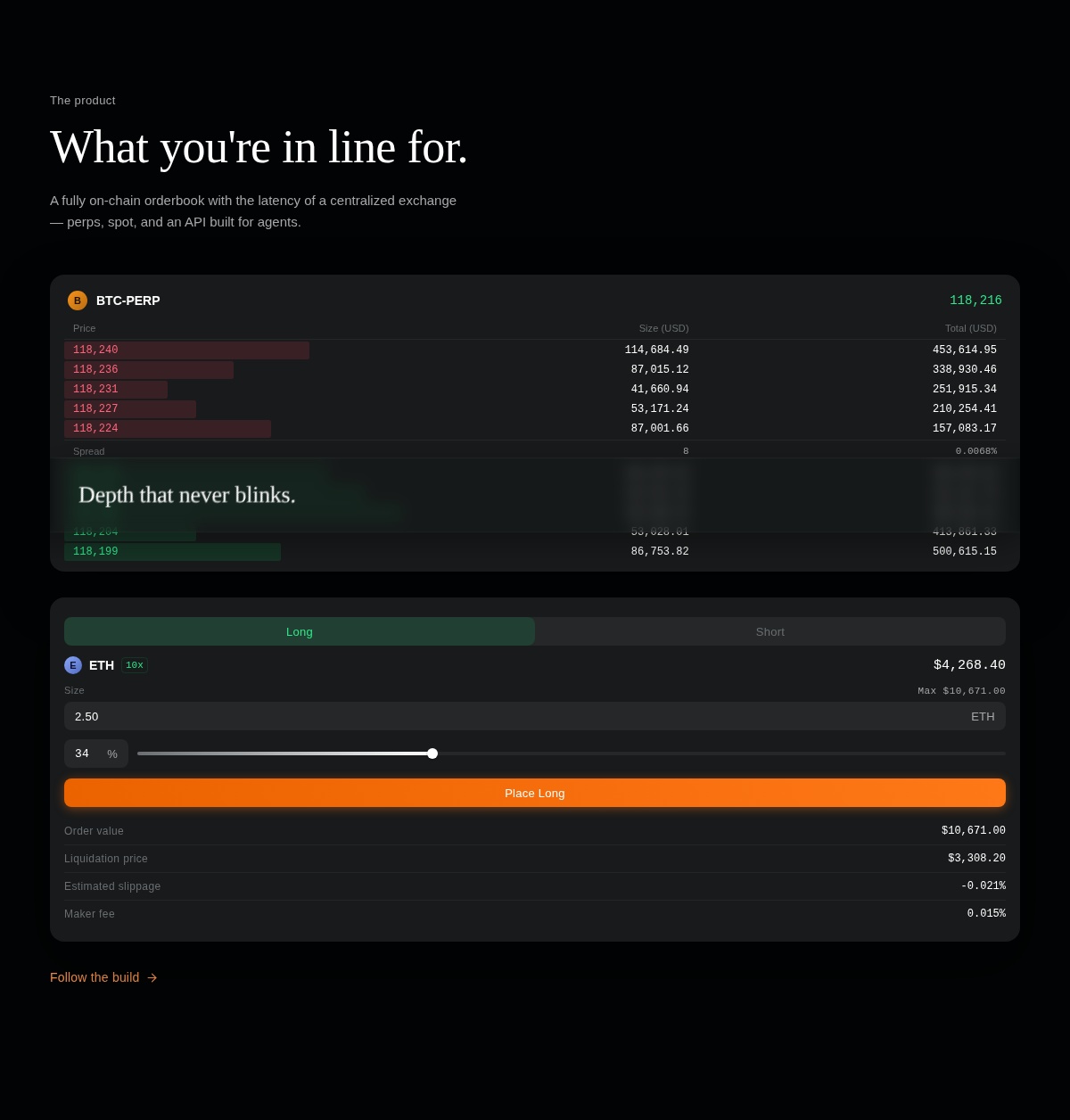
The current GTE website presents the next product through a waitlist. Its preview advertises an onchain order book, spot, perpetuals, and an API built for agents. The distinction matters: the displayed market and leveraged position illustrate what users are queuing for. They are not evidence of executable prices or a published production fee schedule.
06 / Copy the handoff, then measure the fill
There is a practical lesson here for builders outside crypto: map the customer’s entire task before choosing which feature to improve. Liquid Labs’s early design joined creation, circulation, and execution. The current direction emphasizes a unified trading experience and automated access. Both address the labor users perform between tools.
The conditions still matter. Fast infrastructure cannot conjure liquidity; public access must precede ordinary customer adoption. The audited contracts support trading fees, but a preview fee is no business forecast. Earlier reports of roughly 700,000 testnet users indicate attention, with different stakes from paying customers. Liquid Labs’s wager will be judged where it began: at the moment the whole trade actually completes.