On March 4, 2014, the owner of Poloniex explained to an internet forum why some of its bitcoin had disappeared. Several withdrawals could arrive together, pass the balance check and get paid. The accounting could still add up. The customer’s balance could still be negative. Software had found a way to be internally consistent and financially disastrous.
- The business: a centralized crypto marketplace for eligible international traders, with spot, derivatives and programmatic access.
- The attraction: an early reputation for altcoins, plus tools for people who trade more than occasionally.
- The trade-off: execution speed, custody and permission to operate are separate questions. Poloniex has had to answer all three.
The arithmetic that went wrong
The exchange was weeks old. Its founder, Tristan D’Agosta, had been a musician; Poloniex’s later account says he taught himself to code because he wanted a better place to trade. That is an appealing origin for a software company. It is also quite a responsibility to attach to a balance sheet.
The March attack took about 12.3% of the bitcoin held on the exchange. D’Agosta temporarily reduced customer BTC balances by that proportion, disclosed the shortfall and proposed repayment from exchange income and his own contributions. His technical response included queuing withdrawals, verifying critical database operations and bringing in developers.
“I do not have the money to wave away the debt, so we’ll need to work together.”
Tristan D’Agosta · March 2014
The useful detail is the diagnosis. A balance check performed before competing requests finish changing that balance offers less protection than it appears to. Anyone building payments, booking systems or scarce inventory can copy the underlying discipline: test what happens when several valid requests arrive together. A friendly interface cannot settle that argument.
A market for the overlooked
Poloniex nevertheless became a place where traders could find alternatives to Bitcoin. Its advantage was access: give a new asset a market before it becomes an obvious choice everywhere else. When Circle announced its acquisition in February 2018, it singled out Poloniex’s early Ethereum liquidity and breadth of token offerings.
A listing, however, is only the beginning. A useful market needs buyers, sellers and people prepared to quote prices while everyone else hesitates. The last group, market makers, turns a catalog into a place where transactions can happen. An exchange with an impressive list of assets and no reasonable counterparties is a very elaborate display cabinet.
Today, Poloniex’s central business remains matching cryptocurrency orders. Customers can buy or sell in spot markets, use borrowing-enabled margin trading, or trade perpetual futures. These contracts have no expiry date; they allow a position on price direction without being the same transaction as buying the underlying coin. APIs let developers submit orders and monitor markets through software.
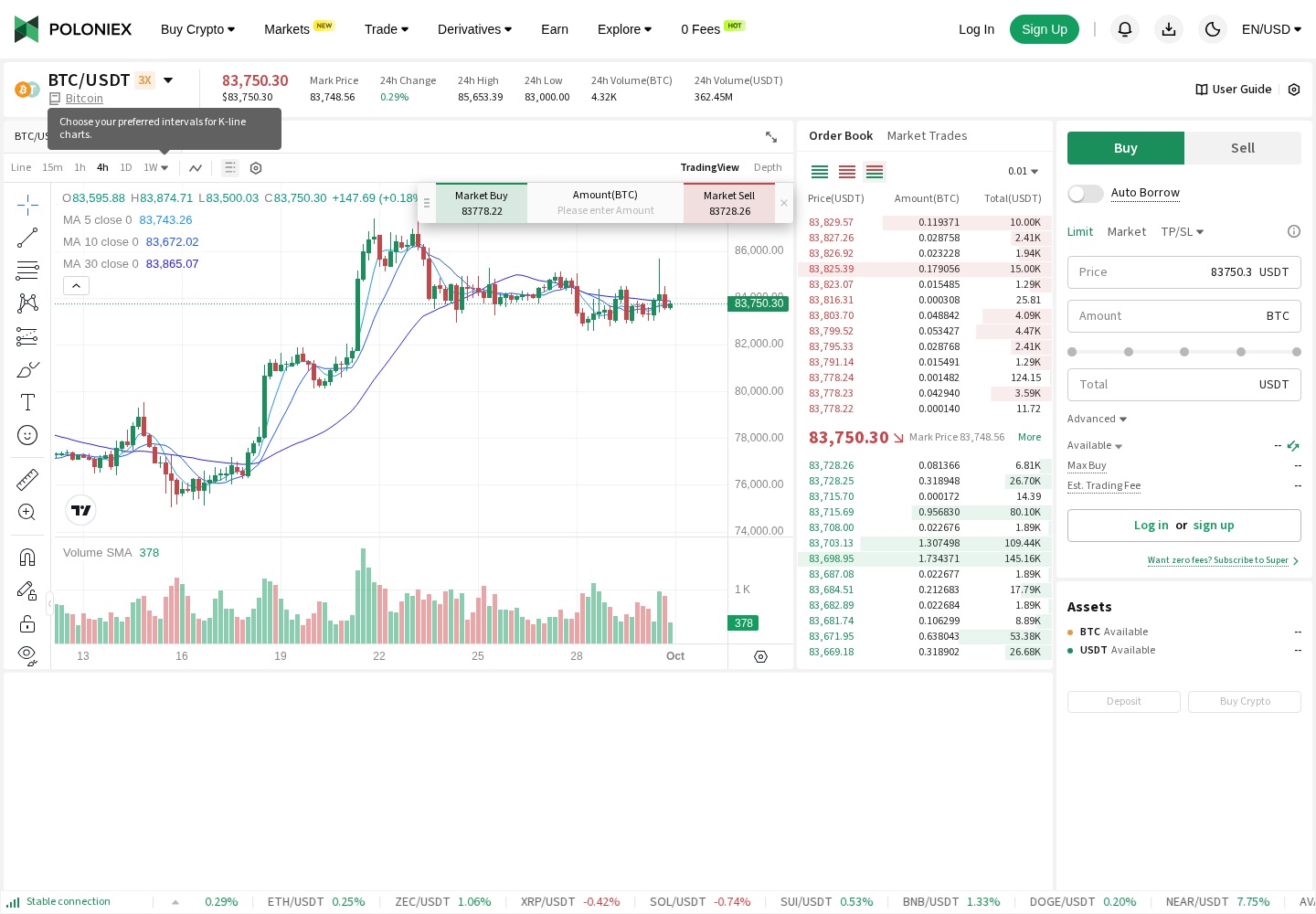
The platform also advertises grid trading, futures copy trading and Earn products. Grid tools automate orders around chosen parameters; copy trading follows another trader’s strategy. Their own terms leave the investment risk with the user. Automation can repeat a decision efficiently. It cannot make that decision wise.
The geography of a business model
Circle wanted more than an altcoin exchange. Its acquisition announcement imagined a marketplace for tokens representing a much wider range of value, including property and creative work. The purchase was widely reported at roughly $400 million. That figure belongs to the historical transaction, not to Poloniex’s present valuation.
By October 2019, Circle was announcing a spin-out into Polo Digital Assets, Ltd., backed by an Asian investment group. Circle cited the difficulty of growing a competitive international exchange as a US company and sharpened its own focus on USDC and other financial services. The new operation planned more than $100 million of development and expansion investment. A spending plan is a promise, not a receipt.
The change had a concrete consequence: US customers could no longer trade from November 1, 2019. Geography became part of the product. The April 2026 user agreement still excludes US persons, alongside other restricted territories. An exchange can be available on the internet and unavailable to the person sitting in front of it.
The attractive growth strategy also brought legal exposure. In 2021, the legacy US entity, Poloniex LLC, settled SEC charges concerning operation of an unregistered securities exchange between July 2017 and November 2019. The total was $10.39 million in disgorgement, interest and a civil penalty; it neither admitted nor denied the findings. In 2023, OFAC announced a separate $7.59 million settlement over apparent sanctions violations. These concern historical conduct and the legacy entity. They should not be carelessly attached to every current Polo group company.
A faster engine, a different kind of risk
On August 1, 2022, Poloniex launched a replacement trading system. It reported more than 30 times the matching speed and more than 10 times the request throughput of the old system. Those are company-reported comparisons, not independent benchmarks against rival exchanges. New market and stop-market orders, improved APIs and an architecture designed to tolerate partial outages addressed the everyday business of keeping orders moving.
Compared with Poloniex’s previous system. Faster matching does not measure wallet security.
In November 2023, the exchange suffered another breach. Security firm Beosin estimated stolen assets at about $126 million and classified the incident as a private-key compromise. Poloniex subsequently announced a wallet update and replacement deposit addresses. The intervening years had changed the size and form of the problem considerably.
The distinction matters when judging the product. The matching engine determines whether an order finds its counterpart. Custody determines who can authorize assets to leave. Improvements in the first do not establish the safety of the second. A trader sees the chart; much of the consequential engineering remains out of sight.
The bill beside the Buy button
Poloniex earns money through fees and product-specific charges. On September 30, 2026, its live spot schedule listed a basic VIP 0 fee of 0.20% for both makers and takers. A maker adds an order to the book; a taker executes against an available order. Eligible TRX/HTX fee deduction reduced the displayed entry-level rate to 0.14%. Other tiers and promotions have different terms.
A $1,000 execution at 0.20% therefore costs $2 in trading fees. Buying and later selling are separate executions. Futures add another moving part: funding payments between long and short positions. In April 2026, Poloniex announced a revised funding calculation with dynamically adjusted intervals. Holding a position involves rules that continue working while its owner is doing something else.
That makes Poloniex more relevant to an active, eligible crypto trader than to someone seeking an uncomplicated savings account. Against alternatives such as Binance, Kraken, Coinbase or OKX, the practical comparison is the specific asset, usable order depth, total cost and services permitted where the customer lives. A decentralized exchange introduces a different custody arrangement and its own execution constraints.
The marketplace lesson hiding in the order book
Poloniex’s expertise is the operation of markets: matching orders, integrating asset networks, managing trading accounts and serving software-driven customers. Its 2022 Huobi partnership, followed by a 2023 announcement of a successful VOLT listing referral, shows another route to distribution. A project could move between audiences through a concrete listing relationship.
For builders, the transferable idea is to find a transaction other venues neglect, then serve the people who make that transaction possible. For traders, it is to examine the whole journey: eligibility, deposit network, execution, ongoing charges and withdrawal. Neither approach works well when liquidity is thin, the customer is prohibited from using the service, or access to funds is interrupted.
Poloniex makes an interesting company because its early advantage and its expensive problems are so closely related. It gave unfamiliar assets somewhere to trade. Keeping that invitation useful required far more than adding the next ticker symbol.
Explore the exchange
Markets, mechanics and a little moving-picture instruction.