An exchange is supposed to be a crowded place. Buyers make offers; sellers decide whether to accept them. Uniswap asks a peculiar question: what if the market could run without waiting for those people to meet? Its answer begins with a pool of tokens and a mathematical rule. The company that helps people use it has spent years dealing with everything the formula leaves out.
- Traders swap tokens through smart contracts while keeping control of their wallets.
- Liquidity providers supply the inventory and earn fees, taking financial risk in return.
- Uniswap Labs builds the apps and infrastructure; UNI governance makes protocol decisions.
01 / A demo with two problems
Hayden Adams began the project after losing his mechanical-engineering job at Siemens in 2017. His first prototype had two severe limits: one token pair, one liquidity provider. Friends helped turn it into usable software. Callil Capuozzo worked on the interface; Uciel Vilchis refactored the frontend. Adams also learned that explaining the mathematics was a poor substitute for explaining the benefit.
The protocol launched on November 2, 2018. Its opening liquidity was about $30,000 from one provider across three tokens. That supported roughly $100 swaps. The early market was small enough to make the word “exchange” sound rather ambitious.
02 / The inventory does the work
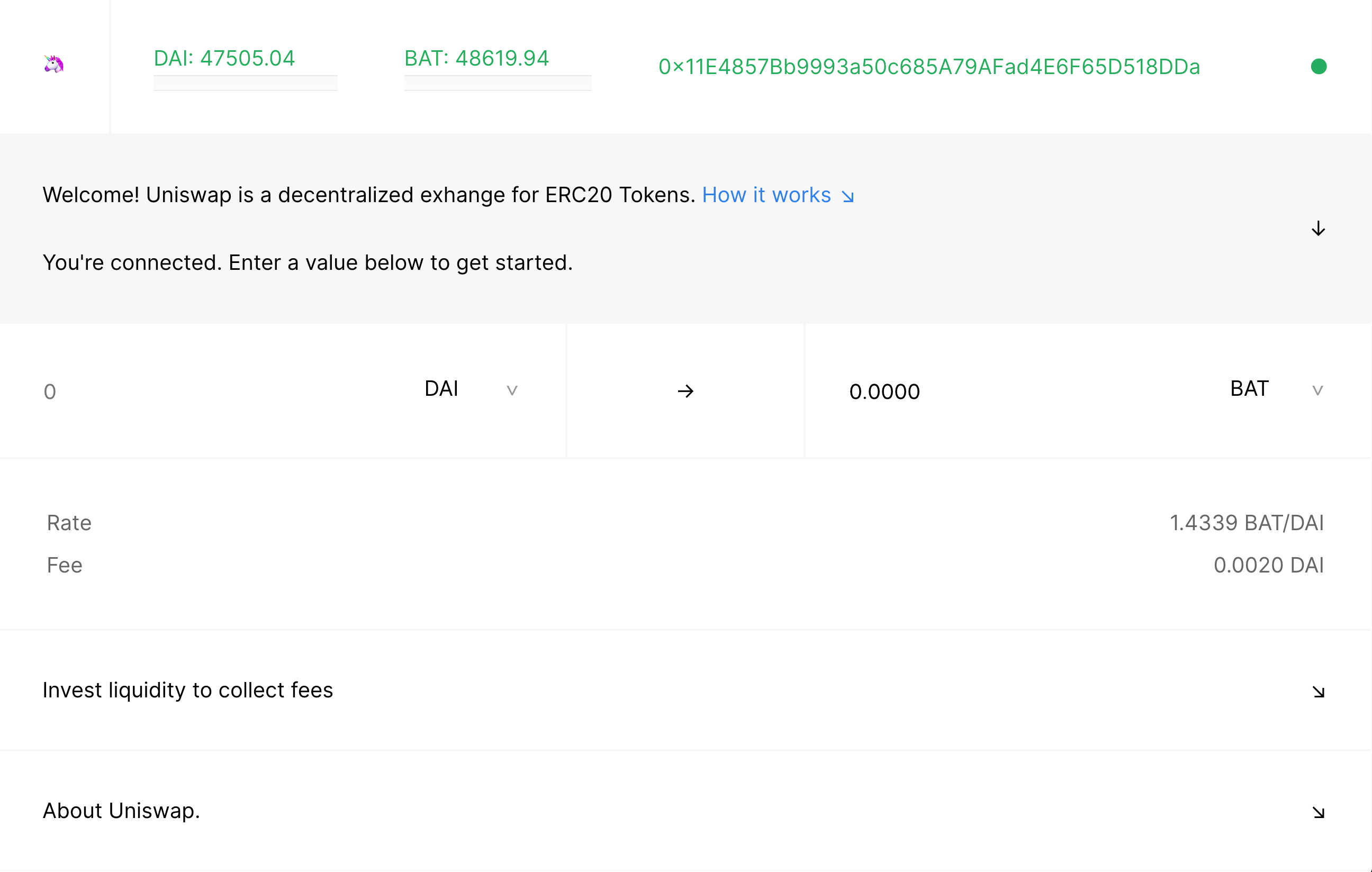
In Uniswap’s original design, a pool holds two assets. Their quantities obey the constant-product rule, x × y = k, with fees handled separately. Buy one asset and its supply in the pool falls; its price rises relative to the other. Arbitrage traders help bring pool prices back toward prices elsewhere. There is no order book waiting for a matching seller.
This solves a practical problem for people who already own crypto: exchanging it without depositing it with a centralized exchange. The Web App offers swaps and liquidity tools. The Wallet makes those actions portable. The Trading API lets developers put execution into their own applications. Customers include casual swappers, professional liquidity providers and teams building wallets or financial products.
Self-custody changes the bargain. A user gets control, but must understand approvals, assets and transaction costs. A thin pool can offer a disappointing price. Network fees can overwhelm a small trade. Permissionless access does not certify the token somebody has decided to sell you.
03 / Make capital useful, then make it programmable
The original pool spread liquidity across every possible price. Much of that inventory sat where nobody was trading. With v3 in 2021, providers could concentrate assets inside a chosen price range. More capital could work near the market price. The catch was rather human: someone had to choose the range.
When the price leaves it, a position stops earning fees until trading returns within its boundaries. Providing liquidity becomes a strategy, with exposure to changing prices and losses relative to simply holding the tokens. An elegant mechanism has a habit of giving its operator homework.
Then came v4, launched in January 2025. Its “hooks” let developers attach custom logic to pools: variable fees, liquidity management or other trading rules. Uniswap Labs’ expertise spans market design, smart-contract engineering, routing and product design. The competitive advantage is their combination: infrastructure other developers can extend, with consumer products that bring it users.


There was serious work behind the wardrobe. Before v4 launched, its contracts underwent nine audits and a $2.35 million security competition. A bug bounty offered up to $15.5 million for critical bugs. That ceiling was an incentive to investigate, not a reported bill paid out. Audits reduce uncertainty; they cannot erase every risk in a pool’s custom code.
04 / A busy market still needs a budget
Labs raised $11 million in a 2020 Series A and $165 million in its October 2022 Series B, led by Polychain Capital. Those are company financing figures. Protocol trading volume measures something quite different: assets changing hands, often repeatedly. A trillion-dollar counter is an activity meter, not an income statement.
The distinction became central to UNIfication, approved by governance in December 2025. The framework directs enabled protocol fees toward burning UNI and provides an annual 20 million UNI growth budget. Labs’ interface, wallet and API fees went to zero. Development funding and protocol activity were being tied together more directly.
With the v2 protocol fee enabled: 0.25% to liquidity providers, 0.05% to the protocol’s burn mechanism.
Network costs and price impact are separate. This is not a live quote.
That shift followed a change in the legal backdrop. In February 2025, Labs announced that the SEC had closed its investigation without taking action. The November governance proposal explicitly cited a changed US regulatory climate. This was a stated reason for the new approach, rather than proof that every legal question had vanished.
05 / The formula acquires new neighbours
Unichain, the Ethereum Layer 2 launched in February 2025, tackles execution costs and speed. UniswapX lets competing third-party “fillers” find liquidity and execute orders. Its gas-free presentation means fillers incorporate network costs into their prices; the cost has moved, not evaporated. Coinbase or Binance offer a different custody arrangement, while other decentralized exchanges and aggregators compete for liquidity and routing.
“Our mission at Labs is simple: make exchanging value cheaper, faster and more accessible.”Hayden Adams / February 2026
New users got a shorter entrance in June 2026: an in-app wallet powered by Privy, plus integrated crosschain swaps using Across. Institutional customers bring different requirements. The Securitize integration lets pre-qualified, whitelisted investors trade BlackRock’s BUIDL through UniswapX. On October 2, Labs announced support for a Japanese trading venue built by SMBC Nikko and Nethermind, targeted for mid-2027.
The useful lesson is specific: simplify participation, then solve the constraints revealed by actual use. That approach needs inventory, security and users willing to manage their assets. It struggles where liquidity is sparse or a customer needs somebody else to reverse mistakes. Uniswap’s formula opened a market. Making that market useful remains a very social undertaking.