On a flight out of Lisbon in November 2022, Armani Ferrante was texting his co-founder about a problem that no amount of programming could fix. FTX was coming apart. His startup had money on the exchange. Attempts to get it out were going unanswered. Weeks earlier, Coral had announced a $20 million funding round. Now $14.5 million was trapped inside a business that had helped finance it.
There is a particular cruelty in raising money to build something and then discovering that the money itself needs rescuing. Ferrante and his colleagues cut expenses, checked their remaining runway and kept working. He called the resulting arrangement “cockroach mode.” It was an inelegant name for an essential skill: staying alive long enough to have another useful idea.
The company became Backpack, whose wallet, exchange and Mad Lads collection can seem like an eccentric assortment of possessions. Look at Ferrante’s working life, though, and a pattern appears. He finds something that makes a promising system unpleasant or difficult to use, then starts pulling at it. Sometimes the loose thread becomes a developer framework. Sometimes it leads to running a financial institution.
A perfectly good job, abandoned
Before any of this, there was Berkeley and Apple. Ferrante studied computer science at the University of California, Berkeley, then worked on iOS and macOS applications. In 2017, Ethereum supplied an idea interesting enough to interrupt a perfectly respectable career: a world computer, available to people without first asking somebody’s permission.
He read the Ethereum white paper and left Apple without another job arranged. The practical preparation was modest but deliberate. He had saved roughly a year’s living expenses. He imagined getting by on ramen and microwave meals in a small San Francisco apartment while finding a way into crypto. A technical career had given him a way back if the experiment failed.
What followed was less tidy than a founder biography usually permits. He contributed to open-source projects and looked for work worth doing. His own account includes an early, three-month stint at Alameda Research, from January to March 2018, before FTX existed. He left to pursue protocols and smart contracts, then returned in September 2020 in a role focused on the young Solana ecosystem.
Those distinctions matter. A familiar company name can swallow the smaller, stranger details of a career. Ferrante describes his work then as helping build what the network lacked: wallets, exchange infrastructure and a multisignature tool. Solana offered speed and a great deal of unfinished business. For an engineer with a taste for open repositories, that was a plausible invitation.
The framework nobody else was building
Solana also presented a problem. Writing its programs securely was hard. Ferrante recalled that his first smart contract was probably exploitable. Developers had to get comfortable with an unfamiliar programming model, while the tools around them were still catching up. A fast network was of limited use if people tried building on it and promptly went elsewhere.
He asked in Solana’s Discord whether the team intended to build a framework. In his recollection, developer Michael Vines said they hoped somebody else would. Ferrante took the job upon himself. It is a wonderfully unceremonious origin for Anchor: a question in a chat room, followed by the realization that the answer had become his responsibility.
Anchor helps developers write, test, deploy and interact with Solana programs. Its security features reduce some of the repetitive, error-prone work involved. A framework does not make every application safe, but it changes the conditions under which developers work. Ferrante had found a way to make his own frustration useful to other people.
“It was just engineering work.”
Armani Ferrante, on the ideas behind Anchor
He has described his broader approach as “hill climbing,” borrowing from algorithms that search for an optimum by making successive improvements. That is a revealing choice of metaphor. The engineer is allowed to discover the next problem after solving the current one. A grand plan would have to wait its turn.
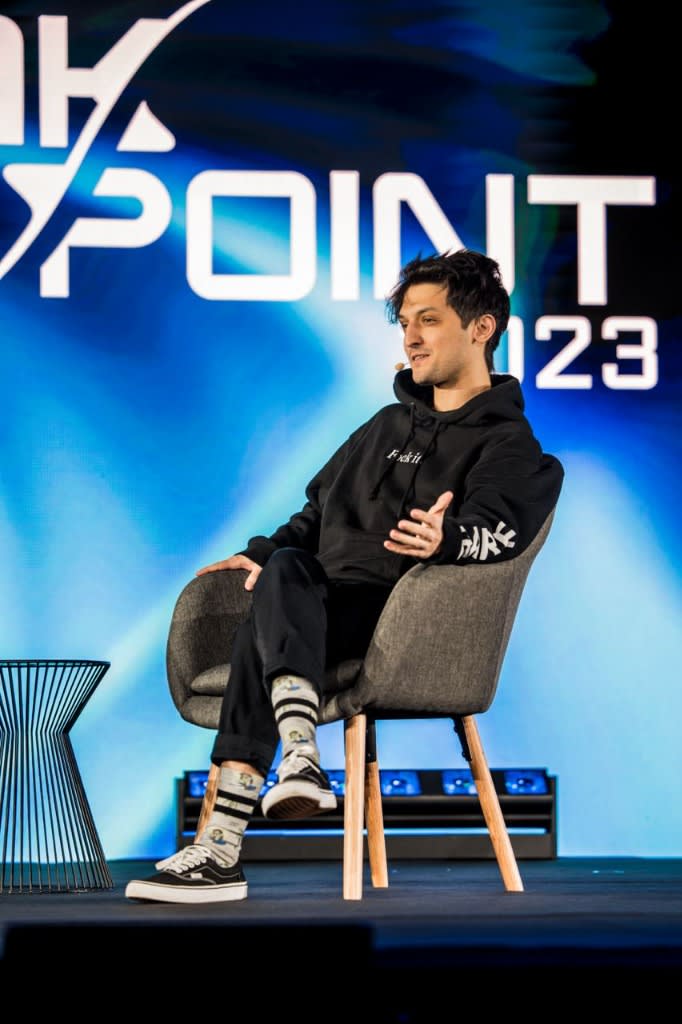
A wallet with ambitions beyond storage
By April 2022, Ferrante was building a company with Tristan Yver. Coral’s work expanded from developer tools toward Backpack and xNFTs, or executable NFTs. The notion was that a token could carry access to an application experience, with software running inside the wallet. Users would have somewhere to do things with their assets, beyond inspecting balances and approving transactions.
Ferrante reached for an Apple comparison: the iPhone could make calls, yet its applications were what made it much more useful. The ambition for Backpack similarly extended beyond the category printed on the box. A wallet could be a place where applications lived. His old employer had left him with a productive analogy.
Mad Lads made that experiment tangible. The NFT collection launched in April 2023, following a period when FTX’s failure had damaged confidence in Solana and prominent collections had departed for other chains. Ferrante spoke about a community needing a new heartbeat. Collectible characters were one way to give people something they could gather around.
There was engineering underneath the pictures. The team used games and puzzles inside the wallet to help people qualify for the collection’s whitelist. Ferrante later called Mad Lads a test bed. Art and storytelling brought users into contact with software that might otherwise have remained an explanation in a developer’s presentation. It was a fairly elaborate way to get someone to try a wallet.
The acquisition with an uncomfortable name
Then came the exchange. Backpack secured a Dubai virtual asset service provider license in October 2023 and beta-launched the trading venue in November. In February 2024, a $17 million Series A led by Placeholder valued the company at $120 million. Those numbers describe the business at that moment; the valuation says nothing about Ferrante’s personal fortune.
The more striking transaction arrived in January 2025. Backpack acquired FTX EU for $32.7 million. A company whose operating funds had been stranded at FTX was now buying its former European arm. The name alone supplied an irony that a branding consultant would probably have advised against.
The attraction was concrete: a European investment-services license and a route into regulated derivatives. The responsibility was concrete too. Backpack took on the distribution of customer claims attached to the European business. Ferrante described returning those customer assets as a priority. Buying a piece of the wreckage meant accepting work that went well beyond relaunching a website.
Backpack EU went live on September 8, 2025, following further work on its team, structure and product. Its opening offering included more than 40 perpetual futures pairs. The gap between the acquisition announcement and the launch is part of the story. Ferrante’s career had moved from fixing developer friction to negotiating the slower, less glamorous requirements of financial operations.
- 2017Leaves Apple to pursue Ethereum and open-source work.
- 2020Starts building in the early Solana ecosystem.
- 2022Founds Backpack; FTX’s failure freezes company funds.
- 2023Mad Lads launches; the exchange follows in beta.
- 2025Acquires FTX EU and launches Backpack EU.
The ledger has to answer
Running an exchange gives his earlier experience an awkward second life. He knows what it is to request money back from a platform and hear nothing useful. Now he occupies the other side of that relationship. A customer’s balance on a screen creates an obligation that cannot be discharged with a confident interview.
In August 2025, Backpack introduced daily public proof of reserves, developed with security firm OtterSec. The system uses cryptographic proofs to let customers check that their account appears in a snapshot of liabilities without publishing everybody’s individual balances. Its open-source verifier makes the checking process something a user can actually perform.
A proof describes a defined set of facts at a particular time. It cannot make every business decision wise or eliminate every operational risk. But the direction is consistent with Ferrante’s earlier work: give people tools to inspect a system rather than requiring them to accept an explanation. For a former developer-tool author, publishing the means of verification is a recognizable instinct.
His public persona still has room for untidiness. He has cheerfully acknowledged the inconsistency of his X posts, which mix product updates and commentary. Asked about prices, he has been much less interested in forecasting a token than in the industry’s rate of progress. The useful question, in that account, is what people will be able to build.
Good evening from Tokyo
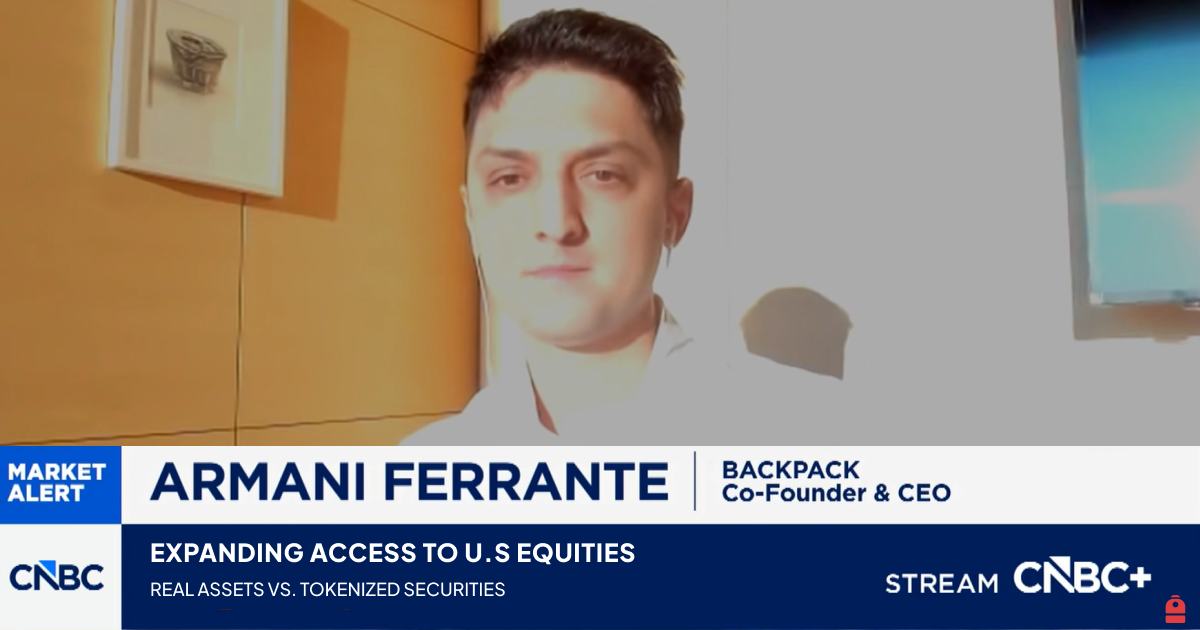
In July 2026, Ferrante appeared on CNBC from Tokyo to discuss round-the-clock U.S. equity trading for international investors. He corrected the time-zone greeting before turning to a characteristically precise question: what asset does the customer actually own? A stock symbol on a trading screen can conceal differences in the legal rights attached to it.
By his October 19 conversation with The Defiant, the discussion had moved further into how shares might travel between brokerage accounts and decentralized finance. He explained Backpack’s model of stocks redeemable one-for-one, rather than treating every token carrying a familiar ticker as interchangeable. The financial ambition had become broader, while the questions had become more specific.
The Solana Foundation has also announced him for November’s Breakpoint in London. It is another public stop in a career that began with reading a white paper and leaving a job. Between those points sit a framework, a wallet, illustrated characters and a company balance sheet that nearly disappeared.
Ferrante’s story resists the clean line that startup histories like to draw. Each solution created a larger set of obligations. Writing software for other developers led eventually to answering for other people’s money. The next problem is no longer sitting quietly in a GitHub repository. It has customers, regulators and opening hours he would like to abolish.
Follow the work
Profiles & projects
- Backpack Exchange
- Backpack Wallet
- Armani Ferrante on X
- Armani Ferrante on LinkedIn
- Ferrante’s GitHub
- Explore Anchor
- Mad Lads
Watch & read
- Watch: Solana and Web3 applications / Cryptonews
- Watch: U.S. equities and international access / CNBC
- Watch: Ferrante on Talking Tokens
- Read: The startup’s survival period / The Block
- Read: Backpack’s FTX EU acquisition / Blockworks
- Read: How Backpack’s reserve verification works
- Listen: Tokenized stocks / The Defiant, October 2026