At Christmas in 2012, Haoyuan Li built the first version of a system that would occupy much of his working life. He was a doctoral student at Berkeley. The software was called Tachyon. Its subject was the unseasonal business of getting data from where it lived to where a computer needed it. By April, he had released the code for others to use. A holiday project had acquired a public address.
Today, Li is the founder, chairman and CEO of Alluxio, the company that grew around that project. The name has changed. So have the applications demanding its attention, from big-data analytics to AI training and inference. The underlying irritation has proved durable: a fast computer can spend an extraordinary amount of time waiting for something to read.
There is a certain comedy in buying more processing power to solve a problem of delivery. The kitchen acquires another chef; dinner is still on the truck. Li has spent years working on the truck.
A storage ambition, revised on a patio
Before Berkeley, Li had studied computer science at Peking University and Cornell. At Peking, he represented the university in international programming competitions, placing 11th in the 2005 ACM-ICPC world finals and 13th the following year. Those contests reward the ability to turn a difficult question into working code under a clock. His later career would offer rather fewer opportunities to declare the problem finished.
Research at Google during his undergraduate years helped convince him that data would become a foundation for much of the world’s future activity. He arrived at graduate school interested in building a storage system. Data spent so much of its life in storage, he reasoned, that this seemed an especially useful place to work.
At Berkeley’s AMPLab, his advisers were Ion Stoica and Scott Shenker. His collaborators included Matei Zaharia and Ali Ghodsi. Li helped create Spark Streaming and became a founding committer of Apache Spark. He had a close view of the computing machinery that would need to be supplied with data.
That streaming work dealt with a different kind of waiting. Applications receiving live data needed timely results even when a machine failed or another ran slowly. The team’s approach divided incoming data into short batches, making the computation easier to recover in parallel. It also let streaming operations work alongside batch and interactive queries. Li’s path to Alluxio ran through these questions about speed and reliability, where a delay could change the usefulness of an answer.
One early Alluxio conversation took place on a patio in Santa Cruz during a lab retreat. Li remembers Stoica, Zaharia and Ghodsi being there. Years later, he could recall the pleasure of the conversation more clearly than its precise contents. It is a useful correction to the polished startup origin: even the founder cannot always provide minutes of the moment the future supposedly arrived.
His thinking moved beyond building another storage system. New hardware, architectures and workloads kept producing new generations of storage. A better system could eventually meet a still better successor. Li began considering what could connect those changing systems to the changing applications above them.
The useful space in between
The problem grew from abundance. Developers had more ways to process data and more places to keep it. Each combination could introduce work: another interface to understand, another connection to maintain, another journey across a network. Innovation at either end could make the middle more troublesome.
Li’s doctoral work proposed a virtual distributed file system between computation and storage. Alluxio implemented that architecture, presenting different stores through a common file-system view. Applications could gain access to data without having to absorb every underlying system’s peculiarities. The technical proposition had a pleasantly social ambition: allow the parties to get along without requiring everyone to become someone else.
Give the applications a common doorway.
Speed was part of the design from the beginning. A memory-centric architecture could let applications share and access data quickly. The virtual layer also offered flexibility: a team could choose computing and storage systems with less dependence between them. An upgrade below would have fewer reasons to become an ordeal above.
Li’s dissertation, published in May 2018, also examined lineage as a way to improve write performance and introduced a framework for evaluating distributed file systems. Its title was wonderfully plain: Alluxio: A Virtual Distributed File System. By then, the work had already escaped the university. The dissertation described production deployments at hundreds of companies and a community of more than 800 contributors.
When the code acquired colleagues
The company was founded in 2015, with a $7.5 million investment from Andreessen Horowitz. It gave the project a commercial backer and a team that could work on making the technology useful beyond research. In February 2016 came version 1.0 and the public emergence of the Alluxio name.
The renaming had a practical reason. Tachyon became Alluxio to protect the project against potential trademark litigation and safeguard the community’s contributions internationally. Even software designed to remove obstacles must occasionally consult the people who specialize in creating paperwork.
Early users gave the architecture concrete jobs. Baidu had put it into production; Barclays was using it alongside Spark. Alibaba, Intel and IBM were among the organizations exploring or contributing to its ecosystem. Each deployment tested the distance between a compelling design and something an engineering team could depend on.
A community also needed a way to make decisions. In May 2016, Li announced a governance model with a project management committee and maintainers responsible for particular components. He would take the open-source title of benevolent dictator for life. It is a grand name for a role that still requires people to agree on code.
The arrangement put a recognizable structure around collaboration. People contributing from different organizations needed responsibilities and a route to getting work reviewed. A shared codebase makes cooperation possible; maintaining it calls for decisions about quality, ownership and who will answer when something breaks.
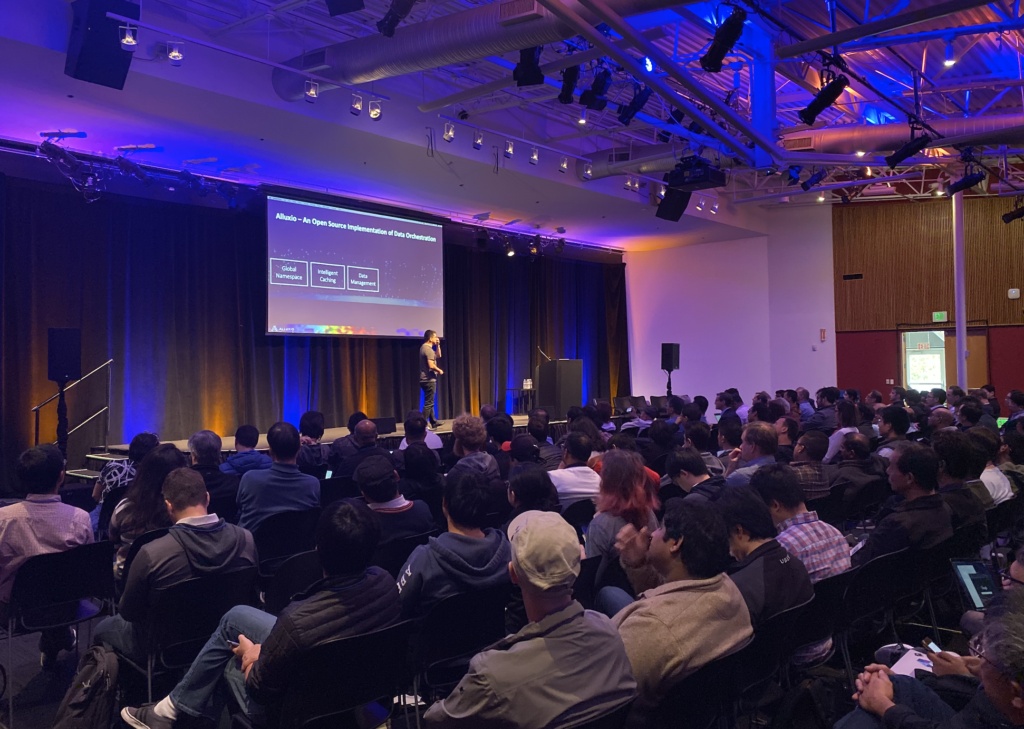
By November 2019, Alluxio’s inaugural Data Orchestration Summit brought nearly 400 attendees together for a day of talks. Li opened it with a keynote called Orchestrate a Data Symphony. Engineers from companies including Walmart and Ryte described their own systems. The audience could hear the idea tested in other people’s working lives.
The machines grew hungrier
Li’s early interest in data access gave Alluxio a problem that could travel. Cloud computing distributed information across more environments. Machine learning introduced applications with their own patterns of reading and processing it. The particular workload changed; the need to supply it remained.
In November 2021, Alluxio announced a $50 million Series C financing and an expanded Asia-Pacific presence with an office in Beijing. That same month’s release, version 2.7, included work directed at machine learning and AI training. The company was already adapting its original architecture to the demands of models.
In a 2019 essay on data orchestration, Li described the difficulty of connecting a growing population of computation frameworks with a growing population of storage systems. A common access layer could reduce that burden. Read beside the later AI work, the essay shows how long he has been pursuing the same architectural question.
The AI version makes the cost of waiting particularly visible. An expensive GPU needs a supply of training data to do useful work. If storage or the network cannot keep up, adding processors leaves the limiting step in place. Distributed caching brings data close to the infrastructure that consumes it.
By March 2025, Li was discussing Alluxio Enterprise AI as part of the company’s response to training, deployment and serving workloads. He described customers finding that GPUs were underused even while training jobs missed their completion targets. The diagnosis mattered: a shortage of useful data delivery can look, at first, like a shortage of computing.
“The goal is simple: maximize the value of every GPU.”
Haoyuan Li · June 2026
In June 2026, Alluxio announced a solution for AI workloads on Oracle Cloud Infrastructure. Fireworks AI described using the software across distributed GPU environments, including OCI, and reported cutting large-model replica download times from 20 minutes to two. These were customer-reported results for a particular deployment. They supplied a concrete example of the delivery work Li had been considering since graduate school.
A career he would choose again
Li’s public account of entrepreneurship is patient. Asked in 2025 for advice to aspiring founders, he stressed caring about the problem a product solves. Markets and technologies change; a company must adapt with them. The useful anchor, in his telling, is a vision connected to customers’ problems.
There is room in that outlook for interests with no obvious connection to a distributed file system. Li enjoys hiking and scuba diving, along with world history and learning about other cultures. He has described diving as a way to concentrate on the immediate surroundings and long scenic hikes as time for reflection. Even someone occupied with data access has reasons to go somewhere the laptop would be a liability.
Asked in 2019 what alternative career he might have preferred, he could not think of one. “What I’m doing is my ideal career!” he said. The answer sits comfortably beside the years of work that followed: a student project, an open-source community, a company, and successive generations of machines waiting to be fed. There is plenty left to do in the space between them.
Follow the thread
More from Li, and the work around him.
Personal website ↗LinkedIn ↗Twitter / X ↗GitHub ↗Weibo ↗Alluxio ↗Watch: Orchestrate a Data Symphony ↗Listen: the origins of Alluxio ↗Read: Li on data orchestration ↗Read: the 2025 interview ↗Read: Alluxio’s June 2026 announcement ↗Read: research, hiking and diving ↗Read: the founder’s account of the first release ↗Read: Alluxio’s open-source governance ↗Read: the 2019 conversation ↗Read: the Spark Streaming research ↗